Also, I don't know of any alternative that doesn't have large unauditable blobs integrated into the chip.
All ARM SoCs come with radio processors that are running a non-trivial piece of software with full access to the system memory, which is responsible for power management, boot sequence and wireless communications. It is by definition network connected.
AMD has a technology it calls the Platform Security Processor (PSP for short) which does basically the same thing.
To have a processor that doesn't have this kind of technology, you have to give up on decades of advancement in compute power, or buy a very expensive and non-portable POWER8 or POWER9 system.
But yeah you are totally right on the alternatives. Nothing quite matches Intel and AMD, and a lot of those ARM SoC's have proprietary code running on their bootloader too. But you can get some processor from 7 years ago that are usable.
OpenPOWER is fantastic though and has real potential. There were a few projects out there looking to implement a laptop and personal desktop computer using it, but unfortunatly didn't reach it's funding goals.
I think the more people that know about Intel and AMD's shading practices that more funding open hardware projects can get, and maybe in the next few years we can replace Intel and AMD with ethical and open solutions.
Haven't heard about OpenPOWER, I hope more people are made aware of alternatives to get funding and spin.
There are some ARM processors that live without blobs, I think Olimex produces what they call open-source hardware (OSHW), is this an acceptable product?
Usually possible to replace that blob! e.g. https://github.com/christinaa/rpi-open-firmware for the Raspberry Pi
Isn't it more accurate to say it might at some point be available as a motherboard with power 9 CPUs?
I mean, it looks very interesting, but afaik no-one has been shown even a prototype yet?
I am finding the Talos II an increasingly attractive proposition, even though the prices got a full system are quite staggering by comparison to mainstream hardware.
The high-end ones used for flagship smartphones/tablets do, but low-end ones used in cheaper tablets/TV boxes and more specialized hardware often don't have any radio interface.
I am all in for some philosophical discussion but actually being this detached from reality doesn't make you any good. It's not because you can see the stars that you can reach for them right now...
So yes, in summary: it is hard, to the point of impossibility.
Keep that up for a while longer, and it will become a physical impossibility, as any gesture of resistance leads to automatic extermination. Until then? Thanks for nothing.
Pretty much everyone can imagine computers being insecure and unreliable, since computers are currently insecure and unreliable.
ARM devices?
Everything in it is free, including all of the firmware, and the CPU is an open specification.
My guess is it's definitely possible but it would have been popped by foreign agencies by now too and there would have been a leak of tools to exploit such devices? I guess maybe it's very tempting to be able to hack any device though so knowing the NSA they are probably for doing this, fuck the consequences?
If you had the chance to make a supplier who creates millions of chromebooks happy, wouldn't you take every opportunity to help them, especially if it costs you little to no money at all. Obviously there is a big reason why they don't want this backdoor removed.
Basically he says that even Google is puny (in terms of production units) in front of Intel or Samsung, and cannot ask for custom firmwares.
Hardware security is currently a shit show because of global monopolies/"oligopolies".
They operate a top 3 cloud service and have enormous internal data centers as well.
Maybe if Lenovo, Toshiba, Acer, Dell, etc all asked Intel to provide said blobs (and the threat was tangible) then they would probably reconsider.
I'm very unhappy with my old Sun servers, for example, because the management system cannot be upgraded and the servers are no longer supported. I'm stuck with proprietary insecure software that I depend on and that I have no way of changing. It's all worse if the insecure outdated software can only be replaced by soldering wires to a chip on the board.
I'm curious about how one would be associated with a particular chip. I understand that key strokes can be logged, TCP/IP can be read; you can be scraped, but ultimately how is their backdoor aware of you so that it doesn't appear to them like needle in a stack of needles. A fascinating and revolting technical conundrum.
[1] https://blogs.technet.microsoft.com/mmpc/2017/06/07/platinum...
[2] https://arstechnica.com/information-technology/2017/05/intel...
It is troubling how little priority the computer world gives to proper security models.
Also, the management engine is more about the chipset than about the core, which is what the announcement is about.
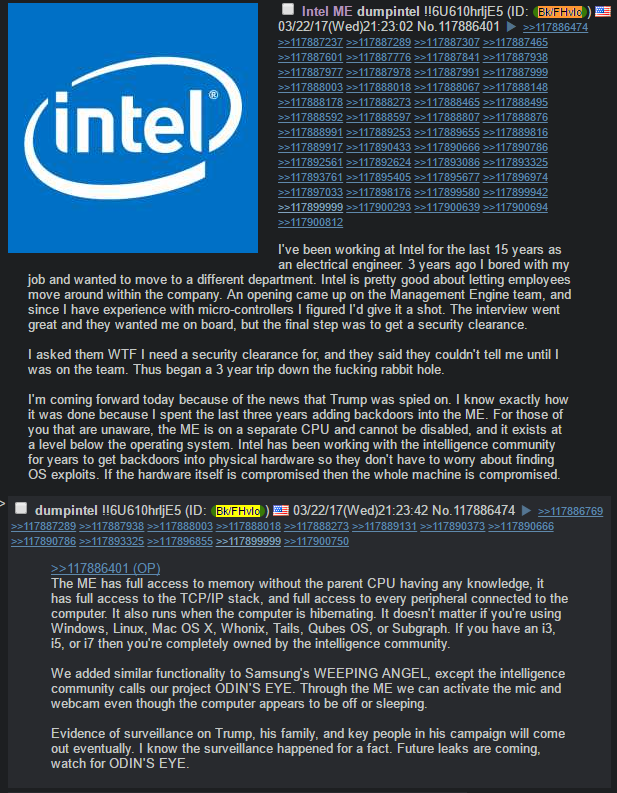
Basically whatever you run at any level on your Intel chip can be monitored by the Intel ME chip, no matter how many VM's, operating systems, encrypted files/processes you have installed/are using.
so go back to stone age by stop using all PCs/Servers? nice troll.
But I guess people have to make a personal judgement. Is ethics, privacy, freedom more important than a faster processor to run your games on?
Intel (and AMT) keep pushing more and more proprietary code that can not be read, changed or removed. No one knows exactly what it does and it has built in screen and key recording. It's my advice and the advice of privacy advocates that no one should purchase or use any processor made by Intel or AMD until they address these serious issues.
1. https://libreboot.org/faq.html#intel
2. https://puri.sm/learn/intel-me/
3. https://news.ycombinator.com/item?id=14708575