You can make something akin to ball lightning in your (friend's) home microwave:
Get a birthday candle, melt some of it onto a small plate, then stick it on the plate. Put the plate in the microwave. Turn the microwave on high for about 1-2 minutes.
Again - don't do this at home with a microwave you care about...
"akin" isn't really much use. To read what visitors to Tesla's laboratory saw it was much like something imagined for a book on magic where a magician conjures a ball of light to illuminate the room and follow around the magician.
It's fun to think about because many many people saw him do it and yet no one has figured out how he did it, and not for lack of trying. Its like the "Fermat's Theorem" of physics phenomena as far as I'm concerned.
Now that I've got a couple of software defined radios (SDRs) that can generate microwaves on demand with an arbitrary modulation, I expect there might be some fun experiments to do here.
Tesla's gear kicked out a lot of power in a way that I'm not sure has really been done since. At least I haven't seen photos looking as impressive as the ones of him in his lab https://upload.wikimedia.org/wikipedia/commons/e/e5/Tesla_co...
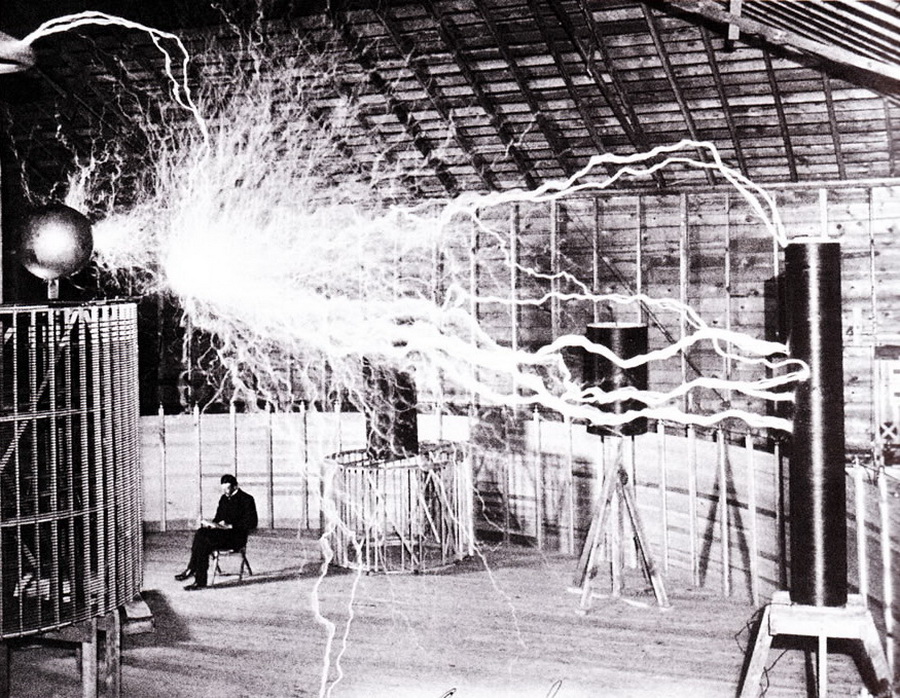
https://thevelvetrocket.files.wordpress.com/2010/03/nikola-t...

I like the idea of a the microwave bubble (or even just an RF bubble). We know that ionized air reflects radio waves (ask any amateur who has bounced off the ionosphere for an over the horizon signal) so I can imagine that a 'ball' of ionized air would reflect any radiowaves that were inside of it with energy leaking out in the form of light. But how to do that with Tesla era equipment? Good question.
[1] "I never saw fireballs, but as a compensation for my disappointment I succeeded later in determining the mode of their formation and producing them artificially. " -- http://www.bibliotecapleyades.net/tesla/esp_tesla_20.htm