Consider the following example: The [Cauchy distribution](https://en.wikipedia.org/wiki/Cauchy_distribution) is a pathological example of a distribution with very heavy tails. Heavier than the power law distributions meantioned in the GP. So heavy, the distribution doesn't even have a mean value. But if you just look at the pdf, it looks almost exactly like a gaussian.
Too bad inference with long tailed distributions is so hard.
Check out Chebyshev's inequality.
Just don't start talking about it to your pointy-haired boss. You'll get fired.
I'm pretty jaded at this point.
E[(X-EX)^2]
If EX = infinity but X is finite with prob > 0, the standard deviation will be infinite too.
http://www.astro.yale.edu/astrom/spmcat/histov.html
Not really. Plus keep in mind magnitude is a logarithmic measure. Things get skewed when you take logarithms. Also if you look for example at star sizes:
http://spiff.rit.edu/classes/phys440/lectures/size/diam_hist...
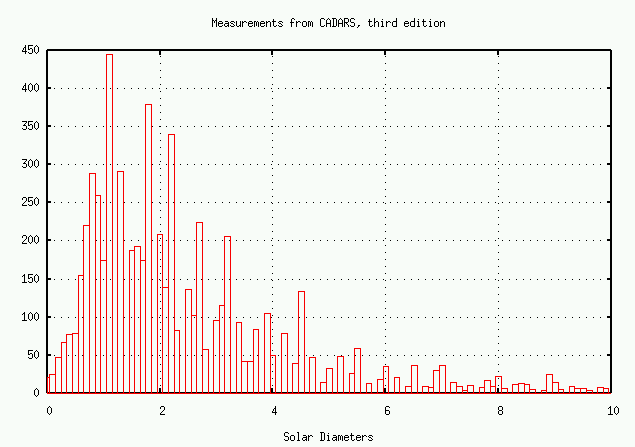
(from http://spiff.rit.edu/classes/phys440/lectures/size/size.html).
The distribution is certainly not gaussian, and very much likely heavy tail.
That doesn't tell you whether the magnitudes are normally distributed though. That just tells you how the magnitude is computed from an object's observed/measured flux.
Well, how about the magnitude of stars. So, is the magnitude of stars normally distributed? I googled "distribution magnitude of stars" and got images (by clicking on images tab) that seem pretty normally distributed to me. Aren't they?