Re:16nm ARMv8 SoC for servers and workstations
by bhouston on Friday June 16, 2017 @11:05PM
(#14574056)
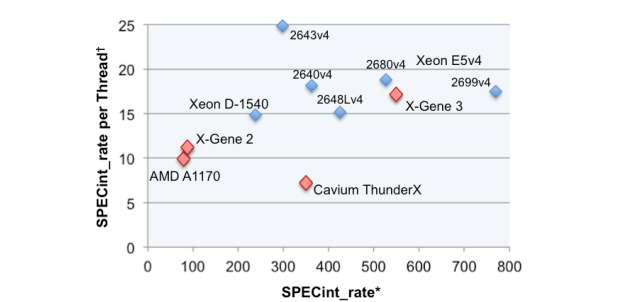
According to the article this CPU as compared to the ThunderX has 80% faster integer performance for the whole CPU and 2x faster integer performance per core - so major a improvement:
http://images.anandtech.com/doci/11189/APM-X-Gene-3-performa...
Re:16nm ARMv8 SoC for servers and workstations
by sargun on Tuesday June 20, 2017 @03:56AM
(#14592847)
Turns out that number crunching isn't what my CPU is doing most of the time. :-/.
Re:16nm ARMv8 SoC for servers and workstations
by m-j-fox on Friday June 16, 2017 @09:31PM
(#14573793)
Interesting! Cavium's network processors running bare-metal have features to ensure no core is ever idle. Maybe at the expense of latency. The idea probably doesn't translate to running a bunch of virtual servers. You probably do better with a shared-memory abstraction than a network. Or, disappointing numbers may just reflect the fact that individual cores are slow. Bad news either way.
The ThunderX's power comes from the fact it's a 48-core CPU, which is awesome for web workloads. The problem comes in that inter-core transfer is ridiculously slow. To make a 64-byte RPC (return / response), was in the area of ~1100 nanoseconds, whereas x86-64 was on the order of 500 nanoseconds on a 2 generation old CPU. Testing on a more modern CPU cut the time further.
I'd love to see ARM either catch-up in single-core performance, or multi-core performance, but until then I don't feel like it's viable.