Plus, it's also much easier to change the configuration of the room, or to transfer one piece of furniture from one room to another. So even if people weren't just lazy about how to fit perfectly pentagonal furniture in their houses, so long as they were trying and testing new shapes, furniture would probably evolutionarily converge to something squareish.
Architecture is, at some level, a packing problem. Packing problems tend to favor lines and corners over organic curves.
And then you need to arrange rooms and corridors around those columns, and it's much more convenient to not have random columns dropping through the middle of most rooms. So you align your walls on the column grid, and now you have a bunch of straight walls and 90 degree angles.
To some degree it goes the other way (I need my rooms to be X by Y, design column grid to match), and you still do rectangular rooms because you know that way you can push your column gridlines into the walls. And it's not perfectly consistent, your central corridor might fall in an off-module grid width. But one way or another most modern buildings are on a grid like that.
This makes for very cosy flats which are very much liked and in demand. It also makes for very good acoustics, unlike modern flat and hard walls/ceilings.
And yet people in charge here still build "modern" buildings, even when we have known for the past 50 years that this kind of building never make people feel part of a community, which is so important for society.
Just a guess, though.
When I was in Singapore in the early 90s, I remember my family looking at a rental unit in the Draycott towers. It was super cool looking, but lack of places for furniture to go is what nixed it.
For the curious... exterior and interior:
https://www.singaporeexpats.com/singapore-property-pictures/...
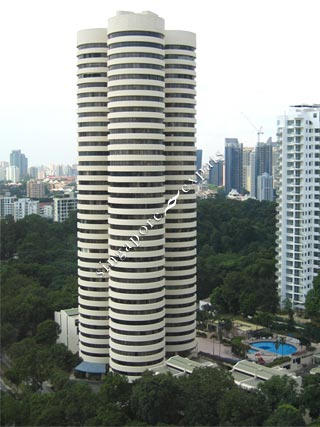
http://draycott.weebly.com/uploads/1/7/5/5/1755412/3811624.j...

The only reasonable alternative is a regular hexagonal tiling, and that means having more neighboring rooms, which gives its own problems.
I always wondered why rooms tend to be rectangular pretty much all over the world. Googling for that suggests that it's a price thing, but I'm not convinced, since expensive homes still seem to prefer rectangular rooms.
Even contemporary buildings, with extremely weird and non-uniform facades, still tend to be grid-based on the inside.
I would be really interested if this preference study was also done in the real world, not just in VR.
Another related universal thing, why do we sleep with the head towards the wall (as opposed to the center of the room). Googling suggests a deep security measure, since the wall prevents attacks from behind you, which are the hardest to defend against.
Feng-shui deals with these kind of issues, if you move beyond the superstitious layer (have a turtle for money, ...)
By reading feng-shui books I learned to get a bit more intune with my inner feelings (the chi/qi), so now, if I sit in a room with no apparent exit, or with a cluttered path to the exit, I can pin point the insecurity feelings emanating from my subconscious.