News for hackers. Stuff that matters.
Re:Kubernetes clusters for the hobbyist by bryanlarsen on Monday May 08, 2017 @09:21AM (#14291210)
Why are you doing all of this stuff manually? There are several providers that will set all of this stuff up automatically for you. I like the Kismatic toolkit (https://github.com/apprenda/kismatic), but there are a bunch of others. Sure, maybe once you go to production you'll want to install manually so that you have everything finely tuned the way you want, but learn it by using it rather than trying to have to figure things up front.

Or even better just use GKE for development / learning purposes. Just stop the cluster when you're not using it, and it'll be a lot cheaper than something you won't want to take down because you spent days installing it.

Re:Kubernetes clusters for the hobbyist by irontoby on Monday May 08, 2017 @09:36AM (#14291311)
Because Kubernetes is a complex beast with many moving parts, and learning about all those moving parts becomes more and more important as your usage grows.

Personally I've used Stackpoint.io to provision some small clusters but I was very excited to see this project because deploying my own cluster from scratch is next on my todo list. Kelsey Hightower's "Kubernetes the Hard Way"[1] is the canonical go-to reference here but it's also very daunting so this looks like a great middle ground.

Let's face it, even today the k8s docs can be quite sparse sometimes or gloss over the details, so knowing how all of the pieces work from the ground up can be a big help. Plus, you prevent vendor lock-in when whatever automated tool you're using doesn't solve your use-case or decides to start charging a lot of money.

[1] https://github.com/kelseyhightower/kubernetes-the-hard-way

Re:Kubernetes clusters for the hobbyist by fndrplayer13 on Monday May 08, 2017 @12:34PM (#14293137)
I agree with this assessment. We decided to do "kubernetes the 'sorta' hard way" by leveraging the Saltbase installer with some level of customization and full control via terraform of how our infrastructure was being allocated. I think its valuable to learn what the tool is doing if you have to maintain it. When something breaks, an upgrade has issues, or you need to better understand the system to make a decision, I feel that you gain a lot in setting up a system yourself. I think you'll be more likely to know precisely where to look to debug things. You also get closer to the tool which makes it easier to contribute back into the community. You also get the benefit of making your own infrastructure decisions. Yes k8s can provision ELBs and EBS volumes (and their equivalents in Google Cloud, Azure, etc) as well as autoscale nodes via a cluster addon, but the big moving pieces, such as instances, VPCs, Networking, etc, remain well-defined in Terraform or some other infra-as-code. That means that you can decide how to deploy that etcd cluster, how it gets backed up, whether or not its encrypted at rest, etc. Generally speaking, we just value the level of control and insight that we get out of controlling the stack definition ourselves. To some extent that may be antithetical to the purpose of k8s, since the goal of the project overall seems to be simplification and centralization of best practices of deployment.

With all that being said, kops is an incredible tool (as are others) and we used it to learn about the system and test some of the functionality for ourselves. Can't recommend it enough.

Re:Kubernetes clusters for the hobbyist by ben_jones on Monday May 08, 2017 @11:40AM (#14292526)
And if you want to be awed look up Kelsey Hightower's Github profile.
Re:Kubernetes clusters for the hobbyist by pstadler on Monday May 08, 2017 @09:36AM (#14291316)
There are indeed many options for automated setups. I did my first steps with Kubernetes on GKE, later followed the CoreOS guide to set it up on bare metal. This guide is for creators, a written form of my lessons learned. It should enable people to run secure clusters wherever they want.

In case you missed it, there's a repository[1] in the same org which offers fully automated provisioning using Terraform.

[1] https://github.com/hobby-kube/provisioning

Re:Kubernetes clusters for the hobbyist by bryanlarsen on Monday May 08, 2017 @09:50AM (#14291411)
Yes, it does seem like an awesome resource for intermediate Kubernetes users like myself. But beginners should be steered away from it because it's too much, too soon. And by talking about choosing a cheap cloud provider at the beginning it implied to me that you were targeting beginners.

Please add a disclaimer on the top pointing beginners at some of the better resources for them, and then tell them to come back once they've learned what stuff like "ingress" means.
Re:Kubernetes clusters for the hobbyist by maleck13 on Monday May 08, 2017 @01:51PM (#14293881)
Used this recently and found it great. That's for the hard work and effort that clearly went into this.
Re:Kubernetes clusters for the hobbyist by scurvy on Monday May 08, 2017 @11:12AM (#14292185)
Hobbyists like to do things for themselves and better understand how things work. It's the nature of being a hobbyist rather than a consumer.
Re:Kubernetes clusters for the hobbyist by tyingq on Monday May 08, 2017 @09:36AM (#14291319)
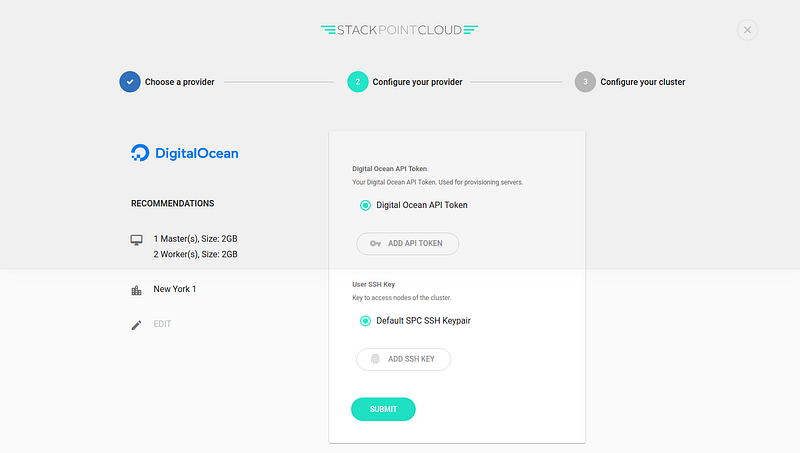
Stackpoint.io is great for just spinning up k8s to get a feel for how it works. No charge, and all web based. It supports other providers, but I tried it with digital ocean. You pass it a DO API token, like this: https://cdn-images-1.medium.com/max/800/1*tcGINse5on6qnbsRYN...

Then it does the installation and gives you urls for the control panel.

I don't think I'd use it for production, as everything is behind stackpoint.io urls, but for experimenting, it saves a ton of time.

Re:Kubernetes clusters for the hobbyist by irontoby on Monday May 08, 2017 @09:43AM (#14291358)
I've been using Stackpoint for a while and they do a great job, but be aware that they'll soon start charging $50/mo, which will remove them as a tool for hobbyists.

https://stackpoint.io/#/pricing

They haven't announced a date for when they'll start charging, and I'm not sure how that will affect existing clusters.

Re:Kubernetes clusters for the hobbyist by treehau5 on Monday May 08, 2017 @10:21AM (#14291656)
> they'll soon start charging $50/mo, which will remove them as a tool for hobbyists.

What's wrong with paying for something as a hobby?

Re:Kubernetes clusters for the hobbyist by Nadya on Monday May 08, 2017 @10:25AM (#14291698)
If every tool/thing I relied on costed $50/mo I wouldn't be able to afford my hobby. I would need to seek a cheaper - possibly free - alternative or give up the hobby.

Many people don't have $50/mo to spend on unprofitable hobby projects. There's nothing wrong with paying for hobbies, but most people's hobbies fall under (a) infrequent large purchases or (b) really cheap occasional costs.

Upgrading my computer falls under (a). It's expensive but I only do it once every 3-4 years. Buying new guitar strings for my guitar every so often falls under (b). It's cheap and while I should do it every-other-month I do it maybe twice a year.

If the cost of new guitar strings was equivalent to the cost of upgrading my computer - I'd give up playing guitar as the hobby would become too expensive.

Re:Kubernetes clusters for the hobbyist by MattRogish on Monday May 08, 2017 @11:00AM (#14292059)
Building this stuff by hand is... yeah.

We open source our Kube bootstrap toolkit (which uses kops). No one should build this by hand. It would be like, I dunno, setting up a MariaDB Galera Cluster by hand when you intend to use RDS (not a perfect example, please no pedantry!). It's a fun learning experience, I guess - if you're into that sorta thing - but is not what you want to use in any production context.

https://www.reactiveops.com/blog/kops-102-an-inside-look-at-...

https://www.reactiveops.com/blog/using-k8s-scripts/

Use the automation to bootup clusters, please!

Re:Kubernetes clusters for the hobbyist by sagichmal on Tuesday May 09, 2017 @05:55AM (#14298759)
I strongly disagree. Rolling out a K8s cluster to a production environment without knowing how to "do it by hand", relying instead on helper tools that abstract away the complexity, is deeply irresponsible, even professionally negligent.

Like learning shortcuts in math, you only "earn" automation once you've done things the hard way often enough to know how it works at a low level. That knowledge is critical. Otherwise you're just cargo-culting something you don't understand.