News for hackers. Stuff that matters.
Re:Rust on AVR: Safer microcontrollers almost here by IgorPartola on Saturday February 11, 2017 @12:14AM (#13621144)
Having more programming languages for embedded platforms is always great. If all you know is Rust or Python or JS, etc. it is great to have it as an option. But I have to wonder if the specific claim of type safety really translates here. In my (albeit limited) experience, certain classes of errors just don't occur on embedded systems because there is not enough room for them. For example, there is no double free() because heap memory is not a thing. I suppose you can still have off by one errors, and problems with referencing/dereferencing, but once again in my experience you usually find this stuff pretty fast because your code just won't run. Am I wrong here?
Re:Rust on AVR: Safer microcontrollers almost here by ekidd on Saturday February 11, 2017 @07:02AM (#13622249)
I used to work as an embedded systems developer (for systems where a single failure could cost a quarter million dollars), and I've experimented with kernel-space Rust just for fun.

Rust is a surprisingly nice language on bare metal.

If you use '#![no_std]' in Rust, it disables the standard library and substitutes the 'core' library. This has no 'malloc' (unless you supply one, which is easy) and no OS-level features. But you still get iterators, slices, traits, "scoped" closures and generic types. You get a lot of abstraction with basically zero overhead. And don't forget that embedded systems have lot of state machines, which are nice to implement using Rust's "tagged union" support and exhaustive 'match' statement.

Here's an example of a Rust I/O port wrapper (https://github.com/emk/toyos-rs/tree/master/crates/cpuio) and an interrupt controller interface (https://github.com/emk/toyos-rs/tree/master/crates/pic8259_s...). These APIs are reasonably pleasant for something so close to the metal.

Rust would be a very agreeable programming language on an AVR system, IMO. And not necessarily because of pointer safety, either.

Re:Rust on AVR: Safer microcontrollers almost here by StavrosK on Saturday February 11, 2017 @08:02AM (#13622420)
As a hobbyist and C junior, if I can get anything higher level than C, I'll be ecstatic. Of course, it's going to be the same as with micropython, which is fantastic: The entire ecosystem is in C.

I tear my hair out every time I have to wrestle with C for the simplest things, though, whereas Rust is a joy to write.

Re:Rust on AVR: Safer microcontrollers almost here by yjftsjthsd-h on Saturday February 11, 2017 @09:19AM (#13622703)
On "full size" systems we solve that with FFI, but I don't know whether that would work here is not.
Re:Rust on AVR: Safer microcontrollers almost here by ComputerGuru on Saturday February 11, 2017 @11:21AM (#13623217)
Having recently worked on a few projects written in C++11 for embedded systems (again, no standard library), I must concur with your comment. C++11 brings a lot of the same features (minus the functional coding components) to embedded systems making program flow a breeze.
Re:Rust on AVR: Safer microcontrollers almost here by _b8r0 on Saturday February 11, 2017 @05:08AM (#13621997)
I'd be interested in seeing the challenges and outcomes of assumptions made porting between 64-bit von neumann and 8-bit harvard architecture systems.

Most of the AVR community tends to code in a mix of C and assembly, I think Rust is possibly not the best language to port, and type safety is not really an issue that's going to sell it.

To put it into perspective, Rust on a more powerful IC like an ESP32 or STMF32 makes sense to me, as you have a lot more to play with, but I've spent the best part of a year and a half working on a design constrained within 512 bytes of dynamic RAM, 512 bytes of SRAM and 512 bytes of EEPROM. I'm not sure what type safety buys me when I'm already trying to squeeze out every last bit.

All of this is not to suggest we shouldn't try new things, of course we should. Hacking things previously thought impossible is a longstanding and welcome tradition. However, I'm struggling to see how this would increase adoption of Rust, or make things significantly easier for AVR users vs say Arduino scratch.

Re:Rust on AVR: Safer microcontrollers almost here by pjmlp on Saturday February 11, 2017 @01:39AM (#13621436)
Yes, Therac-25 as an example.

The code will run and corrupt data without crashing, due to off by one error.

In the proprocess a few people got cooked.

Although the code was in Assembly, the situation wouldn't have been different if it was coded in C, due to the lack of bounds checking.

Re:Rust on AVR: Safer microcontrollers almost here by janzer on Saturday February 11, 2017 @03:55AM (#13621807)
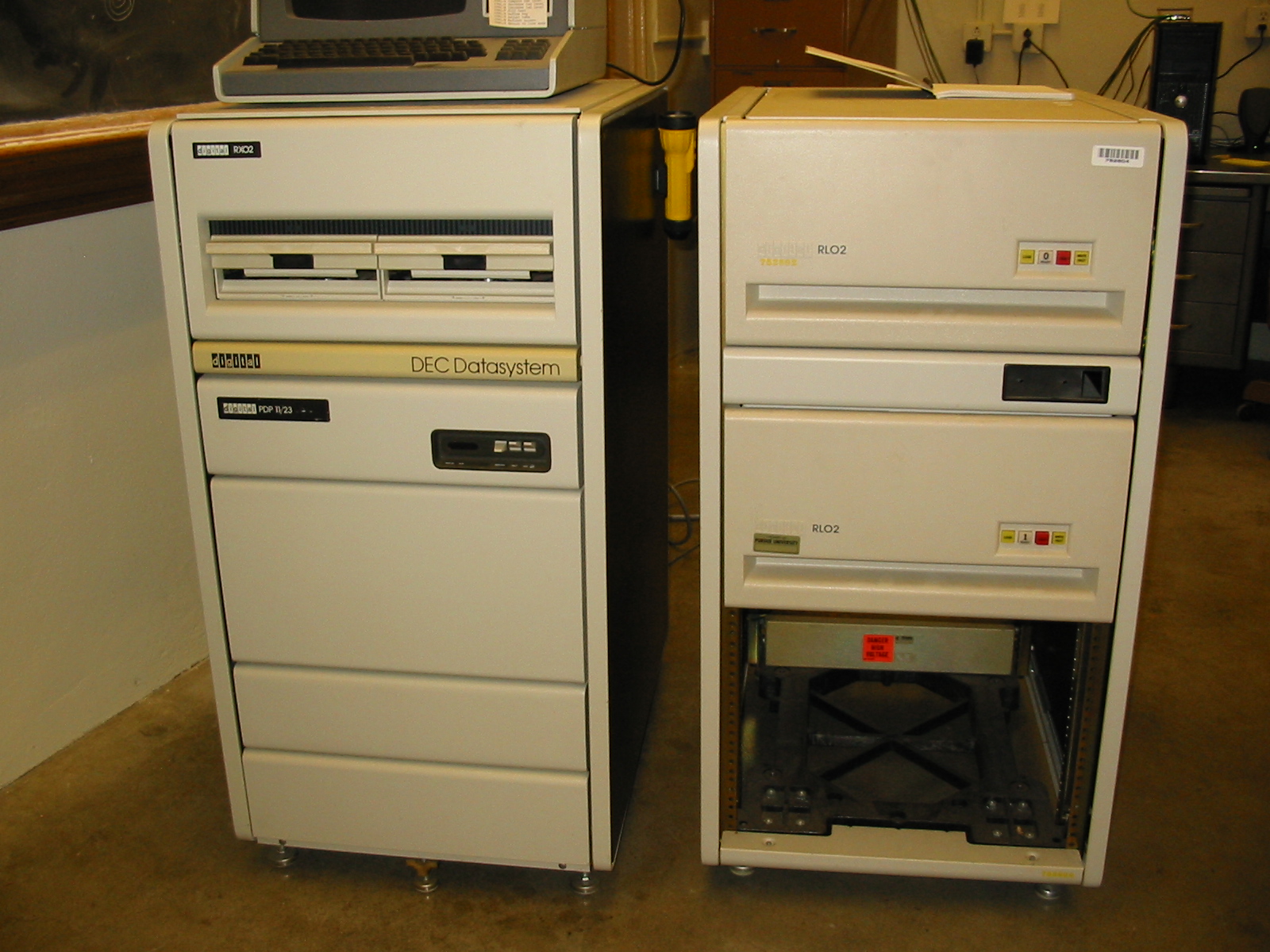
A PDP-11 is the classic example of a microcontroller. ;)

Here's a picture of the model used for the Therac-25 the PDP-11/23 http://www.physics.purdue.edu/~jones105/pdp-11/images/IMG_28...
Re:Rust on AVR: Safer microcontrollers almost here by pjmlp on Saturday February 11, 2017 @04:00AM (#13621817)
As I mention on another thread, an ESP-32 would be good enough to run MS-DOS.

Your example makes it even more obvious that current microcontroller are actually quite powerful, when we look at the hardware resources of the 60 - 70's.

Re:Rust on AVR: Safer microcontrollers almost here by extrapickles on Saturday February 11, 2017 @02:22AM (#13621571)
On the smallest (I've used ones with 16 bytes RAM) you simply don't have room for doing much at all so you pretty much only use registers, none of this fancy pointer stuff and you can easily fit everything its doing into your head as its program space is only big enough to fit 64-256 assembly instructions (a paper pages worth).

It can be hard to pin down when something switches from a fancy logic circuit to a microcontroller on the low end of the spectrum.

In my opinion, it stops being a microcontroller when the RAM is external to the CPU or it needs to be provided multiple voltage rails.

Re:Rust on AVR: Safer microcontrollers almost here by yokohummer7 on Saturday February 11, 2017 @06:50AM (#13622221)
I have zero knowledge about microcontrollers, so forgive my dumb question... But how do you program with 16-byte RAM!? I believe even ENIAC had more memory than that? (Though I'm not sure if ENIAC had such a concept like main memory.)

What useful thing did you conduct with it?

Re:Rust on AVR: Safer microcontrollers almost here by LeifCarrotson on Saturday February 11, 2017 @08:25AM (#13622481)
You have lots (where "lots" means maybe 512 bytes, or possibly 8k bytes) of flash memory. Flash is cheap both in cost/silicon area and in the power budget.

You store constants and your actual program code in Flash. The limitation of Flash memory is that you can only erase a whole page state time. On many of the smaller microcontrollers, one page may be larger than your SRAM!

So you treat Flash as read-only, writing it with a separate hardware programmer. You store state in the limited SRAM. You would also read or modify external state by loading or writing to special function registers outside of the Flash and RAM address space, where the "memory" mapped to that bit or word would do something in hardware. It would tell you whether a digital pin was on or off, or turn it on or off, or tell you the analog voltage on an input pin, or configure the pulse width of a pulse-width modulation timer, or read/write to a communication port, or set up a hardware interrupt timer.

Here's probably the most common example of this class: http://ww1.microchip.com/downloads/en/DeviceDoc/40001239F.pd...

They're often used to 'glue' two separate circuits together. For example, you could use it to measure an input, and in one mode output a high voltage if that input was on, or in another mode output a low voltage. In more physical examples, you could read the position of an analog input knob and control the pulse width of a TRIAC to control the speed of a motor. You could monitor the capacitance of a touch sensor (with an ATTiny) and turn a device on or to standby, or do a hard reset if the button is held down for a long time. You could modulate an RGB LED through a rainbow of colors. You could run a flashlight in a high power, low power, or strobe mode depending on how a button was pressed. And so on.

Re:Rust on AVR: Safer microcontrollers almost here by bleke on Saturday February 11, 2017 @07:16AM (#13622286)
Not everything needs ram you can perfectly write program having only few variables. Mostly what saw is exchange part of circuit to microcontroller which sometimes led in saving big chunk of components, you can you mcu as simple state machine for specific task in circuit like power controller or sensor processing unit... For example I saw 3 mode led flashlights selling on ebay for 3$ have PIC12 (probably chinese clone).
Re:Rust on AVR: Safer microcontrollers almost here by Someone on Saturday February 11, 2017 @05:55PM (#13625343)
A historical example of what one can do with limited memory is the Sinclair Scientific calculator (http://files.righto.com/calculator/sinclair_scientific_simul...). It doesn't use RAM at all, doing everything in registers.

If it would have had RAM, one could have used it to implement a memory or to implement a 'normal' infix UI.

And no, it isn't cheating that it uses a CPU designed for calculators. At best, that keeps the ROM space needed down, but I doubt that, given its somewhat weird instruction set.

Re:Rust on AVR: Safer microcontrollers almost here by kosma on Saturday February 11, 2017 @07:26AM (#13622313)
Consider it yourself: what kind of math can you do in 16 bytes of RAM? What kind of control? I suppose you can fit some running average, statistics, logic equations, maybe even PID would fit. A single for loop takes just one byte. These 16-byte microcontrollers are usually very small, and have very few pins (usually eight); they are the electronic equivalent of a very short shell script that glues some stuff together.
Re:Rust on AVR: Safer microcontrollers almost here by adrianN on Saturday February 11, 2017 @01:31AM (#13621401)
Microcontrollers are a continuum. On the tiniest you might be right that there is no room for error (I doubt that though), but there is a large class of chips that are powerful enough to be connected to a network. Those are dangerous.
Re:Rust on AVR: Safer microcontrollers almost here by taneq on Saturday February 11, 2017 @03:05AM (#13621675)
> For example, there is no double free() because heap memory is not a thing.

This was my experience back when I first did embedded stuff. These days unless you're programming something that costs less than a dollar to make, you've probably got at least double digit KBs of RAM and a C compiler. Not saying it's good practice to be using malloc() in this environment but you'll get away with it.

Re:Rust on AVR: Safer microcontrollers almost here by kosma on Saturday February 11, 2017 @07:30AM (#13622327)
> Not saying it's good practice to be using malloc() in this environment but you'll get away with it.

Actually, for the sake of keeping code modular and portable, it's fine to malloc() once on boot and never free(). It's the "dynamic" part of memory management that's dangerous on MCUs, especially on those without an MMU (as fragmentation gets in the way very often and you can't really reason about memory usage anymore).

Re:Rust on AVR: Safer microcontrollers almost here by wyager on Saturday February 11, 2017 @12:36PM (#13623640)
If you're using malloc on boot only, you can almost always replace that with a static data declaration, which usually gets put in the same space the heap would otherwise use. It's better because the compiler can drop malloc, saving you some flash space, and static analysis tools can see how much RAM you're using (and if something is clearly going to blow up).
Re:Rust on AVR: Safer microcontrollers almost here by loeg on Saturday February 11, 2017 @01:29AM (#13621384)
There are people who think ARM SoCs with a few hundred MB of RAM are embedded systems. You can fit a lot of errors on that scale of embedded platform.
Re:Rust on AVR: Safer microcontrollers almost here by imtringued on Saturday February 11, 2017 @01:04PM (#13623796)
Those are considered embedded because the intention is to just flash them with software like android once during the manufacturing process and then never update it.
Re:Rust on AVR: Safer microcontrollers almost here by pjmlp on Sunday February 12, 2017 @06:19AM (#13627874)
Love the Android example regarding the update.
Re:Rust on AVR: Safer microcontrollers almost here by daeken on Saturday February 11, 2017 @01:23AM (#13621357)
That used to be the case, but as more functionality makes its way in (USB support, networking, etc) the attack surface grows substantially.

Right now not a lot of that goes on, but that's changing -- and fast.

Re:Rust on AVR: Safer microcontrollers almost here by pjmlp on Saturday February 11, 2017 @02:51AM (#13621643)
A good example would be the ESP-32, powerful enough to run MS-DOS (520 KB hurray!), dual core with extra modern peripherals.

Which means every programming language we used to enjoy back in the day are possible to target such environment, assuming someone would bother to port them to it, that is.

Re:Rust on AVR: Safer microcontrollers almost here by yjftsjthsd-h on Saturday February 11, 2017 @09:27AM (#13622745)
I wonder whether it would be practical to write an emulator and actually run DOS et al. You'd lose some memory and speed, of course, but we might be powerful enough that it doesn't matter.
Re:Rust on AVR: Safer microcontrollers almost here by shmolyneaux on Saturday February 11, 2017 @01:27AM (#13621377)
A simple example for 8-bit microcontrollers would be concurrency issues in an interrupt handler.

Heap memory is still a thing for larger devices running on a RTOS, in addition to threads, mutexes, etc.

Re:Rust on AVR: Safer microcontrollers almost here by notalaser on Saturday February 11, 2017 @05:48AM (#13622087)
Bugs that occur due to dynamic memory allocation and freeing are definitely not a concern for 99.99% of well-written embedded software. We avoid dynamic memory tricks not because of memory size constraints, but because it makes verification difficult and introduces additional uncertainty in the program's behaviour and timing. Even in systems where there's plenty of memory to support it, dynamic memory allocation is done sparingly -- sparingly enough that it can be properly managed via code reviews and the like.

Real-life, but somewhat extreme metric: in my last project, there were two instances of dynamic memory allocation, in about 100k lines of code, and both were in third-party code (we could have replaced them but you know, not broken, nothing to fix). At the other end of the spectrum, I think we had about one dynamic memory allocation at every 6-700 lines of code, but almost all of them were confined to a single scope, and they were largely due to code smell. (Edit: I think at one time we got really pissed when we saw how out of hand it had gotten and we went back and replaced most of these occurences, but I don't remember the metrics.)

In any case, lifetime management at the lexical level should not be a problem in most embedded applications, because there should not be much lifetime to manage. By "lexical level", I mean "things that are exposed to the language and manipulated through its primary means" -- variables, functions and so on. (Edit: there are legitimate exceptions to "should not be much lifetime to manage", but they are very few; the non-legitimate ones are in code of such poor quality that Rust won't help: what those codebases need isn't a new language but different managers, different programmers, or both.)

Unfortunately, this retains a whole class of errors that, to my knowledge, Rust (or any other language, frankly) can't manage. Off-by-one errors, for instance, can be handled if they occur at the end of the buffer (because you'd be spilling out of the container) but there's no way to handle off-by-one errors inside a buffer (you meant to say "read from the beginning of the buffer up to the last character that's been read from the serial line" but you actually ended up including one more character because you wrote off + 1 instead of off).

It's still up to the programmer to manage these things, and sloppy programmers will still write sloppy code that does this sloppily.

However, and this is a very big and very important however, we're talking about a level where any kind of additional safety helps. Returning to the previous example, off-by-one access errors inside a statically-allocated buffer are generally easy to spot and get caught very quickly during QA (since ooh, let's look at the buffer is the first thing you say when you get a bug about repeatedly garbled data when reading data from the serial interface). Off-by-one access errors outside the buffer (accidentally zeroing all the TX buffer, oh, and the first byte of the structure next to it that's used by an entirely different module) are the icky ones that sometimes fly under the QA radar for months.

I don't think the safety gains are on the level that the Rust fandom expects, but no one in their right mind is in a position to not welcome them. No, Rust won't solve everything, and bad programmers will continue to productively shoot themselves in the foot in Rust, too, just as they can productively shoot themselves in the foot in pseudocode. But for people who realize that there's a pretty big chance their next bug is going to get somebody killed, anything that reduces the bug population is a welcome addition.

tl;dr In most embedded scenarios, this will help less than the Rust community wants to think, but enough that sane people welcome it!

Re:Rust on AVR: Safer microcontrollers almost here by kazagistar on Saturday February 11, 2017 @11:43AM (#13623344)
I'm not entirely familiar with embedded programming, but I don't think I understand your buffer example. A serial line adds to the buffer, incrementing an internal "current end position". You grab a drain iterator or a slice, incrementing the internal "current start position". At no point is there any manual arithmetic for any off by 1 errors.
Re:Rust on AVR: Safer microcontrollers almost here by notalaser on Saturday February 11, 2017 @12:36PM (#13623641)
The opportunity for off-by-one errors is at the other end of the pipe, when you grab data from that same buffer and munch it in the application. Depending on how unlucky you are, that ends up involving crap like CRs and LFs and totally sane protocols that include the header length in the byte count for some packets, but not for other packets.

It's probably not the best of examples, but the mistakes pop up the same way as for dynamically-allocated buffers -- you pick the wrong offset or count up to the wrong limit, and it doesn't make much of a difference if the buffer was statically allocated or not.

Re:Rust on AVR: Safer microcontrollers almost here by nercury on Saturday February 11, 2017 @07:22AM (#13622304)
While I also agree that Rust does no better in unsafe code, I think it allows for some sweet careless use of pointers (references) in _safe_ code.
Re:Rust on AVR: Safer microcontrollers almost here by milesrout on Saturday February 11, 2017 @03:49AM (#13621784)
You're definitely right.