1) Those that have participated in government/military have less say than when they served. This could be a positive, but I feel some objection to a POW (my grandfather for instance) having less say than someone who didn't serve. 2) Do _really_ we want the least experienced citizens having the most say? The US already has age limits for certain offices so that sort of reduces my concerns about this, but... 3) Phase in plan? Currently voting is dominated by older voters. I don't see those people rushing to their polling places to vote to have the value of their vote lessened. Could be interesting to see the reasoning that happens for people to vote for or against it from a game theory perspective.
Still, I am interested.
That's the first thing that I thought of, but then I realized that I have a pretty dim view of the 'experience' of most older people that I know. They are woefully unable to use computers, and on account of their 'trust' in things like fake news they seem incredibly unprepared to deal with our current reality and are just as susceptible - if not moreso - to populism. And while this is a bold claim I'm not quite prepared to defend, they seem quite a bit more selfish and materialistic than the twenty-somethings I spend much of my time with.
Maybe in times of rapid change like ours, 'experience' doesn't mean as much as it once did.
Plus, it goes both ways. If we should defer to those with more experience, it's only fair that they should take better care of their offspring.
Seems like, besides lack of mobility in a era of never stable employers, owning a home essentially weds you to your locality's debts - unfunded bonds, pensions, etc. You can already see how cities with the biggest problems - Chicago, Detroit - are already cracking. They went for the easy things first: traffic cameras, cigarette taxes, huge tourist taxes on rental cars and hotels.
But eventually they'll come after the biggest cash cow which is property taxes.
I sure hope so. Actually, scratch that, I'm not sure. It might affect people that I don't want it to affect. It's probably complicated (so by all means enlighten me).
I'm all for someone buying a house and being able to keep it and live in it. But what bothers me to no end is that every single house I've lived in, renting a room for pretty steep prices what with wanting to live in a city, involved a landlord who made a good deal of money on me and my fellow renters, and for no reason other than buying or renting the house a long time ago when it was still cheap.
My previous landlord made a profit on the rent-controlled apartment he snagged a decade or so ago. While the rent is a significant portion of our income, he makes a profit and gets to kick us out (in a friendly way) once he wants it back. The fact that this guy was a major squatter back in the day only makes this more frustrating.
My current landlord does fuck-all and has some kind of disability that has kept him from working for a while. I'm pretty sure that the rent I pay at the very least pays his mortgage, and perhaps even leaves him with some profit, all because he's older and he got there first. Meanwhile I, in my early thirties, am paying a significant sum just to be able to live in 'the city'.
I'm happy he's got a place, don't get me wrong, and I can afford it. But it feels more than a a little unfair to see my younger siblings and friends struggle to pay rent when he's got a whole apartment all for himself for no particular reason other than 'times changed'.
I could go on and involve my 'Boomer' grandparents who are throwing all their money at improving their home in bum-fuck nowhere that none of their offspring will ever care about, while they've got kids and grandkids who could really use a bit of money, but I'll leave it at this.
It reminds me of 'We Suck Young Blood' by Radiohead, and while I suppose that's what we get in a society that emphasizes the individual over the collective, it still sucks, and quite frankly I feel no remorse over never visiting my grandparents once they're in a home and waiting to die. Let them die alone and unsatisfied with their fancy house.
(okay, I'm exaggerating. I'll visit them and I do care for them. But man does this stuff bother me!)
It is possible to support these types of benefits. It's just not possible to do it while also using the public workers' pension fund as a backup piggy bank when the rest of the government budget needs help.
When you dig into these types of stories you almost always find that millions or often billions of dollars have been raided out of the pension fund by the legislature or the executive in order to make their budget numbers look good. Same is true for other publicly-funded initiatives which are always touted as "too expensive" or chronically "underperforming".
Of course, the same is true in the private sector as well, it's just that there at least the leadership has to go through the formality of declaring a bankruptcy in order to raid the pensions and repurpose money to their own preferred projects.
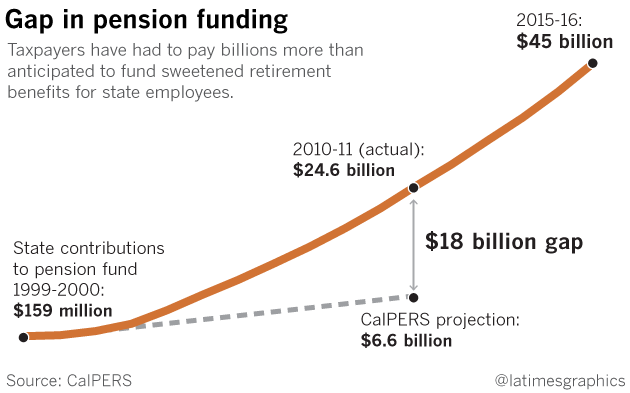
TFA is called 'The pension gap' for a reason. According to TFA, billions are flowing from general funds into the pension fund to cover the short-fall. $24.6 billion in the last decade, and another projected $20 billion in the decade to come. [1]
When the pension benefits amount to $2.6 million annuity at the day of retirement after 30 years on the job, yes, it is objectively too much of a benefit and unaffordable. If we were talking about an annuity worth just 5% of salary for each year worked, it would be a different story. But $2.6m divided by 30 is $86,666. That is just insane.
[1] - http://www.latimes.com/projects/la-me-pension-crisis-davis-d...
It's also recommended to have your 401k set to pay your final monthly pay for your remaining months. We think that's sustainable, don't we?
The real problem in America is gross mismanagement of pension funds. It's going to get worse. I live in a county where it was suddenly discovered administrators had been lying both about funding the pension and it's performance for years and now employees are screwed.
When the global economy tanks everyone is in for a hard time.
It is simply not possible economically to support these type of benefits. Look no further than the Greece or Italian austerity crisis to see how these type of government payments will play out.