Seen in this way, statements about redistributing the monetary wealth of the world are pretty much useless, since people spend money in different ways. It may be that everyone holds $52,819 after the great redistribution, but the value of money and price of goods would have to change drastically such that the number is meaningless and not representative of what such a state of the world would be like (we would have to build a lot more big screen tv's, medium income housing, etc. if the plan were taken to fruition, and a lot fewer opulent dwellings in big cities and yachts).
Furthermore, the very wealthy invest and save a lot more (how else would the great wealth accrue if they spend it as quickly as they earn it?). If the wealth of the very wealthy were redistributed we would quickly learn that what really limits the welfare of your average consumer is the production capacity of the economy-- not the total amount of nominal money they hold.
A counterpoint: some 795 million people in the world do not have enough food to lead a healthy active life. That's about one in nine people on earth. [1]
I do not think that is because of the production capacity of the economy. A little redistribution would go a long way...
But if you want the "glass half full" view - zoom out even further and chart further back into history and measure proportion of global population in absolute povery, poverty, living on $1.25 or less (adjusted) per day, and you get charts like this:
http://s3.amazonaws.com/content.washingtonexaminer.biz/web-p...

and individual cases like China, which are just amazing:
http://iresearch.worldbank.org/PovcalNet/images/ChinaSpecial...

and you're more hopeful that we'll solve global hunger and poverty in our lifetimes.
It wasn't redistribution that caused it - on the contrary the evidence is that previously planned economies opening up reversed their fortunes (no co-incidence on where that China chart begins to show progress).
The major international aid orgs now almost entirely agree that food aid and humanitarian action should be short-term and a stop gap. The solutions are in trade, access to credit, access to markets, food engineering and sustainability, education, empowering the entire population (ie. no sexism, racism, etc.) political stability, etc. [0][1]
It's why I completely agree with grandparent OP that the "division" performed is misleading - the economy isn't a fixed size nor is the distribution zero-summed. We can lift the rest of the world up to our level rather than meeting in the middle.
And in case it's not obvious, consider: Person A just graduated with a law degree from Harvard; they have negative net wealth. Person B is a retiree who lost their retirement savings in a Ponzi scheme; they still have a fair chunk of equity left in their house, but they've already got two mortgages Which one do you think is going to have trouble buying food?
Amartya Sen won a Nobel for helping point out how misleading a simplistic analysis can be here.
If they want to inherit their house to children, that might be the case. But that is the case with any asset - it is irrelevant whether any jewellery or painting you own is worth $1 or $1 million if you never intend to sell it, ever.
But the house is real wealth and that wealth can be unlocked - a reverse mortgage is not unusual, and the more valuable the house, the higher the annuity you can earn from releasing the equity from it step by step. And that allows you to get a nanny or make car payments or go on cruises or whatever.
The only way you can release this wealth is by selling it and moving to live in a cheaper place. But to a family who lives in London, always had and has no plan to leave, this is only theoretical wealth. It doesn't really say much about wealth inequality between different cities or countries.
It's not a matter of rich people hoarding wealth, it's just that it's culturally natural to behave that way. Nobody blames rich people, it's just that everybody is jealous. There is nobody else to blame than every each of us, collectively.
This is not sufficient to explain to people why there are no rich conspirators hiding wealth. Mind you, I mostly agree with you. But I personally feel we need to have as simple as possible, verifiable, non debated arguments before we are allowed to think of things as silly.
> ... which is, of course, silly. And the author should know that, since I assume he is aware of $clear_refutation
Otherwise we either delude yourselves or dismiss others
While I disagree with his premise of translating it into money, I think his point still stands that whomsoever holds assets alo control means of becoming rich out of those assets which means poor and bound to become poorer.
If there isn't a single limited pile of wealth, then why can't we helicopter drop on everyone millions of dollars, and raise all boats to American lifestyle level.
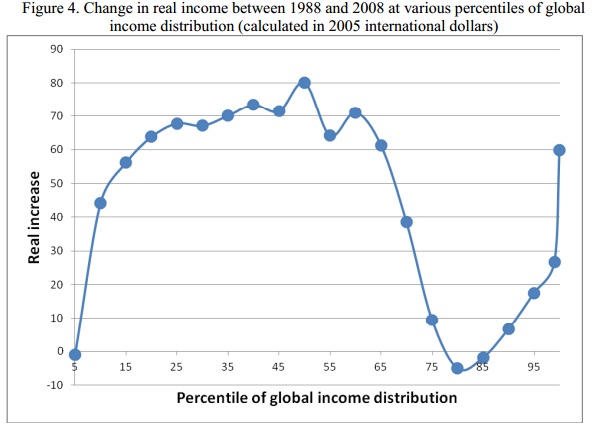
The thing is that the dollar as no value by itself, its value derives from what it could buy. If the economic activity increases generating more value, the value of the dollar will increase. And that's not just theory, that's what happened in the last 20 years were a large number of population in developing countries were raised out of poverty. Check the Milanovic chart for seeing it [1].
The second problem is that it is not necessary that a society that has an unequal wealth distribution is also unjust. Suppose to have a society where everybody between 20 and 60 years old works for 1K a month. Before 20 years old the could use debt to leave, after 60 years old to their death (let's say 80 years old) they live with the savings. You would agree that this society is just, everybody makes the same amount of money. And yet there is inequality in wealth distribution. Youngs just before turning 20 will have a huge debt, people turning 60 will be, conversely, in the top 1%.
This example could sound naïve, replace it with student loan and pension funds and you will see that is pretty much the status of US economy.
[1] http://blogs.ft.com/off-message/files/2013/10/Change-in-real...
Everyone who had less than $100k would be richer.
In the limit you could give everyone a trillion dollars, and we'd all be equal.
This is a thought experiment. My point is that wealth is real and meaningful and can be adjusted.
In the medium term, you have to ask yourself who is able to capture this money. Not for sure the homeless that has no means to start with. Probably will be captured by the people that control directly or indirectly the manufacturing means. So the rich will be the one capturing most of the helicopter money.
The reason is that money is not capital. Money by itself does not produce value. One of the most effective ways to increase social mobility is by investing in education because allows people to acquire social capital that they could invest to generate real capital and then money.
Bill Gates doesn't live in a $40B house.
After he gets a million dollars he will have money to buy a $30 loaf of bread.
But the truth is: money is just a tool, a way to get something.
In your example, there's no point in giving a million dollars to the homeless, it would make much more sense to make the $3 loaf cost 0,3 cents. Now everybody can buy it.
But if you just drop money in the lap of somebody that doesn't know how to produce value and change this value for money, those who produce the real value and owns the means to produce it will still making more money from those who can't produce.
To solve that: take the homeless, provide basic care and opportunities for him start to produce value. Then the money will come.
The world doesn't need most of the people to work. Today what you actually consume is produced by <20% of people working. Most products are produced by machines and not labor.
The homeless don't need to work, because society can provide for them even if they don't.
Actually, I guess, the real losers would be middle class...
In effect, we have.
I work, earn a dollar and put it in the bank... who lends it to a company who pays it to somebody else... who puts it in the bank...
There's orders of magnitude less pie to go around than has in fact gone around. That's essentially the basis for the world economy.
You can't arbitrarily make assets. The total capital in the world grows but grows slowly. And doubly slowly for you if you are poor. I think Piketty wrote something about that.
For an example, I live off the profits of a SaaS business that I built myself. In addition to creating wealth for me, it is in fact an asset that I can sell if ever I want. It genuinely is "money" poofed into existence out of nowhere.
All we've actually done is add an extra zig in to the capital flow I described above. So before, we had Joe earning a dollar, using it to buy a donut from the grocer who puts it in to the bank. Now, Joe gives that dollar to me in exchange for my service, and I use it to buy that donut.
No central authority decided to increase the wealth supply. I did it myself.
I can understand why it's tempting to perform this calculation (you've got two numbers, may as well divide them), but I kind of wish people would stop doing so then trying to draw conclusions about the result. Especially if they work for an organization that calls itself "The Economist", which implies that the author knows something about Economics.
Because all it serves to do is convince people who don't understand how economies work that there is in fact some big fixed pile of "wealth" out there, and that all those rich people have hoarded it already and are now sitting on it, preventing anybody else from having any of it.
... which is, of course, silly. And the author should know that.