I was more making a more general statement: that wireless is not necessarily synonymous with shared medium.
Thanks for working this out. This matches with Musk's stated goals for the project from January 2015 ("the majority" of internet traffic): https://www.youtube.com/watch?v=AHeZHyOnsm4&t=2m40s
>The focus is going to be on creating a global communications system. This is quite an ambitious effort. We're really talking about something which is... in the long term it will be like rebuilding the internet in space. The goal will be to have the majority of long distance internet traffic go over this network, and about 10% of local and business traffic. Probably 90% of people's local access will still come from fiber, but we'll do about 10% of business and consumer direct, and more than half I think of the long distance traffic.
>As you guys may know, the speed of light in a vacuum is somewhere between 40-50% faster than in fiber. So you can actually do long distance communication faster if you route it through vacuum than you can if you route it through fiber.
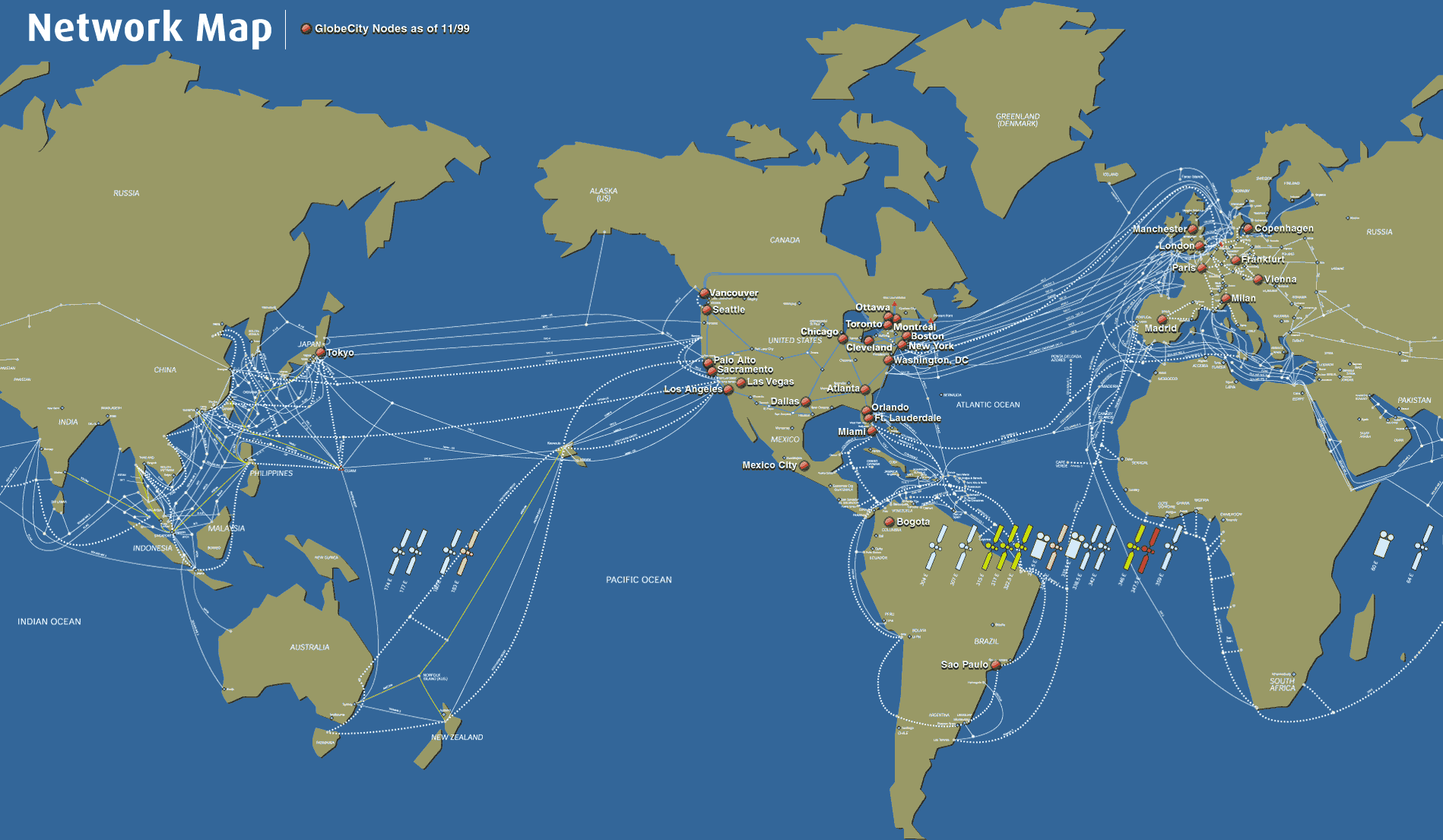
>And you can also go through far fewer hops. Let's say if you want to communicate from Seattle to South Africa. If you look at the actual path that it takes it's extremely convoluted[1]. It will follow the outline of the continents. It will go through 200 routers and repeaters, and the latency is extremely bad. Whereas if you did it with a satellite network you could actually do it in two or three hops. Well maybe four hops; it depends on what the altitude of the satellites are, and what the cross-links are.
>Let's say at least an order of magnitude fewer repeaters or routers, and going through space at 50% faster speed of light. So from a physics standpoint it's inherently better to do the long distance internet traffic through space.
[1] https://personalpages.manchester.ac.uk/staff/m.dodge/cyberge...
- Satellite with LEO orbit covers 1-2 percent of earth surface with 10 degree elevation.
- Land occupies less than 30% of earth's surface area. Urban areas occupy less than 3 percent of the Earth's land surface. That's where the customers are.
You have to divide at least by 100.
On the bright side, this completely solves the bandwidth for adventurers. The farther you are from civilization, the less contention for the links.
The traffic between europe and the US is not solely dominated by the amount of data sent and received by visitors of a particular web site. It includes a lot of other background data such as backups between regions.
The analogy to economics would be the calculation of GDP in that you generally don't factor in B2B products/services when the end product/service is the consumer.
Obviously, this won't replace my "laptop -> router" communication nor "server -> server" communication but it's the consumer that matters.
[1]: https://en.wikipedia.org/wiki/Internet_traffic#Global_Intern...
An astounding O(54% of global internet traffic) [2]! Obviously there are many many more variables in this [3]. Nonetheless this will be super interesting to follow.
[1]: my estimated current data usage from https://en.wikipedia.org/wiki/Internet_traffic#Global_Intern...
[2]: http://www.wolframalpha.com/input/?i=(4425+*+23)+%2F+((60,00... (1024+%2F+1)+*+(1024+%2F+1))
[3]: Side note, someone should create a multi user algorithm website (it might be able to be done over google spreadsheets) but adding in extra factors like revenue streams and what not sounds like it would be fun to play around with.