I'm not disagreeing with you but what makes you say this? I've never owned a phone with more than 2GB of RAM and I'm not sure what I'm missing out on.
> no optical image stabilization
I trust a software company like Google with EIS, particularly given their work with HDR+. I owned an iPhone 7 for about a week and loved the stabilisation Google's app did on my Motion Stills.
> Google needs to blow Apple away with features rather than aping the latest iphone.
The impression I got from the announcement is that that's what they see their assistant being. Personally that doesn't win me over at all but we'll see how it goes. I could see my mother and her friends all wanting the phone that can talk to them (and it looks more impressive than Siri).
It's Linux under the hood which will always make use of more memory, but our phones are slowly migrating towards service platforms. When my phone is fully kitted out playing Ingress with friends I'm running Slack, Glympse, Zello, team-specific app(s), Ingress and maps. I want the device snappily switching between and/or giving cycles to all those apps as needed without being forced to save state off to my flash storage which is a wasting asset.
I would imagine VR apps will be even more hungry with the large and complex objects and interactions modeled and displayed.
On EIS yup if that replaces OIS I'm fine with it. The assistant may be really cool but it won't remain a google-exclusive for long and it doesn't justify a (in my mind) $200-$300 premium for the phone.
I'll probably pick up the pixel XL when the sales start but as someone who has been an Android acolyte since my developer's edition G1 came in the mail this is not a compelling upgrade for me from the Nexus 6, particularly at this price.
> It's Linux under the hood which will always make use of more memory,
Linux won't really be the beneficiary of all the extra RAM in this case. The motivation behind the extra RAM is Java.
It is well known (i.e. researched) that garbage collection system performance is heavily dependent on free RAM. You typically want around 4x the amount of your peak memory usage to keep the garbage collector speed reasonable. The more free RAM, the better the performance.
http://sealedabstract.com/wp-content/uploads/2013/05/Screen-...
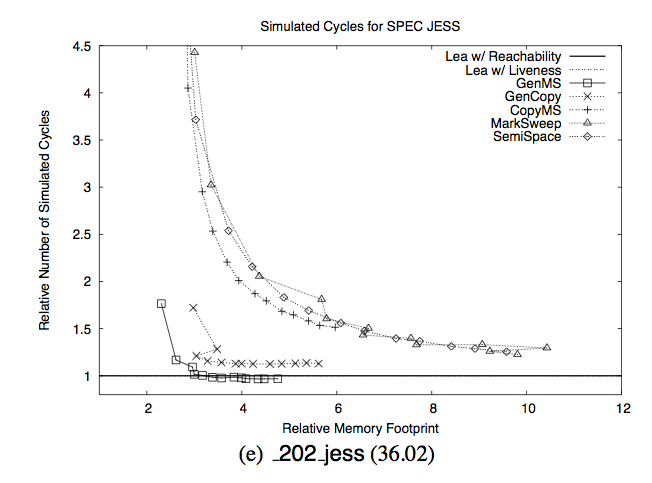
But having 4x has been a real challenge for mobile and Android over the years, especially as people want to do more and more with the phones. It also didn't help that Dalvik and ART are new ground-up implementations of the Java VM which means a lot of optimizations for garbage collection needed to be reimplemented from scratch.
The lack of needing to support a garbage collector is a big reason Apple can get away with shipping far less RAM in their phones which in turn helps keep their profit margins high.
Why does it need OIS if its EIS produces a stabilized image better than anyone else's image stabilization?
The feature is image stabilization - whether or not it's done optically or electronically is irrelevant, all that matters is how good the end product is. And DXO's review claims that the image stabilization in Pixel is superb.
https://www.dxomark.com/Mobiles/Pixel-smartphone-camera-revi...
Do you have a link that supports the claims made above? That one simply does not.
Yes it does, but it'd be under "blurry photos" description rather than stabilization because stabilization is more inherently a video issue than a photo one.
In the case of OIS and photos you want to look at the low-light performance, which DXO did test and the Pixel did do very well on.
That's a fair point. If it indeed does produce a great image I have no complaint.
Innovations in photon capturing technology like light field be damned. This is the best.camera.ever.
Did this not factor into your decision?
You mean support for the OS, not for the hardware, which is probably more of a concern for phone users.
You know, I knew the day would come that we'd be saying this unironically, but in still surprised it's here.
http://www.theverge.com/2016/9/12/12886058/iphone-7-specs-co...
But the feature list for what is now Googles top phone is underwhelming. 4 GB of RAM is barely adequate - it should be 6 GB like the other Snapdragon 821 flagship. No water proofing? That's the new black. Bottom-facing speakers? Complete regression from the Nexus 6. Including a smoking camera but no optical image stabilization? Make up your mind - is it a digital camera competitor or not?
And frankly since there's no waterproofing there's no excuse for a fixed battery and no sd-card slot. Even some waterproof phones offer those features now. Google needs to blow Apple away with features rather than aping the latest iphone.