> the parts on apple things are a bit older than the competition
Not sure where you got that impression, maybe you're thinking about Apple's laptops? Apple get the best and the latest from TSMC, which at the moment is 16nm finfet and next year expected to be 10nm finfet. Intel is the only company with a better process, and they don't make smartphone SoCs. And Apple has hired all the best Austin-based talent for their design team, poaching AMD and others heavily.
That may be my mistake. Thanks for the links and information.
http://www.anandtech.com/show/9837/snapdragon-820-preview/2 http://www.anandtech.com/show/9686/the-apple-iphone-6s-and-i....
Heck, in many cases the A9 leaves the Snapdragon 820 behind, and that hasn't even shipped in a Nexus phone yet (the Pixel will probably have the 821).
Apple could just drop new Intel chips into their existing MacBooks as they get released, and easily be getting improved speed + efficiency each year. The new Kaby Lake chips even do hardware 4K video and VP9. http://arstechnica.com/gadgets/2016/08/intel-unveils-kaby-la...
sigh
I think the real reason is some combination of (a) ARM isn't competitive (or only recently became competitive) at the high power/high performance point that Intel CPUs excel at; (b) the Mac line generates so much less revenue and operates at so much smaller of a scale than iOS devices that it isn't worth developing CPUs in-house for them, not to mention the fixed costs associated with undergoing a transition.
Dumping Intel chips would take a ton of effort and resources, in an area where Apple isn't interested in making an effort or investing resources.
http://macdailynews.com/2016/09/30/macos-sierra-code-suggest...
Measuring browser performance is hard because there's a lot of different functionality but notice how routinely we see reviews where the device the Android flagship phones are trying to beat is the iPhone 6 or even 2013's 5S:
https://cdn.arstechnica.net/wp-content/uploads/2016/09/iPhon... https://cdn.arstechnica.net/wp-content/uploads/2016/09/iPhon...
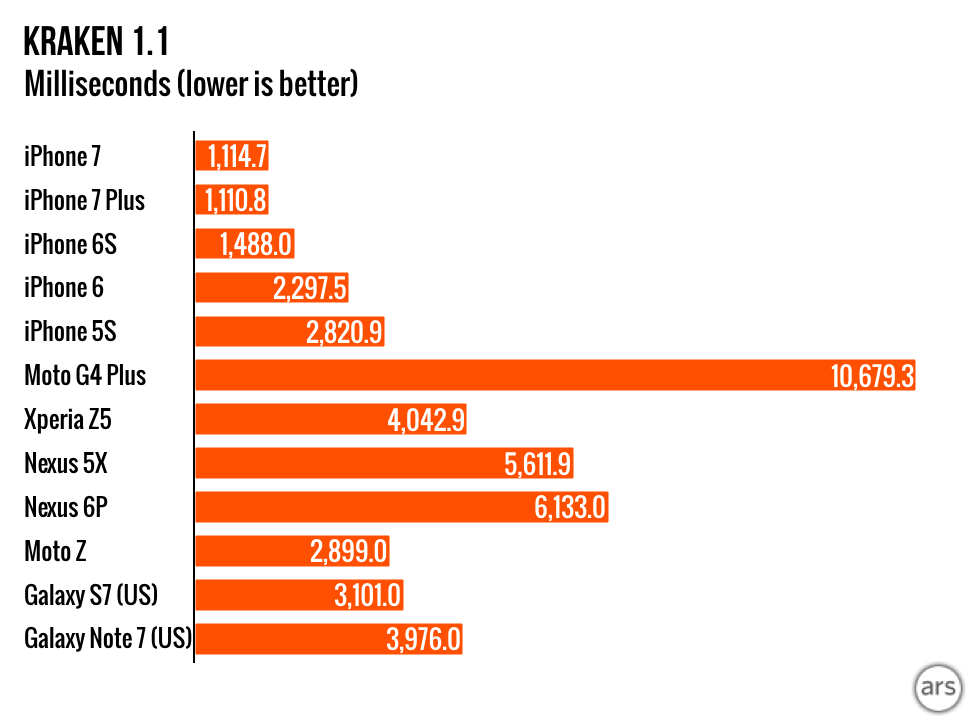
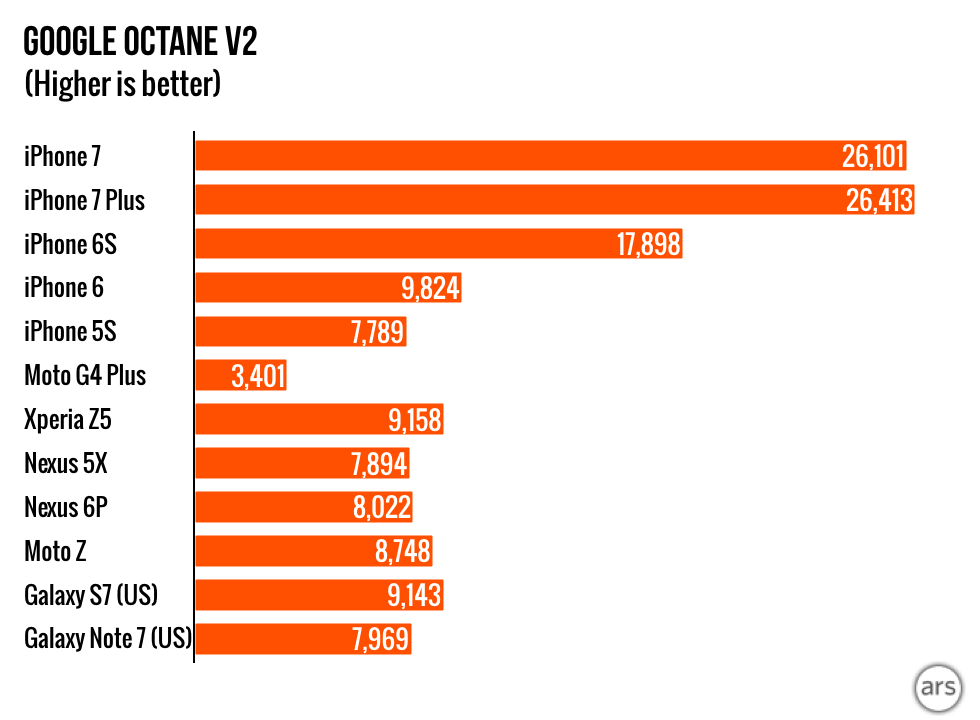
(from https://arstechnica.com/apple/2016/09/iphone-7-and-7-plus-re...)
Some of that reflects the considerable amount of work which Apple has put into Mobile Safari but a lot of that is going to come down to single thread performance.
This is an empty statement backed by no data. The only evidence you provide to the superiority of single core perf is browser performance. Except,
1) browser usage is now a mostly insignificant part of time spent on mobile (http://flurrymobile.tumblr.com/post/127638842745/seven-years... )
and
2) The bottleneck in mobile apps which depend on the network (including browsing the web) is rarely the CPU, it's the network.
The other side of this is that we're not really talking about which app has the most time in the foreground so much as which app causes the user to wait the most. Much of that time will be network I/O which is a real challenge but also not relevant to this discussion about CPU performance.
Fundamentally, all I'm trying to say is that Amdahl's law still applies until we're at the point where the user is never waiting on computation. Developers have been getting better at multithreading but uneven CPU usage is still common enough that I'd favor fewer faster cores over more slower cores.
But just look at the benchmarks. Apple SoCs slaughter Qualcomm and Samsung chips in mobile benchmarks.
Yes, they're highly optimised for their workload, but the point is that Apple is much better at doing this than everyone else making mobile SoCs.
Can anyone confirm if this is true? I thought the general advantage for i[a-zA-Z0-9]\+ is a well defined small N number of targets, which allow great optimization. Generally, the parts on apple things are a bit older than the competition but they pull off more (at least in user's eyes) compared with Android due to that optimization.