News for hackers. Stuff that matters.
Re:There are no particles, there are only fields (2012) by Ono-Sendai on Sunday August 28, 2016 @06:11PM (#12378788)
Generally I think the field idea is more plausible than the particle idea. But I think there are some things that the field can't explain yet (to my satisfaction at least). Why, whenever we measure the charge of an electron, do we measure the same value? Why not one half, or one third of that charge sometimes? After all, if an electron is just a disturbance in a field, why might we not capture just part of that field in our measuring apparatus?

This is of course trivially explained by the particle idea.

Re:There are no particles, there are only fields (2012) by kmill on Sunday August 28, 2016 @06:44PM (#12378893)
I don't know anything about the physics, but here's something field-related that seems particle-like to me. On a smooth manifold (which is a space that is "locally Euclidean" in such a way that you can do calculus), there is a concept of a smooth vector field, which is a smooth assignment of a vector tangent to the manifold to each point. While there isn't too much to constrain a vector field, there is an invariant: if you take all the places where the vector field vanishes and compute something called the "index" there, and sum up all the indices, you get the Euler characteristic of the manifold. Index is an integer quantity, and it roughly corresponds to how many times the vector field spins around while going around the vanishing point once.

You can smoothly deform vector fields through time, and there are different features you can notice: zeros of opposite index annihilating each other, zeros of opposite index appearing out of nowhere, and other sorts of combinations of zeros combining and splitting.

For the surface of a ball, the Euler characteristic is 2, so the sum of indices must be two, so it seems spheres must be "positively charged," if index and charge are actually analogous. For a torus, the Euler characteristic is 0, so the "charge" is neutral. For a plane, on the other hand, the theorem I mentioned doesn't quite work because it requires a compact manifold, but a vector field could have any total index (though there will be a virtual zero at infinity which always has the opposite index).

If measuring charge corresponds to finding the total index in a region of space, then maybe that's why it's only ever an integer.

Re:There are no particles, there are only fields (2012) by Ono-Sendai on Sunday August 28, 2016 @07:58PM (#12379158)
The idea of the charge being some topological quantity is interesting and I think the mostly likely explanation. There's something similar with the electron spin that I don't fully understand. (If you rotate an electron once its wavefunction is negated, twice to restore it, I might have the details incorrect there though)
Re:There are no particles, there are only fields (2012) by andrewflnr on Sunday August 28, 2016 @06:43PM (#12378889)
Saying that particles explain why electrons all have the same charge presupposes that all particles are identical, but why should that be? Your particle theory has to explain why all particles of a given type have the same property; or rather, why there are types of particles.

The field idea, as discussed here, actually explains why all electrons are identical: because they're all quantized excitations of the same field. It's the quantization that really does the trick, but after all that's how we got started here.

Re:There are no particles, there are only fields (2012) by Ono-Sendai on Sunday August 28, 2016 @07:54PM (#12379142)
That's a good point, we would have to consider all electron particles identical.

Regarding field quantisation - why should the electron field be quantised?

Re:There are no particles, there are only fields (2012) by DavidPlumpton on Monday August 29, 2016 @05:57AM (#12380961)
If I understand it a free particle is not really quantised; it can have pretty much any wavelength. But when it is confined by boundary conditions (e.g. within an atom) we then get interference and reinforcement in the wave equations.
Re:There are no particles, there are only fields (2012) by Ono-Sendai on Monday August 29, 2016 @09:37AM (#12381726)
Boundary-induced quantisation does explain the limited set of acceptable/stable wavelengths around e.g. an atom.

However, what it doesn't explain, is why the amplitudes of such wavefunctions should be what they are. For example, why should the integral of the squared norm of the wavefunction for an electron be 1, if it is not a particle?
Re:There are no particles, there are only fields (2012) by blueprint on Sunday August 28, 2016 @06:33PM (#12378855)
In fluids, we sometimes get discrete but dynamic structures. Those structures would not be stable without a certain base energy. That could explain it. For example, suppose an electron is a vortex.
Re:There are no particles, there are only fields (2012) by Ono-Sendai on Sunday August 28, 2016 @07:56PM (#12379149)
I have seem some papers discussing the idea of an electron as a ring or vortex of electromagnetic energy. I believe the idea is still purely speculative though.
Re:There are no particles, there are only fields (2012) by blueprint on Sunday August 28, 2016 @08:25PM (#12379250)
It can be said to be speculative, but if the model can explain everything in the world of phenomena, including things that are not explained by particle physics, then, by the same token, so can particle physics. What we need is for the theory to be put to paper and then simply confirmed by a lot of people. Then people will start to develop new technology with the things that it can explain and by that point no one would say it's not confirmed. But I have found that there are societal and psychological issues which prevent many people's confirmation of the basis of my supposition.
Re:There are no particles, there are only fields (2012) by snovv_crash on Monday August 29, 2016 @09:04AM (#12381556)
That actually makes a lot of sense to me. What with E=MC^2, antimatter explosions, generating new particles from collisions, everything.
Re:There are no particles, there are only fields (2012) by blueprint on Monday August 29, 2016 @10:09AM (#12381921)
I've been told by a lot of physicists and engineers to write a paper. I'm pretty certain it's correct. The theory can go much further and explains gravity.
Re:There are no particles, there are only fields (2012) by taneq on Sunday August 28, 2016 @08:26PM (#12379255)
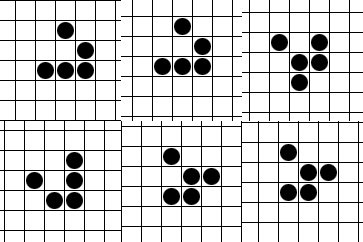
Why do gliders (https://upload.wikimedia.org/wikipedia/commons/9/96/Animated...) always have a 'weight' of 5 cells? Why not 4 or 6?
Re:There are no particles, there are only fields (2012) by platz on Monday August 29, 2016 @11:06AM (#12382308)
Space itself cannot be quantized into a grid because it totally fails under special relativity.
Re:There are no particles, there are only fields (2012) by taneq on Monday August 29, 2016 @08:31PM (#12386510)
I seem to remember reading somewhere recently that you can in fact quantize space in a hexagonal grid in a way consistent with quantum mechanics, but I can't find a link now.
Re:There are no particles, there are only fields (2012) by platz on Monday August 29, 2016 @08:48PM (#12386581)
quantization consistent with QM is tautology; issue is this can't be made consistient with GR. see raattgift's comment in thread.
Re:There are no particles, there are only fields (2012) by Ono-Sendai on Monday August 29, 2016 @11:14AM (#12382378)
citation?
Re:There are no particles, there are only fields (2012) by raattgift on Monday August 29, 2016 @04:48PM (#12385194)
Special relativity is defined by invariants on the Minkowski metric ds^2 = dx^2 - dt^2 using general coordinates and setting c to unity. This is a generalization of the Euclid metric ds^2 = dx^2. (In Cartesian coordinates and in 2d, ds^2 = dx^2 + dy^2).

Just as the Euclidean metric fails on a gridded plane where one would instead use the Taxicab metric (ds = \sum _{i=1}^{n}|p_{i}-q_{i}|), and the problem persists to higher spatial dimensions, the 3+1 Minkowski metric of Special Relativity fails on a discretized spacetime, and one would have to use a metric appropriate for whichever dimension(s) is/are discrete. Assuming it's not just the timelike dimension that's discrete, the Taxicab metric is readily generalized to small patches of 3+1 spacetime, just like the Euclidean metric.

The other part of Special Relativity is important here: the fundamental actions that are invariant under translations, rotations and boosts -- Poincaré invariance -- is impossible to fully recover from a spacetime that does not admit the Minkowski metric; the best we can do with a metric on discretized spacetime is where the discrete steps are extremely small.

The firm upper limit, from experiment and astrophysical observation, on discretization approaches the Planck length. [0]

There is plenty of literature about violations of the full Poincaré symmetry under discrete spacetime (especially violations of Lorentz invariance; the Lorentz group is a subgroup of the Poincaré group). example at [1]

Essentially, the problem is that in a discrete spacetime a boosted observer could see a Lorentz-Fitzgerald contraction acting on the minimal length, further contracting it. The ways around that are either extremely shaky as there is lots of conflict with experiment (e.g. fixing a preferred rest frame) or extremely subtle (e.g., UV corrections to the smooth Lie groups of the Standard Model or replacements for them that reproduce existing IR results e.g. by replacing the metric with an operator (but see also [0] again vs [3]).

Some further detail on Sabine Hossenfelder's blog: http://backreaction.blogspot.co.uk/2016/04/dear-dr-b-why-is-...

[0] http://arxiv.org/abs/hep-ph/9812418 [1] https://arxiv.org/abs/hep-th/0112090 but for contrast [2] http://arxiv.org/abs/1406.2610 and http://arxiv.org/abs/gr-qc/0405085 which shows that in a toy 2+1d model with a discrete spacetime, Lorentz invariance can be recovered by introducing non-local interactions; it is only suggestive with respect to our 3+1d spacetime, however. [3] http://arxiv.org/abs/gr-qc/0205108

Re:There are no particles, there are only fields (2012) by taneq on Tuesday August 30, 2016 @07:58AM (#12389200)
Thanks for taking the time to type that up, the bits I understood were interesting and the bits I didn't have enough detail for me to do some reading. :)
Re:There are no particles, there are only fields (2012) by Ono-Sendai on Monday August 29, 2016 @07:03PM (#12386139)
Thanks for the great comment!
Re:There are no particles, there are only fields (2012) by Ono-Sendai on Monday August 29, 2016 @09:33AM (#12381703)
Are you suggesting an electron is a glider? :)
Re:There are no particles, there are only fields (2012) by taneq on Monday August 29, 2016 @08:32PM (#12386517)
Well, sorta. I'm suggesting it's a stable pattern (like a standing wave) in some (maybe-)discretized field resulting as a natural consequence of simple locally applied rules. Its properties (mass/energy, charge etc) are fixed by the properties of the field.
Re:There are no particles, there are only fields (2012) by hyperion2010 on Sunday August 28, 2016 @06:43PM (#12378890)
The probably is continuous, but the actual 'coming into being' is quantized. The question thus becomes 'Why are things quantized?' and the answers to that are either 'because they are' or unscientific in their nature.
Re:There are no particles, there are only fields (2012) by Ono-Sendai on Sunday August 28, 2016 @08:05PM (#12379175)
Quantisation does not have to be axiomatic however. Some things are naturally quantised, such as the frequency or wavelength of standing waves in a chamber of a given length, and likewise the energy levels of an electron in a harmonic oscillator potential or an atomic potential.