Can you elaborate? I don't understand what dynamic is being alleged with this often-cited reference to limited residency funding. If there really are (quasi) monopoly profits to be made, why would government funding limit that? That is, if it's really lucrative to become a doctor, but you have to do a residency, but no one will pay for it, then potential doctors should be happy to eat the costs, knowing that they can lay it back from later high salaries.
Let me put the argument in another context to say why it doesn't make sense: "demand for passenger air travel is through the roof, with revenues at hundred of times the cost of a flight. But we can't increase the number of flights because the government won't purchase more airplanes to give to the airlines."
In that case, it would be a poor argument: buy the new airplanes with the passenger revenue; you don't need a government subsidy there.
Well, there aren't. There's a bottleneck in the supply, but there aren't monopoly profits to be made, because Medicare acts more like a monopsony. Medicare sets reimbursement rates unilaterally, and medical providers are forced to accept them, even though they don't (in the aggregate) even cover the direct COGS, let alone allow for the overhead of running a practice.
I'm only bringing up residency funding to explain that the AMA has nothing to do with restricting the supply of doctors, as is commonly (mistakenly) believed. But the real topic that OP brought up was the costs of care, and the supply of doctors isn't really relevant to that topic either, because providers' earnings only account for 10-15% of total costs of care.
Nor did I ever endorse the claim the doctor compensation was a significant factor, although I should have perhaps made that clearer to avoid the rabbit hole.
My comment was intended to challenge the claim that the small number of Medicare-funded residency slots could affect doctor supply, which you seemed to genuinely believe and be able to defend. (If you can't defend this claim, I would recommend not repeating it.)
It does address your point. As I stated, there aren't higher-than-typical returns, because Medicare acts like a monopsony. Monopsonies result in lower-than-typical returns.
Medicare is involved in a number of different ways, but the two main ones here are to set the number of available residency slots, and separately to control providers' revenues through a monopsony power.
Aviation is highly regulated, but neither airlines nor passengers are monopsonies, so the analogy doesn't work.
Are you saying that the financial return to becoming a doctor is lower than for other occupations? If not, then you probably misunderstood the argument. Medicare doesn't somehow lower the return to becoming a doctor.
>Aviation is highly regulated, but neither airlines nor passengers are monopsonies, so the analogy doesn't work.
The relevant buyer would be the passengers or the employers of doctors, neither of which is a monopsony, and the use of airlines was arbitrary. Again, the point is that (lack of) governmmet subsidies can't be a bottleneck when existing revenues suffice to pay for whatever expansion is necessary.
In three comments, plus two citations, you have not provided substantiation to address the point (that lucrative businesses can't be bottlenecked by subsidy caps), and at this point I don't think you understand the criticism, but prefer instead to dismiss any clarification of the relevant dynamics with "oh that's regulated".
I request that you stop propagating your argument (and dismissing critics as having a "misconception") until you understand these criticisms better.
I did my best to make it clear that these two things are intricately linked.
> If not, then you probably misunderstood the argument. Medicare doesn't somehow lower the return to becoming a doctor.
Medicare absolutely does lower the returns to becoming a doctor, just as any monopsony lowers the returns for suppliers in that market.
> The relevant buyer would be the passengers or the employers of doctors, neither of which is a monopsony
Until very recently (the last 2-5 years), the majority of doctors were self-employed, meaning that insurers were the direct purchasers of their services. And because of both its size and also various laws, Medicare has monopsony power in the insurance market. The recent employment of physicians by hospital groups doesn't really change those economic forces; it simply adds an extra layer of indirection when resolving them.
> you have not provided substantiation to address the point (that lucrative businesses can't be bottlenecked by subsidy caps), and at this point I don't think you understand the criticism, but prefer instead to dismiss any clarification of the relevant dynamics with "oh that's regulated"
I've stated pretty clearly that medical practice is not a particularly lucrative business (hence why private practices have been going bankrupt and being bought out by hospitals and insurers, and why so many hospitals have negative gross profit margins). That's not a 'dismissal' of your criticism; it's a refutation of the underlying premise.
> I request that you stop propagating your argument (and dismissing critics as having a "misconception") until you understand these criticisms better.
I could request that you stop dismissing me as 'misunderstand[ing] the argument' until you understand what I'm saying better.
Admittedly, this is a complex topic requiring both a detailed understanding of the ontology of the health insurance industry and a firm grasp of some economics concepts that are usually only covered at the graduate level. Most HN readers, understandably, have neither of these. I happen to have domain knowledge about both of these, and sometimes I share pieces of it in HN comments where relevant, and when I think it might be appreciated.
Neither one of these is particularly easy to convey in only a few hundred words, which is the amount of text I have written today on the topic. Sometimes I succeed, and sometimes I don't. Perhaps I have not succeeded in this particular instance. Perhaps I could if I spent more time, or elaborated more, I could convey these points better, and maybe then we could come to an agreement. But that's the amount of time and energy I have to spend today writing HN comments on the matter.
Where? You haven't once mentioned the return to becoming a doctor, nor compared the two, nor given a reply that suggests you recognized the distinction between the two.
>>you have not provided substantiation to address the point (that lucrative businesses can't be bottlenecked by subsidy caps), and at this point I don't think you understand the criticism, but prefer instead to dismiss any clarification of the relevant dynamics with "oh that's regulated"
>I've stated pretty clearly that medical practico is not a particularly lucrative business (hence why private practices have been going bankrupt and being bought out by hospitals and insurers, and why so many hospitals have negative gross profit margins). That's not a 'dismissal' of your criticism; it's a refutation of the underlying premise.
Then I was correct that you misunderstood the argument. The "lucrative businesses" referred to here, two which I was drawing an analogy, would be 1) the hypothetical airline business, and 2) the "business" of training to be a doctor; it was explicitly NOT referring to that of a medical practice!
Just as superprofitable airlines don't depend on government subsidies, superlucrative becoming-a-doctor shouldn't depend on government funding of residencies. See the dynamic there?
Now, after reading your last post, it sound like you're saying that Medicare has monopsony power over all doctor services and therefore is the major determinant of all doctor compensation, even those that eg work for rich people as their personal doctor.
If that's what you meant, I don't see why you couldn't have just said that the first time around, given your deep domain knowledge. Then, the appropriate reply would be "the return to becoming a doctor is no higher than other training, so it would be pointless to become a doctor if you had to also bear the cost of the residency". Note the length is less than 500 words.
But then, seen so clearly, it would depend on very questionable claims.
If that's not what you meant, then I stand by my claim that you're not responding to my point, because that's the only way that government-paid residency slot caps could hold up the correction of doctor undersupply.
And, regardless, if physician pay went to 0, US healthcare costs would drop by only 10%.
If we consider them in isolation, shrug and say the cut won't fix the problem, we won't fix the problem.
http://image.slidesharecdn.com/pnhplongsetweisbartversion-12...
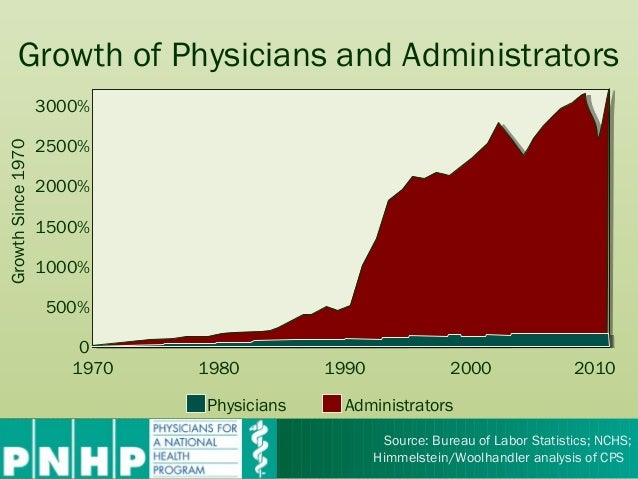
So, sure, we can cut physician salaries and nursing salaries (nursing pay collectively is about the same as physician pay). But I don't see a downside to trying to reduce the administrative burden as a means of cost reduction.
I definitely have lots of concerns about the mega institutions that are swallowing hospitals. It's hard to believe that they really do much to improve outcomes for patients (and it's pretty observable that they haven't done any good for prices).
Sorry for potentially being probably completely obtuse here due to being deep within the structure of medicine, but new supply of what?
This is a common misconception. I've posted about this many times before, but in short, it's the AAMC, not the AMA, that used to medical school spots. They are no longer the bottleneck anymore, however; the issue is that we don't have enough residency slots, and the funding for those comes through Medicare[0].
That said, this isn't really a driver of costs anyway, because providers themselves are responsible for only 10-15% of spending.
> Basically, all entrepreneurs who don’t join the union are shut off the health care industry. This is why you pay so much money in insurance & for simple doctors visits. Do you think if a fresh entrepreneur opened a hospital you would pay $8,000 per day for a room?
No, the reason that you pay so much is because of the convoluted way that Medicare reimbursements work (even if you're not on Medicare). In short, Medicare doesn't cover its own costs, so private insurers and uninsured patients are overcharged in order to cover the difference[1]
[0] https://news.ycombinator.com/item?id=8122377
[1] https://news.ycombinator.com/item?id=10479398