http://www.spur.org/sites/default/files/wysiwyg/asking.price...
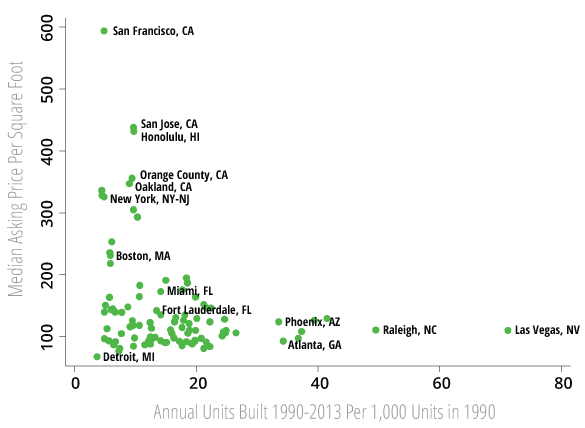
How difficult is it to build new housing in Dublin? Does the city allow new apartment buildings, or are most areas single family, detached residences only?
http://www.irishtimes.com/business/economy/time-to-end-irela...
Pigeonhole principle: if K people want to be in Ireland at any one time, and there are N < K apartments, K - N people will have a problem. All the folks criticizing AirBnB want to do is make sure they aren't the ones who face the problem.
I'm not arguing that this is necessarily bad, but it's really interesting to look at the reasons why this is happening and the negative effects it can have. Increasing domestic prices because of underutilisation is one.
I wouldn't be surprised if this becomes a problem and affected cities introduce heavy taxation on short-term renting out dwellings which you don't usually live in and which are not planned for commercial use.
OTOH, "semi-commercial" actors renting out apartments has existed for a lot longer than AirBnB. We stayed in one of these in Rome for a week in '09, found through some website for private rentals (AirBnB went international in '11). So it's not really a new thing, just a slicker UX which may or may not increase total demand for such services.
Tourists are people too, and need a place to live. The folks in Barcelona just want to make sure it's the tourists, rather than them, who suffer from the housing shortage.
Is there any justification at all that could prioritise tourists over residents for living space?
Empirically it seems like cities value tourists over residents -- if cities actually wanted residents, they'd approve construction of housing for them.
How does that work? Don't tourists use the same infrastructure?
http://gothamist.com/2013/04/11/interactive_chart_nycs_budge...
(I'm assuming "debt" and "pensions" are allocated proportionally.)
You're looking at it wrong.
What AirBnB does is allow apartments to be rented as hotel rooms, at prices somewhere in-between.
Thus you get mostly empty hotels and lots of mostly empty apartments (1/3 or 1/4 use yields better money than full-time rent).
You've inverse-optimized resource usage.
There is a supply and demand tension in Dublin over accommodation. Building more apartments, i.e. increasing supply, will help alleviate this tension. That doesn't mean we can't also tackle the problem from the other direction by reducing demand. AirBnB is demand.
It's hard to tell how much any government would want to pull on a lever that might reduce demand. Those tourists bring valuable outside revenue into the city. We need them too. There's lots to balance here. Let's not optimise just revenue.
[1] http://www.reuters.com/article/ireland-economy-housing-idUSL...
[2] http://www.ft.com/cms/s/0/15bb4d40-4714-11e5-b3b2-1672f71080...
If a city/country wants to base its rental units on a day-by-day, airbnb model, then fine. The problem is when airbnb comes into a regular market and "disrupts" that market by not paying hotel taxes or following local subletting laws.
I say that as someone who very recently used airbnb for a great deal in NYC, and was admonished by the host not to talk about our situation in the lobby, the elevators, or anywhere else someone might overhear.
Perhaps we should see a pattern: The 'sharing economy' shifts power and wealth to those who own the assets, for which there is now greater demand and, due to resulting increased value, which are more costly to acquire.
How bad is the shortage? I'm asking because Google has once again contacted me, this time for a position in Dublin. Or do they have their own housing for employees?
More interesting is what the long term picture would look like if the AirBnB is left to carry on unimpeded. Whatever it is will surely be better for people in general. It might hurt some people who feel entitled and got caught by surprise, but that's how progress works. There are usually losers along with people overall being winners.
> The average rental value of a two-bed apartment in the city centre at €2,000 per month, less a management fee, would equate to the apartment being occupied for just 120 nights of the year through Airbnb.
> Investors have confirmed that if correctly managed, the income can be double that of a long-term rental.
(AirBnB disagrees [2])
As much as I like the idea of AirBnB, their impact on the housing market in any given city needs to be considered. Unfortunately the article doesn't mention that at all, focussing solely on tourism.
[1] http://www.independent.ie/business/personal-finance/property... [2] http://www.irishtimes.com/news/social-affairs/airbnb-insists...