Given the author's background, I'd put money on the idea that this is the result of years of frustration at having his life's work dismissively reduced by casual observers to something like "yeah, it's basically a computer" and thinking they therefore understand all the intricacies of the human brain. I can see how that might grate on a person in his field and trigger a response like this.
We know that the brain uses signals, and that these signals are composed of codes. We know that to interpret the world, certain information processing must take place. We are learning more about the exact nature of this processing, more about how neurons and even other fundamentals of the body code information and contribute to processing (e.g. chemical processes), but they definitely process information. We even know some of the codes.
On the other hand, if the author wants to argue about the nature of what is information, what is processing.. he's going to have a steep hill to climb.
From this we can often find things like:
- frequency of impulses increases as stimulus increases
- different numbers of neurons in a similar area fire simultaneously
Things like that. The wikipedia articles linked by wickedagain contain a good summary. I won't link specific sources, since there are thousands, but here's one for instance:
http://jn.physiology.org/content/85/4/1561
There in fig 6 for example you can see that the frequency of nerve firing increases in the tibial nerve as heat is applied to the paw. (Yes, a lot of information comes from horrible animal studies. It's part of the reason I didn't continue in this domain of work -- although rest assured, this technique is possible with humans, without harm.)
So, do impulses in the perceptual nervous system reflect how brains work, how we think? It's hard to say for sure, but it's clear that information is coded according to certain possibilities related to how neurons work, and this information must be combined and processed somehow to create what we call perceptions. Is it such a stretch to imagine that these perceptions become their own codes, abstract reductions of correlations of perceptual information, that are evaluated, compared, and combined in the much, much more nerve-dense central cortex to produce what we call "thought"?
A further frustration might be with computers themselves. I don't see why an introduction/exposition to computing should be something that needs pardon.
- The brain's network is not very well understood. For example, half your body's neurons are in your cerebellum. There people that don't have a cerebellum, and they only seem to walk later, and have balance issues [0]. That is half of all your neurons, and until you do a scan, people can't tell you are missing them. Alternatively, we have Henry Molaison (known in literature as HM), who could not remember a thing from after his surgery to save his life. All the surgeons took was his hippocampus (and some other stuff) back in 1953, which we then found out was SUPER important for memory [1]. He lived to be 82 and died in 2008, incidentally. Suffice to say, the neurons, their local network, and the long range network (aka, your whole body) are all very important in terms of how it all works. You can take out a ton, and not loose really anything, or you can take out some special ones and never remember a thing again. The brain is not 'fuzzy' and really 'fuzzy' all at the same time. It's like lumping all of China's politics into just their Chairman's ideas; you loose any sense of what is going on.
-The brain's recall system is also not well known. As with HM's life, you take out this special part, and it all goes to shit. However, when HM sang or played music, he could do an entire song or piece, even if it was Indagardadavida's length. Also, he remembered shocks to his hand when a surgeon put a joke buzzer in one day; he was hesitant to shake the next day. Our memory is not in any way good or lossy. Look at PTSD victims, they remember it ALL. Typically, it comes down to the motivations of the person. If you have to remember for the future, like an important fact for a test, or the sound a wolf makes right before it leaps onto you, then you will remember it very well. If you don't need to remember, then you typically do not. Again though, the brain is not well understood and we all have experienced exceptions to this.
-Some people are better at recognizing, some are better at recalling, and we don't know why. People that are face blind [2] are really bad at remembering faces; Brad Pitt says that he is face blind. Some people are really good with faces and really bad with names, some are the opposite. Some are synesthetes [3] and will recall equations or speeches by the taste that they experience when doing it. Some people are savants and can recall an entire phonebook and then draw it, nearly as a cc, from memory [4]. Memory is a fascinating subject and whenever you think you know what is going on, something new opos up and kills the theory.
-Our brains can be very good at deterministic calculations. Any major league ballplayer is very good in the outfield (the D-backs excepted this year) and can very accurately catch a ball hit from 100s of feet away. They may not be good with math, but some of them are much better than any computer [5].
The brain is not well understood at this time. Calling it a computer is obvious nonsense, but it's a good working theory to approach from, especially considering we have no other real ideas.
[0] http://www.iflscience.com/brain/24-year-old-woman-born-witho...
[1]https://en.wikipedia.org/wiki/Henry_Molaison
[2]https://en.wikipedia.org/wiki/Prosopagnosia
[3] https://en.wikipedia.org/wiki/Synesthesia
[4]www.neatorama.com/2008/09/05/10-most-fascinating-savants-in-the-world/
The same thing could be said about 'intelligence'. Current definitions of intelligence are not abstract definitions(even though the word itself seems like some abstract term, similar to calculation, motion etc.), but rather are labels/descriptions of particular human traits. If a more abstract definition was offered, you would see a lot more things in nature 'becoming' intelligent. So, currently we are in a situation where 'intelligence' is defined in terms of human traits(like being able to speak human language, do human mathematics, drive cars etc), but then at the same time we're looking for intelligent aliens. You can't find 'intelligent' aliens if the term intelligence is defined in such a way to only ever apply to humans. It's really a parlor trick.
This is an expression of human desire to feel special - you don't want to be labeled as a computer or cluster of regular matter - rather you are an 'intelligent' soul(a different substance, not a regular matter) made in the image of the most powerful creature in the universe who happens to love you and care about you.
Agreed with the rest of what you wrote, but "intelligence" is more or less uniformly defined as the ability to quickly assimilate and apply information. What we try to measure is the speed, accuracy and complexity of that process. We have tried to measure the same process with dogs, parrots, monkeys, and ravens, and we even use comparable scales (e.g. general opinion is that adult dogs can handle the same mental complexity as toddlers).
You are correct that the tests we use incorporate human traits. But that's as much because we are mainly testing humans as because we use humans as our reference.
What these experiments with animals are designed for is to check which animals can do things in a similar way to humans.
Why are ravens intelligent? Is it because they can quickly process information? No, that is not what experiments are checking. They are labelled as intelligent because they can use tools to unlock their food.
Why are dolphins intelligent? Is it because they process complex information quickly? No, it's because they have large brains and exhibit empathy towards humans plus they seem to be able to communicate with each other.
People don't say "Well, that system can process complex information quickly, therefore it's intelligent". Instead, what you'll hear is "WOW, animal X can use tools, can communicate, organize in groups! They are more intelligent that we thought". Using tools or communicating is just one way of processing information. There are many other ways. For example, an animal might not be able to use tools in a cage to unlock their food, but they could be a terrific fighter in the jungle. Fighting in a jungle is a process that demands quick information processing, but those animals are somehow below in intelligence than revens or dogs. That is because people aren't using the definition you've provided.
> You are correct that the tests we use incorporate human traits. But that's as much because we are mainly testing humans as because we use humans as our reference.
Of course a mere year ago the fact that computers can't get good moves in Go was an argument. And all the arguments that came before that, voice recognition, reading, chess, games, even counting itself at one point. Of all those things that computers/"information processing" couldn't achieve we now know : computers have recognized more spoken text, read more books, letters, envelopes and ... than humans ever will. Computers have played more chess games, and certainly have processed more numbers than humans ever did or ever will. Humans probably still have a mild advantage in amount of Go processing, but it's clear that's not going to last much longer either.
This article takes another approach : because the type of processing that happens in our minds differs "so much" from what we do with computers, they must be fundamentally different. The emphasis lies on the human mind being different : humans don't work like computers, not the opposite. That wouldn't work : because computers do work like humans. That's why we build them, and use them. Computers analyse stocks, sell apples and cars and home insurance, they mail letters, they work out what a business should schedule tomorrow, they move their arms to glue soles onto shoes, ...
One might also analyse why computers are working so very differently. Why Von Neumann ? Well, because we don't really know ahead of time what we want computers to do, and even when we do, we want the ability to change it later. We want computers, to a large extent, and maybe even to 100%, to work like humans do, but we can't do that. As illustrated above, we get closer every year. Computers simulate other machines, that's what they do. So what you should compare is not instruction sets versus neurons, but neural network models those instruction sets simulate with biological neurons.
And then the differences melt away. Not fully. Not yet. We don't know how. Not fully. Not yet.
But more every year.
I mean shit, if I judge the distance between two points, how can it not be said that I have collected sensory data and computed the result?
All of his examples were pedantic or irrelevant.
http://cdn.theatlantic.com/assets/media/img/posts/computer_w...
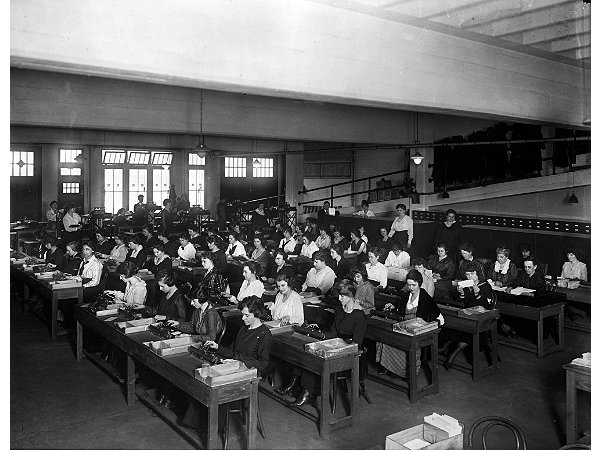
Let's call it "ipython before computers", or "excel before computers" if you must.
In order to make any point remotely like this, he'd have to go talk to some actual neuroscientists, which he very plainly didn't.
To use computers as a simile is not so strange.
However, what we still lack completely is any kind of model for autonomy, i.e. how the brain decides what to "compute".
http://yosefk.com/blog/ai-problems.html
"We don't build machines in order to raise them and love them; we build them to get work done.
If the thing is even remotely close to "intelligent", you can no longer issue commands; you must explain yourself and ask for something and then it will misunderstand you. Normal for a person, pretty shitty for a machine. Humans have the sacred right to make mistakes. Machines should be working as designed."
A "child" that requires far less resources will be a product that will be incredibly popular. Not to mention an economic necessity.
And I would even say : 100 billion "small" AIs (scale vaguely comparable to a human mind) is a far preferable situation to one big AI. Both from a survivability standpoint and from an "oh my God it'll kill us all" standpoint.
> "We don't build machines in order to raise them and love them; we build them to get work done.
I would even say, if it's at all possible we'll do just that in the next 10-15 years. If we don't get advanced enough AI, perhaps 20-25 years.
Not a doubt in my mind.
(Except for Japanese of course. Excluding them from this question)
Seriously, fertility will become no issue if we prolong fertile period of our lives. Imagine having one kid at thirty, and another one at sixty.
The problem does not tend to be that it's physically impossible to get a child.
- The brain is more fuzzy, but it still stores the link between the smell of roses and the look of roses. Just as a probability, like a Bayes network. And you will fall for Illusions, just like a Bayes network can be wrong ("for a second I thought this was..." and than more information from the senses falsifies/corrects the probabilities).
- The brain is imperfect in reading from memory, but it still does. It just uses really good, lossy compression. It's loosing much detail, but often filling holes probabilistically. Besides neural nets, in computers this would be: defaults, recovery blocks etc. In part the good compression comes from an additional layer of abstraction, but computers can do this too. A very simple example are the the blurry color layers in jpg.
- We are better at recognizing than recalling, because a highly compressed memory is not enough to recreate the original, but has enough indicators to verify. This us very much like a checksum.
What there is, is the bias of the "hardware". Our brains are not good at deterministic iterations, computers struggle with the complexity of forming wisdom and fuzziness and feedback does not come naturally to them either. But in principle, we are both turing complete or something :)