"Smoking" is the noun form of the verb "to smoke", also known as a gerund.
"No" is an adjective (quantity) modifying "smoking".
In the unintended misinterpretation, the phrase "no smoking" is an action that is permitted. The misinterpretation is possible because the negative is an adjective on the gerund which allows for ambiguity with regard to the sentence's predicate.
This is a feature of the English language. Colloquially, most English speakers understand the intended meaning.
The ambiguity can be removed by 1) writing "Smoking [is] not allowed" thus asserting the negative as an adverb in the predicate, 2) removing the predicate nominative "[is] allowed" (leaving only a gerundive phrase, not a full sentence), and/or 3) using a diagram like a prohibition symbol atop a burning cigarette [0]
EDIT: grammar and sense (this is getting complicated!)
[0] http://images.mydoorsign.com/img/lg/S/no-smoking-sign-s-9584...
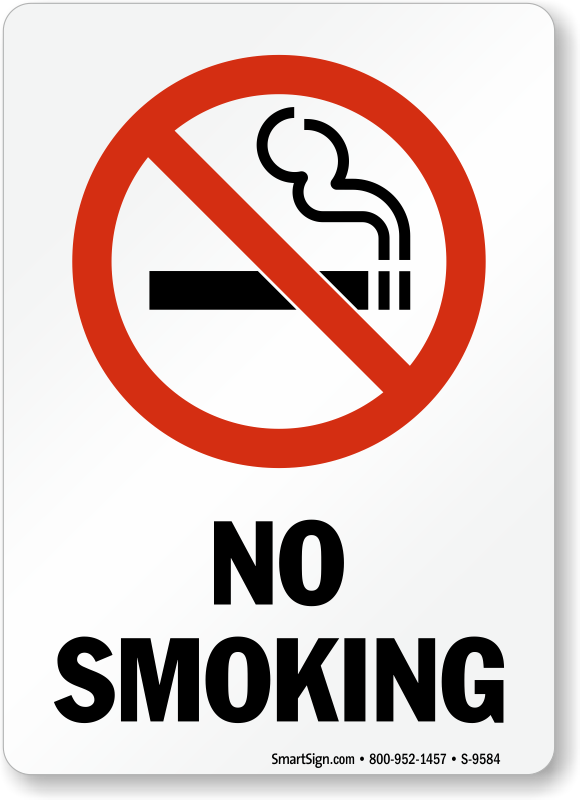
I think the point of this conversation thread was to split hairs. :)
> "Smoking" is the noun form of the verb "to smoke", also known as a gerund.
Yes.
> "No" is an adjective (quantity) modifying "smoking".
Yes.
> "no smoking" is an action
That does not fit with my understanding. "Uncle Bob is no smoking." is not valid English. "No" is a word used when talking about sets of things/actions. To make an action that is the opposite of smoking, you have to use "not".
(edit: changed first example to something more idiomatic)
One way to remove the ambiguity is to recast your sentence using "must": "You must not smoke". But that version is stilted to most modern English speakers raised outside the UK.
This side-discussion is probably one of the reasons people wish HN had collapsible threads, so after this comment I will refrain from further contributing to it.
(Nice job, btw, on highlighting the ambiguity in a version where the negative is in the predicate.)
EDIT: grammar
Edit: Also, I treat the sentence as being declarative with an implied 'is' even when interpreting it correctly.