So, yes, there is some blame to be apportioned for the spending habits. However, there is also the systemic problem of real incomes declining significantly, with major life costs (housing, education, medical, taxation) increasing dramatically:
https://research.stlouisfed.org/fred2/graph/fredgraph.png?wi...
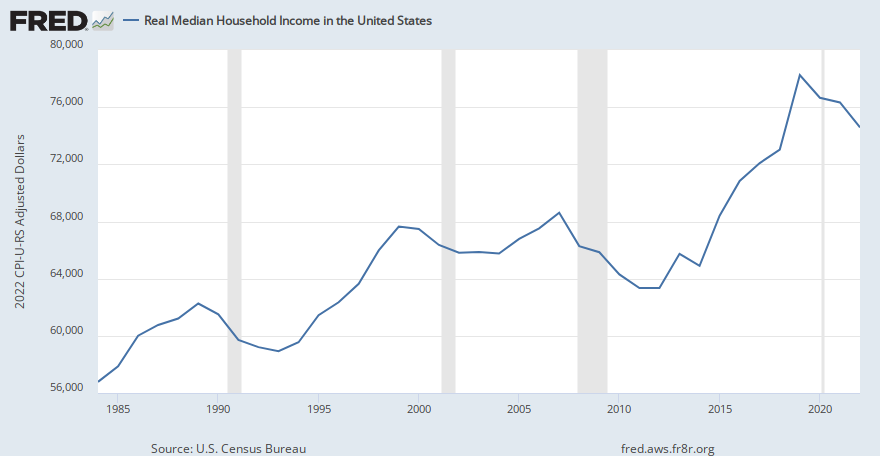
This problem is significantly worse if you use the old CPI, which some people feel is more honest:
http://www.soundmoneyproject.org/wp-content/uploads/2012/03/...

Either way, the decline in real wages in the face of rising major life costs is a major contributor to the increasingly precarious position of many middle class families.
I doubt that middle class families in the past routinely had weddings that required the rental of dedicated space and staffing by a dozen or more paid individuals. Maybe you had it in the church and had a potluck afterwards in the basement, or maybe you had it in a large rural backyard.
Of course, before, middle-class people also did not retire for decades and expect to spend that time traveling and not working. They did not expect to drive cars with air conditioning, carry supercomputers in their pocket, watch 200 channels on TV, or live in large air-conditioned suburban homes.
So what has happened is that the perception of "middle class" lifestyle has grown to include considerably more consumption. That's ok. It's just sort of puzzling to read this piece--he seems to say "I've had a good life, I've gotten good things for my kids, I don't have money in the bank, but it's my own fault, so I'm not complaining." Which is nice, but why is that worth reading?
I see it more and more that parents are expected to pay for their children to go to school - which also means that a big part of my loans are probably because of my father's income being counted when I did the FASFA. If the non-dischargability of the loans is based on a lack of finanical history (which I know I'm in the minority but I do feel that's fair), then the applications for financial assistance really shouldn't take it into account unless your parents are actually paying for your school.
And you can still go to college, but go to a state college and live at home. The con these private universities are pulling on the middle class is something for the history books. They sell this "university lifestyle" to impressionable, naive high schoolers who then throw themselves (or parents) into stupid amounts of debt just to live the lifestyle.
But when people talk about wastefully expensive private schools, they really mean schools that have nothing over state schools but the price tag: GWU, George Mason, American, and the like. Combine that with a non-reliably-marketable degree like Psychology, Political Science, Communications, or Art History, and the result is disaster.
Stanford has some fantastic opportunities, sure. But those opportunities come with significant opportunity costs (at the very least, financially). For some, it is better to attend a state school; the mental calculus involved in making this decision is rather difficult for an 18 year old and his/her family, especially with all of the noise that surrounds the college admissions process.
If a kid is going to be a success, they'll be a success. Multiple studies support this: http://www.huffingtonpost.com/2014/07/20/where-you-go-to-col...
Disclaimer: I'm a proud Penn State alum, which was (at the time) my safety school. Just my $0.02.
All of which seemed relevant to me since the author of TFA was making sacrifices to send his girls to Emory & Stanford.
As a mental exercise, I'm imagining a product that would, given a number of inputs, produce a bayesian curve of the applicant's possible outcomes, and then selects the best school for that applicant. While developing this product sounds like a fun side project, I can't imagine it gaining traction, because the aforementioned groups would get upset (read: not pay) that Prestigious U is not the best choice for Johnny, rather, Mid-Atlantic Middle College is. It would be difficult to get the secondary actors in the process to pay as well, because there is value generated for them by maintaining process homeostasis.
Current thinking would suggest that I should have gone to, say, Bucknell over Penn State (again, I understand n=1 here, and I am not measuring my level of selective perception), whereas I am very happy with the course of events and think it produced the best outcome. I have to believe there is some grain of truth to my line of thinking and a potential for value generation in the decision aspect of college admissions.
I have more respect for someone who blows all their money on "hookers and blow" (or whatever their personal equivalent is) than keeping up with the Jones. If you're gonna flush your wad of cash down the toilet, pick your own stall!
I blow my money on charity medical relief in impoverished regions, not fancily-plated food.
My value-system doesn't lump wedding and college together. It seems much more reasonable for parents to sacrifice their own well-being to send their kids to elite schools. The whole wedding thing seems crazy to me, though.
Considering how bad financial distress is for a marriage, it seems like a really terrible idea to stretch yourself for a wedding. There should be (not saying there isn't) no shame in getting married at City Hall, with a few of your closest friends and family. Could be the best marital decision you make, if it puts you on a better financial trajectory.
I went to an unknown stare college, stated at home and got a degree in computer science. After my first three years of working - almost 20 years ago - my salary has been comparable to anyone else's. No one cares what college I graduated from.
However, you didn't explain why. There are, IMO, two reasons:
- maintaining demand by incessant, aspirational media pressure e.g. if you don't have a Cinderella-like wedding costing $100K+, you are a failure (it is the most important day of your life, right? right?)
- easy availability of credit to finance these wants (not needs)
A lot of people believe that a $100K wedding must be better than a $10K one, or a $75K/year college must be better than a state university.
I'd exclude taxes and health care, though. These are a bit different, because you don't really have much of a choice here.
This doesn't contradict your point that real incomes are declining.
http://www.statista.com/statistics/183995/us-college-enrollm...
http://nces.ed.gov/programs/digest/d13/tables/dt13_302.60.as...
For one thing, top state universities are better schools than the majority of private colleges. They have research programs and a much wider course selection.
My wife and I had a Vegas wedding. Without any hookers or blow. A total of four other people at our wedding; they paid their own way there.
My wife and I used the money we saved on our wedding to help fund the purchase of a house (and all the crazy additional expenses that involves). We're still married 20 years later,
Contrast that with one gal who had a very elaborate wedding, at an expensive venue, with many guests, and who subsequently divorced within a year. What of the "core human experiences" of all the people who attended that misbegotten wedding?
Life comes down to choices. Few people are rich enough to be able to afford everything they may feel entitled to as part of the "middle class".
systemic problem of real incomes declining significantly, with major life costs (housing, education, medical, taxation) increasing dramatically
All that is very true. But it doesn't excuse foolish financial decisions about the events that people do have total control over.
the decline in real wages in the face of rising major life costs is a major contributor to the increasingly precarious position of many middle class families.
Yeah, that and the fact that many people can't grasp the simple concept of saving for a rainy day.
You're right about those other goods though: if people have to shell out all their discretionary income to cover some minimum baseline in those categories, then that is a solvable problem. Arguably, though, education and housing have become positional (and thus intractable via discretionary income) because people are trying to achieve a relative rank through them, not some baseline of quality.
[0] basically a good that derives its value from its ranking relative to others, not absolute metrics https://en.wikipedia.org/wiki/Positional_good
What constitutes 'core human experiences'? There are people in this very forum who think a vacation per year is a very valid human need because 'life happens only once'. So by many a measure 'the trip to vegas' is a 'core human experience'. Plus there is a very think line of difference between a vacation to vegas or grand canyon.
The right way to measure a 'core human experience' is to ask what is the person's highest priority? If you ask me nothing is more important to me than putting food on the table, having clothes to wear, a roof above my head and enough cash for my health expenses when I grow old. That said, now I have to plan my finances accordingly. I can't spend a good chunk on everything else and then complain I don't have enough.
People at all levels of income are faced with 'priorities', this includes millionaires as well.
> The author isn't mysteriously broke. Money is not being stolen from his account. Rather, he's spending a lot of money on things which he believes are necessities (like paying for a child's wedding), and sacrificing a lot of things which he believes is optional (like having retirement savings). Some would suggest both categorizations are wrong.
Bingo.
As much as I think of social security as a ponzi scheme, one thing I do like about it is that it forces people to contribute and they can't touch their contributions. Sure you might only get $.60 back for every dollar you throw in there but hey at least you'll get something.
It's sad to say it, but the majority of people are not financially savvy enough to make sound decisions. Left to their own devices most people wouldn't save diddly squat, work till they're fired, then be destitute. And they probably won't have kids to take care of them anymore either because "Kids are expensive ... you can't afford that!".
Not saying people have no responsibility, but the odds are kind of stacked against you - it is an uphill battle to survive.
Instead, it was "invested" in government bonds, which is equivalent to saying, "oh, I'll just raise the money later". But that's courting disaster: if you have these unfunded obligations that come due, you have to gore an increasingly difficult amount of taxes out of your base, which can become rapidly impossible if and when people start fleeing from the burden.
We could have kept the forced savings but given people back more than a real dollar per dollar forced to contribute.
The article strikes a chord with me, because the author exhibits some of the same thinking as my own parents. They paid for my brother and I to go to college, for which we are very grateful. But they also say that the giant house in an expensive zip code, the foreign cars, etc, are "for us" using some nebulous baby boomer thinking like "if you want to be somebody, you have to look like somebody."
Far be it for me to judge my parents' choices. But recently, my dad quit his job and started a business. At that time, he definitely wished he had built up more of a runway.
Even here, though, there's an easy trade-off. Expensive house in good public school catchment, or cheap house + private school. But, don't do both if you're stretched.
[1] e.g. like much of Europe, let you go where you're accepted, regardless of where you live, and let the public funds follow you
http://www.businessinsider.com/manhattan-weddings-are-us-mos...
They've sold people that they not only can, but should, live beyond their means.
The nightmare many are facing is that it doesn't benefit them. Regardless of what self improvement one may receive from their degree, certain degrees are being awarded at a faster rate than the economy demands them, depressing wages for those who can use that degree to get a job and resulting in many who can't use that degree to get a job.
> We have no retirement savings, because we emptied a small 401(k) to pay for our younger daughter’s wedding.
The author isn't mysteriously broke. Money is not being stolen from his account. Rather, he's spending a lot of money on things which he believes are necessities (like paying for a child's wedding), and sacrificing a lot of things which he believes is optional (like having retirement savings). Some would suggest both categorizations are wrong.
Also:
> we believed [our children] had earned the right to attend good universities
That's actually not how university tuition works, and the rhetorical tricks being deployed here leave me cold. Your daughters did not have the right to attend those expensive private universities; they had the privilege of doing so, because you spent a lot of money you didn't really have to obtain that privilege for them. Which is awesome for them! No doubt it will benefit them (which is why you paid all that money, I imagine). But it's not entirely clear to me how "middle class" paying for your children to go to some of the most expensive schools in the world really is?