I think that the comment you were responding to was suggesting that the tax load should be directly proportional to the income fraction, which I suppose you could make a cogent argument of.
So the idea of 'fairness' is already an artificial construct. It's far easier to make a billion in a society like the US, than say, Vietnam, or Argentina, or Romania. So in a very real way, US billionaires do 'owe' something to the system that allowed them to attain that wealth in the first place (and that 'something' is pretty much 'everything'). If wealth could be attained completely independently of the 'system', then the distribution of billionaires would be completely different than it is right now.
The real question is how does wealth manage to concentrate so highly so quickly and by those who actually contribute so little.
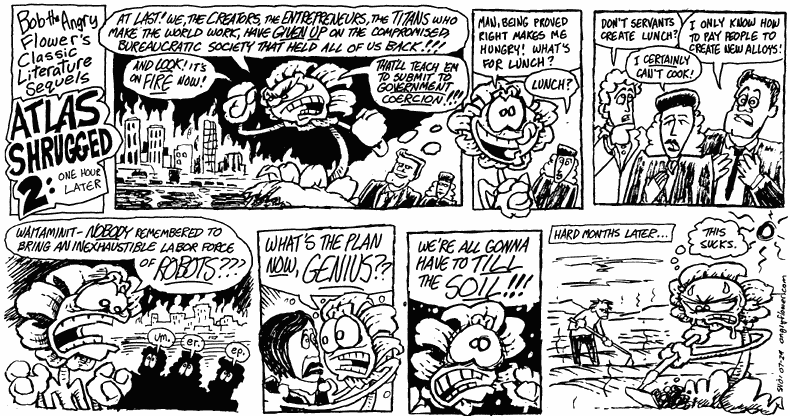
edit: this guy is literally pulling an Atlas Shrugged. If you think you as the owner of the company 'make all of the money', I heartily suggest you try going it alone.
She is obviously glorifying these man, making them the 'hero', but don't we do exactly the same in every other fictional book? It's been a while since I read a book about John and Jane that details their virtuous lives that is not played out, one way or another, on a high level (either starting or becoming a hero etc).
My take from the story was more that these people exist at every level. I remember parts (I might be grossly mistaken here, but this is what I took from it) where Rearden talks about and with his most valued employees, or where Dagny has her valued associates, where the train men that 'stand their ground' are praised. I'm not sure the 'owner makes the money' story is what she wanted to portray, or possibly I just took my biased view and ran with it while reading ;)
CEOs once upon a time made "too much salary" so pay for performance was used. Now this.
Do you really believe the 1% richer would earn so much money without exploiting the work of the 99% others you want them to get rid of? That's ridiculous.
I've had this conversation three times: "What'd it take to get you to move to California?" "More than you have."
So there's that.
This is a democracy, so how much ones owes in taxes is decided by the people. As far as seceding is concerned, good luck with that.
When the top 1% pays for about 50% of the infrastructure, it is time for them to think about seceding. I mean, the top 50% move together, poof they can have something like half of what is provided by the state, without the 99% bothering them anymore.