He asked me what I used to lubricate it, and showed some simple calculations to our host. He said he'd mostly forgotten how to use it, but it was clear that it was very, very familiar to him.
He signed it. Later I got Jim Lovell to sign it as well. One of my most treasured possessions. I only wish I'd had the presence of mind to get TK Mattingly to have signed it when I met him a year earlier. There is yet time.
I've used that before. It is not a standard logarithm stick but a vector addition tool. Does one thing very quickly.
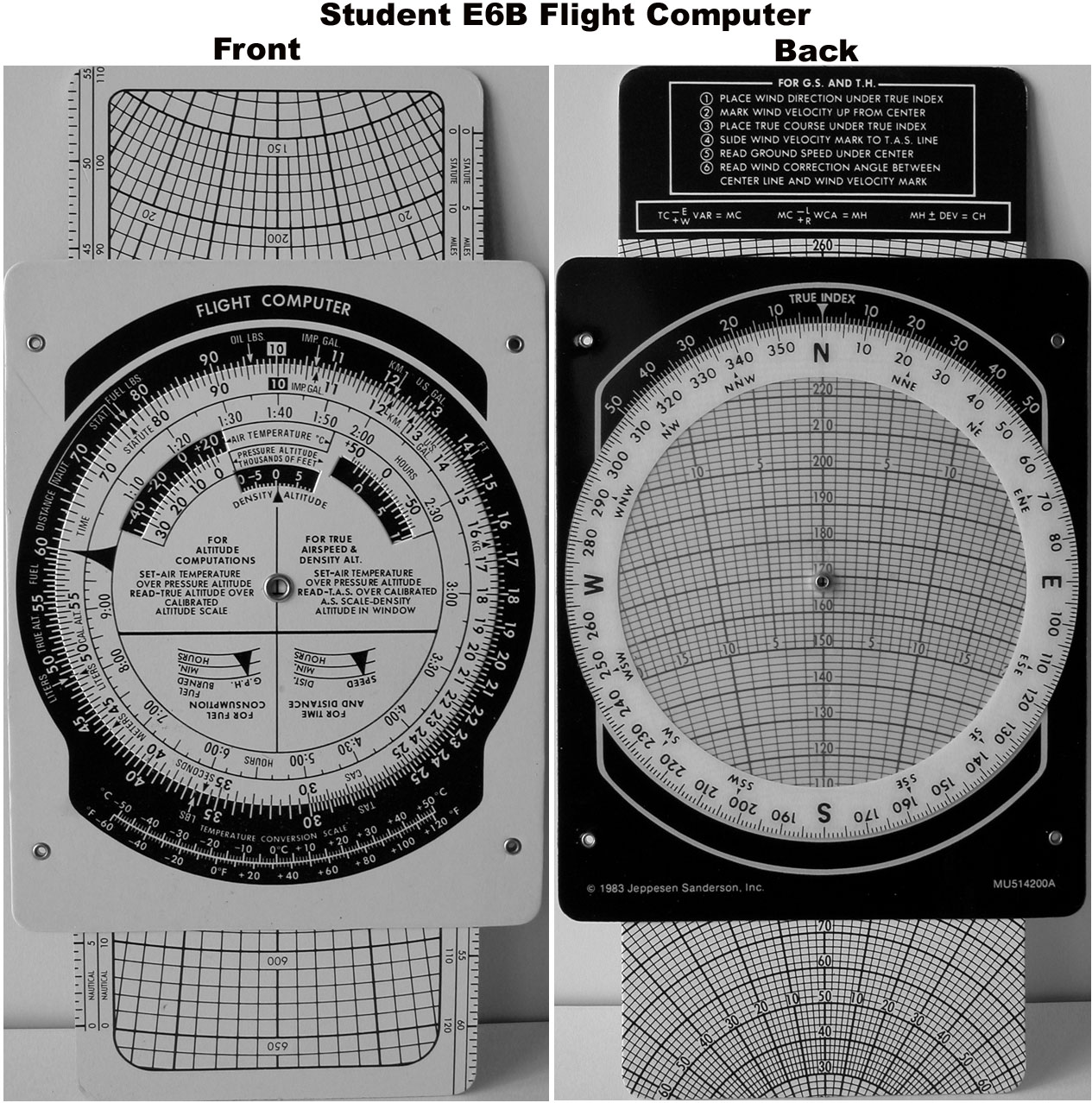
The main difference between a straight and circular rule is that it has only one appearance of the index, so you don't have to move the slide around as much, and it's round so the equivalent of a 10" rule has around 3" diameter.
It also has other scales for converting altimeter/airspeed (really pressure gauge) readings into other numbers more useful for certain purposes like true altitude (good for missing obstructions) and "density altitude" (for estimating takeoff performance, also helpful for missing obstructions).
The first actual hand-held calculator I every saw was a Bowman Brain (simple 4 function calculator) it was for sale in 1971 at the MIT COOP (the bookstore). I only knew one person that bought one; the rest of us continued carrying around our slide rules (they came in handy leather holsters with belt loops.) The HP that came out about a year later was a real scientific calculator.
Years before that, sometime between 1965 and 1968, on an episode of Lost in Space (a TV program with a family of early space explorers lost in outer space) the son, Will Robinson, was carrying around a large device about 3 inches thick and a foot tall that looked like a calculator. I thought the idea quite marvelous and went to bed thinking about it and how much better it would be than my slide rule for playing around with calculations. (I was a weird kid.)