The problem is that an emphasis on avoiding mistakes leads to paralysis. Though he phrases it differently. Students don't want to be wrong so they just don't instead.
As he points out later in the piece, learning from our mistakes is key. If I never learned to walk because I fell the first time and failed walking class, I'd be crawling even today. An overly negative assessment of the students' works, an overemphasis on right and wrong, rather than correction and expansion to different methods when some method has failed a student, ends up producing many students who can't do math.

Then for people for which that's too abstract, I find this graphic helps a lot in explaining. http://static.nautil.us/1635_42a3964579017f3cb42b26605b9ae8e...
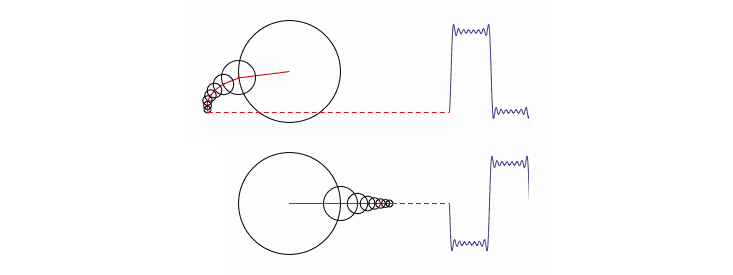
You picked a really bad example for the unintutiveness of mathematics.
Just a data point for you.
https://upload.wikimedia.org/wikipedia/commons/1/1a/Fourier_...
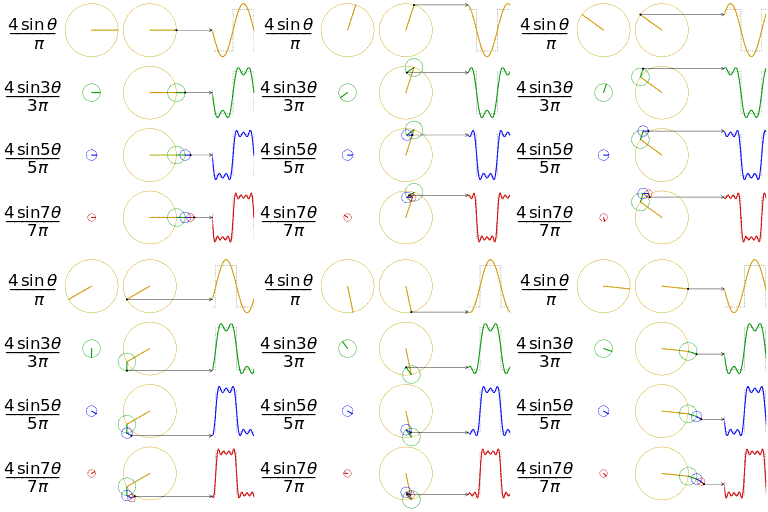
Thank you!
Personally, my intuition gives up at spectral sequences.
Math simply is hard. It goes against all our good-enough, subconscious brain functions we use every day to make basic "bigger or smaller" decisions. The problems mathematicians call "interesting" are counter-intuitive pretty much by definition and now imagine someone thinking like that writing a math book for children. The language used is vast and was built over literally millennia of mathematicians appending their own little modifiers above, below, and all around other mathematical symbols, resulting in monstrosities like the function for the Fourier Transformation which can actually be described quite intuitively geometrically.
Mathematicians want "simplicity" and "beauty" but their definition of either is absurdly different from any that would take into account basic human intuition. That's the problem. And there barely are any mathematicians that would admit that this could ever be a bad thing.