News for hackers. Stuff that matters.
Re:Economics Simulation by bendykstra on Sunday January 24, 2016 @04:54PM (#10964203)
In the strange economy that this simulation proposes, every economic interaction is a zero-sum game. Some or all of the participants' money is placed in a pot and then randomly redistributed. This economy looks a lot like a poker tournament! As the game assumes that each economic interaction produces a winner and a loser, it is no surprise that simulation sorts the population into winners and losers.
Re:Economics Simulation by msellout on Monday January 25, 2016 @12:59AM (#10965833)
I expect you'd find the same dynamics despite adding some positive externalities to the transactions. Depending on how large those externalities are. The nice thing about this example is the code is there for you to modify and test your theories.

A good simulation tries to pare down the system, not getting distracted by other mechanisms that don't change the basic dynamics. For example, it'd be more realistic if the transactions were partially parallelized, but that wouldn't change the analysis much.

Re:Economics Simulation by eru on Monday January 25, 2016 @08:56PM (#10971414)
Please be careful: `positive externalities' are not the same thing as a `non-zero sum game'.
Re:Economics Simulation by msellout on Monday January 25, 2016 @10:56PM (#10971750)
Sure, there could be negative externalities as well. I think the complaint that the transactions were zero-sum implied that "real" economies increase total wealth with most transactions -- positive externalities.
Re:Economics Simulation by eru on Tuesday January 26, 2016 @01:14AM (#10972094)
Still: externalities is different from non-zero sum game..
Re:Economics Simulation by nl on Monday January 25, 2016 @06:24AM (#10966579)
Right.

This is a teaching tool to show a general approach for economic modelling.

The context is http://norvig.com/ipython/README.html - it's part of Peter Norvig's continual exploration of machine learning and AI approaches.

It isn't intended to me a comprehensive economic simulation.

Re:Economics Simulation by Zuider on Sunday January 24, 2016 @07:22PM (#10964779)
The assumption that the economy was a zero-sum game was characteristic of the classical economists who came after Adam Smith. While Smith set himself the task of investigating the creation of wealth, his successors such as Ricardo, and notably, Malthus focused on the distribution of wealth.
Re:Economics Simulation by force_reboot on Sunday January 24, 2016 @10:21PM (#10965381)
During my PhD in economics, the first few quarters of microeconomic theory focused on what we call classical economics, which is also called partial and general equilibrium theory. These theories are definitely not zero sum games. Even though partial and general equilibrium theory don't describe economics in terms of interactions between individuals (in the classical theory, individuals interact with the market), if they did, the nature of these interactions would be that they are always strictly positive sum for all actors. E.g. consider the supply and demand curves, and imagine that for each vertical line (or horizontal, depending on how you draw the axes), you "match" the buyers and sellers along that line. Then the difference in the prices that each individual is willing to buy/sell for is the total gain for that transaction, with how the gain is distributed being determined by the equilibrium price.

Your summary seems to focus too much on early thinkers, and doesn't address the full development of classical theory which took until the 1950's.

Re:Economics Simulation by dragonwriter on Monday January 25, 2016 @01:10AM (#10965854)
Most post-Smith economics -- certainly everything in the market to tradition, classical or otherwise -- views normal transactions as net positive (and positive for each voluntary participant), not zero-sum.

But there's no reason to assume the degree of benefit is the same for each participant, and intuitively I think a more realistic net-positivr transaction rule with the gain randomly distributed would have distributionally similar results.

Re:Economics Simulation by nickff on Monday January 25, 2016 @02:08AM (#10966008)
Ricardo was a paradigmatic case of non zero-sum thinking; he described comparative advantage, which shows the benefit of people specializing in different things.[1]

[1] https://en.wikipedia.org/wiki/Comparative_advantage

Re:Economics Simulation by nabla9 on Sunday January 24, 2016 @04:59PM (#10964228)
relative wealth is a zero sum game.
Re:Economics Simulation by bendykstra on Sunday January 24, 2016 @05:13PM (#10964286)
Some countries have less inequality, but also have less average wealth. People do not migrate to those poorer countries seeking to be richer than their neighbors. Instead, people tend to migrate to areas of higher wealth, even though it means they will have less relative wealth. It's clear that absolute wealth is more important to people than the zero-sum game of relative wealth.
Re:Economics Simulation by whybroke on Sunday January 24, 2016 @05:41PM (#10964399)
1. By that logic, everyone who doesn't migrate from such a country is voting in favor of equality over absolute wealth and they constitute a much larger number.

2. To some degree, people do migrate to poorer areas and countries, including those of retirement age, to improve their perceived quality of life which is solely due to greater difference in wealth.

Re:Economics Simulation by mantasm on Sunday January 24, 2016 @08:32PM (#10965045)
I would argue it's not the difference in wealth, but the cost of living, that entices these people to move to poorer areas.

The greater difference in wealth may in fact hold them back, for fear of criminals with even less to lose than the criminals in their home country.

Re:Economics Simulation by nabla9 on Sunday January 24, 2016 @05:29PM (#10964348)
Relationship between inequality and economic growth is interesting subject.

Inequality seems to have a negative impact on economic growth.

http://www.oecd.org/els/soc/trends-in-income-inequality-and-...

Re:Economics Simulation by nabla9 on Sunday January 24, 2016 @05:21PM (#10964324)
Median wealth is what's interesting.

Compare list of countries by net mean and median wealth.

https://en.wikipedia.org/wiki/List_of_countries_by_wealth_pe...

Re:Economics Simulation by jbotttt on Sunday January 24, 2016 @07:15PM (#10964755)
It's more interesting in chart form: http://imgur.com/GZxm0hD
Re:Economics Simulation by Retric on Sunday January 24, 2016 @07:43PM (#10964869)
That's a rather biased chart.

Net median wealth per adult.

  Australia	219,505
  Luxembourg	182,768	
  Belgium	148,141	
  France	141,850	
  Italy	138,653	
  United Kingdom	111,524
  Japan	110,294
  Iceland	104,733
  Switzerland	95,916
  Finland	95,095
  Norway	92,859
  Canada	90,252
  Netherlands	83,631
  New Zealand	76,607
  Ireland	75,573
  Spain	63,306
  Denmark	57,675
  Austria	57,450
  Greece	53,937
  Sweden	52,677
  Germany	49,370
  Slovenia	44,932
  United States	44,911
...

PS: US only has high wealth if you ignore debt. Owing 200k on a 200k house is not wealth.

Re:Economics Simulation by jbotttt on Sunday January 24, 2016 @08:00PM (#10964935)
There was some slight of hand on my part, the ratios are plotted, not the absolute numbers. The wealth inequality is more interesting than absolute country wealth in the context of the simulation I feel. I agree regarding the debt, that's why net and gross values are included in the chart. For the top 3 it makes no difference. Iceland as an outlier isn't something I would have expected though

Edit: Also the mean probably isn't defined for whatever power law is generating wealth distribution in each country anyway

Re:Economics Simulation by crdoconnor on Monday January 25, 2016 @05:09AM (#10966403)
>Some countries have less inequality, but also have less average wealth. People do not migrate to those poorer countries seeking to be richer than their neighbors.

Of course they do. Retiring abroad in low cost locales is very common these days.

Re:Economics Simulation by clavalle on Sunday January 24, 2016 @10:19PM (#10965373)
How do you reckon?

Wealth can be created or destroyed. Relative wealth has to operate in a sea of transactions that can either create wealth, destroy wealth, or, very rarely, maintain wealth.

In such a frothy environment how does the wealth of one entity hope to balance against all other wealth?

Re:Economics Simulation by Terr_ on Monday January 25, 2016 @12:59AM (#10965832)
> > relative wealth is a zero sum game.

> How do you reckon?

... Basic mathematics? By definition, there's only and always 100% of the current-wealth to subdivide. Never 101%.

Your gain of +1% always means -1% somewhere else.

Re:Economics Simulation by reallydontknow2 on Monday January 25, 2016 @04:09AM (#10966264)
What is your operational definition of wealth?
Re:Economics Simulation by TeMPOraL on Monday January 25, 2016 @07:06AM (#10966700)
The key word here is "relative", not "wealth".
Re:Economics Simulation by clavalle on Monday January 25, 2016 @10:05AM (#10967517)
Wealth is so dependent on circumstance that I don't think it makes sense to say there is a cohesive body of wealth to make up 100%.

It is like saying you have 100% of the talent.

Re:Economics Simulation by ap22213 on Sunday January 24, 2016 @07:15PM (#10964756)
In contrast, what would you propose? Economics isn't always a zero-sum game, but there is usually one who gains more than the other.
Re:Economics Simulation by clavalle on Sunday January 24, 2016 @10:16PM (#10965366)
It is hard to say who gains more in a transaction.

What can be said is that in most transactions both parties walk away with more value. It is guaranteed to be a positive sum game -- value is guaranteed to be created.

The violation of this rule tends to happen if one or both parties will lose some value if they do not make the transaction, in which case they will try to minimize loss rather than maximize gain as measured by the value they entered the transaction with. This is the essence of exploitation.

These more varied classes of transactions can be a positive sum game -- where one party gets more value than the other loses, a zero sum game where they cancel out or a negative sum game where one gains less value than the other loses or they both lose but less than they would without the transaction having taken place. It is not guaranteed to be a positive sum game and value could be destroyed overall.

This simulation, where wealth is maintained at a steady state not only overall but within every transaction, is not really possible.

Re:Economics Simulation by kriro on Monday January 25, 2016 @06:31AM (#10966597)
An important addition to this: it's usually only assumed to be a positive sum game at the time of the exchange and for the expected outcomes. It's very possible to see in retrospect that you wouldn't do the trade on a do over. Asymmetric information, fraud etc.
Re:Economics Simulation by msellout on Monday January 25, 2016 @01:06AM (#10965843)
Imagine that after each transaction, the measure of total wealth is normalized to have the original total. Whether or not actual wealth is increasing or decreasing, Norvig's simulation of nominal wealth will have the same dynamics.
Re:Economics Simulation by nickff on Monday January 25, 2016 @02:14AM (#10966020)
How would you describe the value of being able to spend time with your children vs. being stuck far from your family? This is a trade parties could make, and could result in a Pareto improvement (e.g. if someone with no family traded jobs with someone who had children they loved).
Re:Economics Simulation by msellout on Monday January 25, 2016 @11:08PM (#10971780)
One can generally convert all things to dollars. There's generally a price you can offer to convince someone to do most things, such as your example of spending time away from family.

Sure, money can't buy happiness, humans are weird about non-transitive preferences (if a is preferred to b and b is preferred to c, it turns out that sometimes c is preferred to a), and some things like ethics end up at infinite dollar value... but whatever, this is just a model. You can make it as complex/realistic as you think is necessary.

Re:Economics Simulation by ap22213 on Monday January 25, 2016 @01:53AM (#10965972)
You're just restating what I said with just more words. But, you don't propose an alternative simulation model.

I would say that the simulation is actually generous. Wealth is correlated with power. Power creates opportunities for exploitation. I know of very few examples where this is not the case.

Re:Economics Simulation by clavalle on Monday January 25, 2016 @10:22AM (#10967624)
The alternative simulation model would allow transactions to create wealth or destroy wealth.

Wealth is correlated with power but that power is not necessarily only directed against other rational actors but the environment and circumstance, too. So it makes sense to see power as an increasing or decreasing value overall with time.

100% power in 1500 A.D. is very different than 100% power now (if percentage of power makes sense at all considering how dependent it is on circumstance).

The other thing about power is that there are power singularities. If I can cause the death or pain of another as part of a transaction either actively (gun to the head) or passively (they will starve without the transaction taking place), that person will spend almost any amount of value to avoid that fate. This kind of exploitation should be taken into account.

Power does not always, or even most of the time, create opportunities for exploitation. If someone has some base level of power to avoid the singularities as described above they can have transactions with more powerful entities that are not exploitative at all but of mutual value gained benefit.

Hitting a perfect zero sum game is a very simplified case and only useful as a rough approximation because most transactions are merely /close/ to zero sum with some value add otherwise the market would rush in to narrow the gap.

So, a more interesting model would take both the creation and destruction of wealth into account as well as the opportunities for exploitation (since, while those are not the bulk of transactions, in today's world they are still incredibly common).

This would be more interesting because it would show 1) how various levels power changes over time beyond the relative measure and 2) how prone each group is to exploitation.

If certain conditions lead to the lowest tier group having increasing power over time and reduce their exploitation potential but lead to large increases in the gap of relative power, that would be a much better outcome than if they have less overall power and are in more exploitable conditions but their gap of relative power is smaller, for example.

Re:Economics Simulation by fizixer on Sunday January 24, 2016 @04:59PM (#10964226)
Economy is pretty much a zero-sum game. The non-zero-sum game part (growth) is very small (2-3% even if that) if you consider a country's economy (or world economy) as a whole.

I like to say if your income is consistently growing at ~10% every year, when the economy is growing at 2-3%, you're likely making someone worse off. (Although that someone might be some billionaire in which case have at it).

Re:Economics Simulation by bendykstra on Sunday January 24, 2016 @05:06PM (#10964251)
> I like to say if your income is consistently growing at ~10% every year, when the economy is growing at 2-3%, you're likely making someone worse off.

That is like saying, "The average age of the country is growing at 0.1% per year while my age is growing at 4% per year, therefore I must be making someone else younger." Income usually increases over the course of a career, but in the end, people retire or die and stop contributing to the average.

Re:Economics Simulation by oli5679 on Sunday January 24, 2016 @05:11PM (#10964280)
Wage-growth is conceptually different from the gains from trade within an economy. An isolated individual who doesn't trade(eg subsistence farmer) would produce goods of value of an order of magnitude less than current US GDP per capita.

Similarly, your hypothetical individual who 'makes someone worse off' must by definition be inheriting some scarce asset, be lucky, deceptive, coercive or inflicting negative externalities. Otherwise why would anyone trade with him?

This is not to say that inequality isn't a problem or greater redistribution would not be desirable. But you need to frame the problem correctly.
Re:Economics Simulation by yummyfajitas on Sunday January 24, 2016 @07:34PM (#10964839)
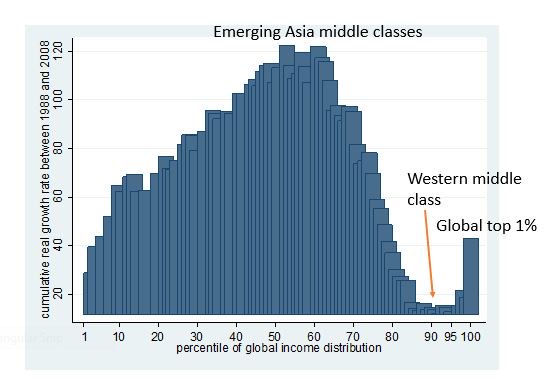
Here is the actual graph of income growth, 1988-2008. Who were the middle class (specifically the 20'th-70'th percentile) making worse off?

https://pbs.twimg.com/media/CUXo2NNUYAASTND.jpg:large

Re:Economics Simulation by msellout on Monday January 25, 2016 @12:35AM (#10965777)
Seems like a wealth transfer from "developed country" workers to "less-developed country" workers and capital owners. The exact dynamics are of course hidden from that chart. The labels on the axes say that the peaks are gaining relative to the valleys in that chart.
Re:Economics Simulation by yummyfajitas on Monday January 25, 2016 @03:37PM (#10969759)
A wealth transfer would cause at least one group to take losses, no? This graph shows growth for everyone.
Re:Economics Simulation by msellout on Monday January 25, 2016 @10:51PM (#10971725)
No. There could be two phenomena occurring simultaneously: growth for everyone and layered on top of that a wealth transfer. The key term you're ignoring in my comment was relative: "peaks are gaining relative to the valleys".

I know you're into finance. Are you familiar with the concept of a long-short hedge fund? If so, you should be comfortable with the idea of focusing on relative movement of two assets within an asset class, hedging against the absolute movement of the asset class as a whole.

Re:Economics Simulation by yummyfajitas on Monday January 25, 2016 @11:29PM (#10971823)
If you want to declare a delta between some hypothetical distribution and the actual distribution "wealth transfer", have at it. That is certainly irrefutable, albeit mathematically vacuous.
Re:Economics Simulation by msellout on Wednesday February 03, 2016 @01:36AM (#11025069)
Not sure what you're getting at with "delta between some hypothetical... and the actual" but yes, I was describing something irrefutable. You'd asked what the chart meant. I looked at the axes labels and described the shape of the curve.
Re:Economics Simulation by fizixer on Sunday January 24, 2016 @08:53PM (#10965129)
Middle class tends to rise off of the redistribution of rich class's wealth. Like I said, the second part of my original comment. (which is a good thing, so maybe "worse" is not the best word).