But that isn't the entire global warming theory.
There are many feedback effects that occur. Like warming -> melting ice -> water vapor from condensation -> water vapor is a greenhouse gas -> more heat
But there are negative feedback effects too. Like warming -> melting ice -> less reflection of sun -> less heat
So many people are pushing theories with high feedback multiples. Some people are pushing theories with high negative feedback.
Depending on how you model the feedbacks--Climate change can either be a small issue with a degrees or two warming or a mass extinction event with 5 degree C warming.
The problem is it is very hard to test the models.
http://www.bloomberg.com/graphics/2015-whats-warming-the-wor...
The state of CO2: now around 400 ppm, 20 years ago was 350 ppm, and that was already more than during the last 800 thousand years, and now it's increasing unbelievably faster:
http://assets.climatecentral.org/images/uploads/news/11_19_1...
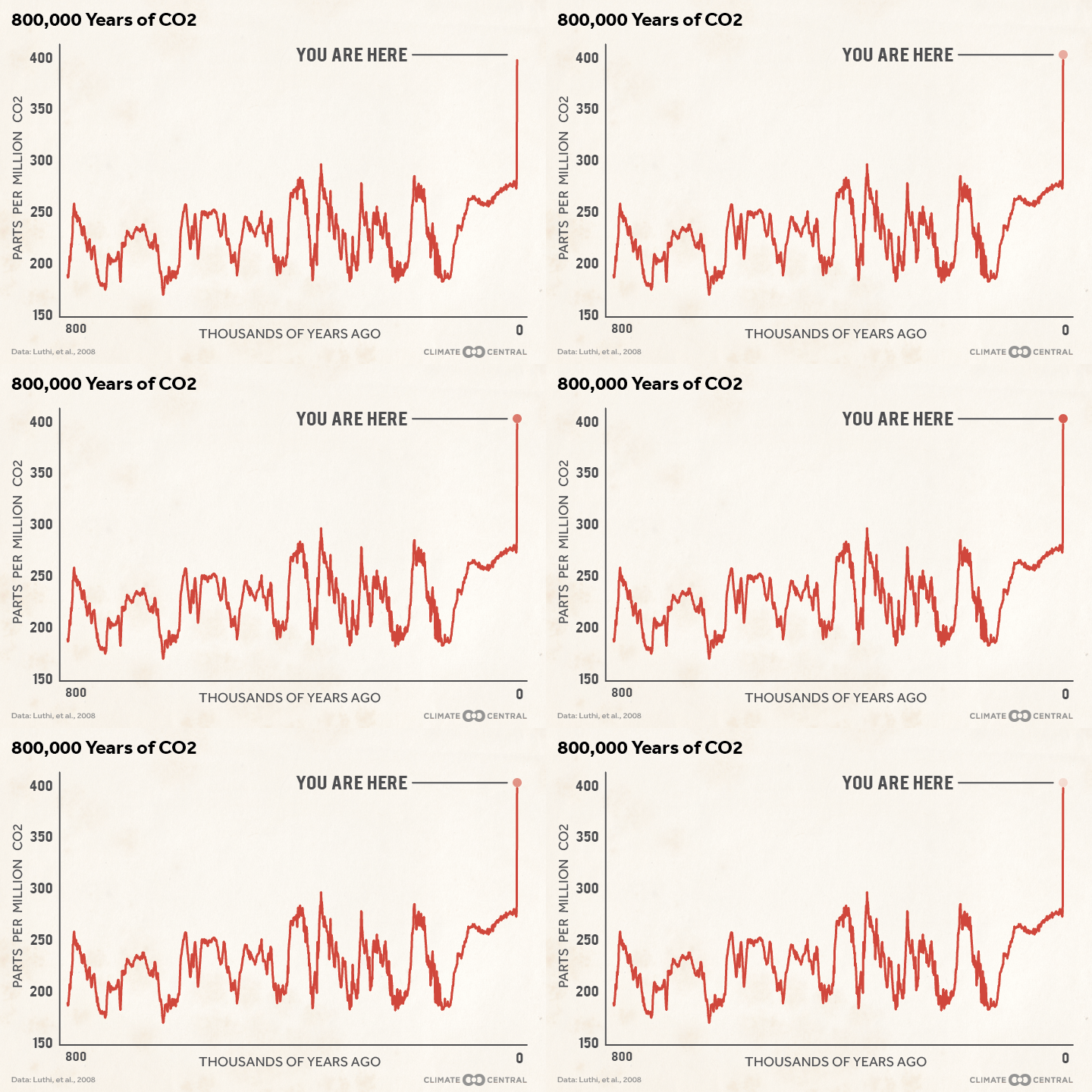
(based on http://cdiac.ornl.gov/trends/co2/ice_core_co2.html )
http://assets.climatecentral.org/images/uploads/news/11_19_1...

As an "engineer" (note: software engineer, not a real engineer), I'd prefer to leave as much wiggle room as we can possibly muster on the spectrum of activities heading us towards "mass extinction event".
The most believable negative feedback I have seen is about increased cloud coverage. Clouds should then reflect visible light back to space. At the same time water vapor is the most significant greenhouse gas in the atmosphere. We really don't know how it's going to turn out.
CO2 in the atmosphere--what's historically known as the greenhouse effect--leads to earth's warming. CO2 emissions are also undeniably connected to the the greenhouse effect, which we clearly have a role to play in. That's science that no one disputes.
But somehow people come out of the woodwork as climate change denialists.
It doesn't really make sense unless seen through a political lens, since politics is antithetical to science in a lot of ways.