I doubt very much of the cost-of-living delta between a city and a suburb or the country has to do with advertising.
Walk me through the causal process here. Does it go something like...
Landlords want more money so they devise a massive marketing campaign, including a complete cultural narrative, TV series, movies, and even gasp whole companies created out of thin air.
They infiltrate media outlets to con dreamers into coming to their city, and expect to charge them 10x more than they used to pay in rent. They have to, after all, to cover the costs of the largest ad campaign ever created in the universe.
And it's a massive success! It just worked. Whoa.
Or... Maybe that's just not very realistic.
Maybe your rent is high because you live in a city with a flourishing job market for highly qualified and highly paid workers who came there to find new jobs, and whose real estate market has a chronically low supply of housing due to various cultural or regulatory reasons.
Not to mention, advertising often has been used to create markets out of thin air:
http://www.theatlantic.com/past/issues/82feb/8202diamond1.ht...
How advertising causes high rents in San Francisco?
Be my guest.
While consumer culture certainly includes sales, it's also about deeper things such as associating your identity and self esteem with consumption, the way those ideas intertwine with culture, the psychological structures through which those ideas are mediated, and the way it all congeals into a way of life.
There's just so much information available to us now through the internet/TV/radio that it has really become exhausting to conduct the necessary critical analysis to defend against malicious ads. Who is funding this advertisement and why - how does the value flow back into their pocket at the end of the day? If the ad industry keeps the firehose on, we get tired of asking these questions, and some ads will inevitably get through our mental defenses.
Sometimes biased/misleading ads are pretty easy to spot, such as in most Tech Crunch/VentureBeat articles where the product or service that is being "objectively reviewed" or covered on a seeming whim is clearly sponsored content. In some other cases its much harder...PG's 2005 essay "The Submarine" [1] is a great read and continues to gain relevance 10 years later. PR/ad agencies manufacture what is hot and trending, and it's usually incredibly hard to determine how or why.
So I've engaged two different strategies to help deal with malicious and/or deeply submerged ads:
(1) Disconnecting from many social media sites that serve as media/info aggregators. Facebook, snapchat, and instagram all had to go. I stay on HN because I find the community to be a bit more ad conscious and averse, but it always pays to remember that HN is both a great tool for discussion and a marketing tool for YC.
(2) Engaging friends and family heavily before making any sort of major "upgrade" decision. Perhaps your friends in said city would have had some interesting advice to share with you about your move had you asked for their frank and honest opinions beforehand.
One negative side effect of the constant barrage of ads/info is a certain critical, skeptical, and frankly negative mindset that has become SOP when digesting any new information. It's really a problem of trust at the end of the day, which is the fabric of any healthy and productive unit, whether that be a relationship, a family, or a society. It's not a new problem, but I feel like it's a hard and important one that has increased in difficulty with the rise of the internet.
Because that's what it's doing. Selling a particular lifestyle.
One kind is an appeal to the person in some general fashion. The usual forms apply. There isn't much of a value add, beyond the appeal. "Ours is 2x better", or "You will feel GREAT!", etc...
The other kind is a value add, in that something of value is given in return for a bit of mindshare or implied consideration. This is HN, and a lot of other content marketing type approaches. Some use forums for discussion, others blogs, still others white papers, and or maybe things like apps, or data one can make use of.
In my own personal thoughts, I refer to this as, "give 'em a cookie. Who doesn't like a free cookie?" And when they take the cookie, they will often give you that little bit of consideration, or a contact address, opinion, something.
Musicians do this by dropping free to play and sometimes free to download tracks. "Here's your cookie, I'm selling more in the store."
I'm generally OK with value added type advertising. I like my free cookie, same as most people. The non-value added ADS are often trading on shock value, or their ability to interrupt you, or some other inane thing. Noise.
Figured the crowd here would sort it easy enough.
For me personally, I tend to map things to simple concepts in that way. Makes a lot of stuff easier, and it often highlights the common where it might not be obvious too. Just FYI.
Preposterous.
And yes, it is very powerful. It can change the values of an entire society.
Believe me, I agree with the idea of shedding useless stuff before a move. Which we have. But you tend to accumulate needed stuff with a family in tow. Also, keep in mind that the amount of money involved isn't just for moving physical items.
There's distance as well. I've moved across the entirety of the United States twice, mostly for jobs. Although it was a bit of adventurous thinking because we liked the idea of such a huge change.
I regret nothing.
That does change things a bit.
Like I said, often there are some good reasons sometimes many good reasons. But as a stereotype, in the US people will have lots of material possessions, most of which are crap.
I know the comfort of having your own things that have been with you throughout the years, and everything is exactly how you're used to them. I do miss the feeling, and will eventually settle down somewhere, or at least settle down my "things" somewhere.
I still couldn't resist pointing out that being geographically mobile is a viable option, even if it does require some effort, planning and certain trade-offs.
And it isn't totally binary, it's a scale from "living out of one luggage-sized suitcase" six flags -style, through being able to pack up and leave on a week's notice, to having planned a lifestyle around moving every couple of years, to having deep roots etc..
I'm sceptical of that. I grew up pre internet and much information on stuff to buy came from TV ads, magazines financed by advertising and the like. Now I've basically stopped watching TV and reading those, read non commercial stuff like HN and when I want to buy toys check out the review sites to see which product is best, not which has the sexiest ads. Here's a graph showing ad spend tailing off http://www.digitaltonto.com/wp-content/uploads/2011/11/Ad-sp...
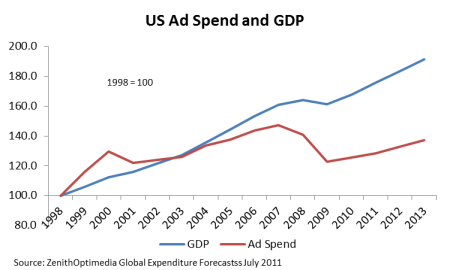
(from http://www.digitaltonto.com/2011/how-digital-leakage-is-rede...)
You wanted "access to a wider range of consumer goods and services" you got that access. Now that you want to save money instead means that you just changed your mind... again.
Advertising is not about selling individual products - It's about selling a lifestyle. Any media which encourages you to 'upgrade' your lifestyle should be considered advertising.
I myself have fallen victim to advertising. I used to live in a big-ish town where the cost of living was low. Advertising (in my case; the promise of a higher salary and access to a wider range of consumer goods and services) convinced me to move to a bigger city where the cost of living is ridiculously high.
So I am working harder and longer, I am able to save less money and I have a lower standard of living overall (in spite of a higher salary).
This lifestyle was advertised to me and I bought it. Much of the value I lost (in terms of quality of life) went into the pockets of advertisers (in the form of cash).