All of the premium non-hurricane, non-forest land, is taken already by rich people. Isn't it subsidising rich people if we allow them to live on the best land, while others contributing to society elsewhere observe no benefit?
It is interesting that some of the poorest, white-trash areas of the country are the safest. At least in Maine, the only natural disaster I can remember is the ice storm of 98, which, aside from knocking out power for a week, mostly amounted to an extra week of school vacation that winter.
I guess if you ignore the entire midwest?
Almost every region comes with its own set of possible natural disasters. Maybe we are better off pooling everything and just have natural disaster insurance that covers fire, flood, tornado, hurricane, earthquake, blizzard, and so on.
I'm not saying home insurance needs to be the same cost for everyone, but the current situation of specialized policies that vary house to house in each region is overly complex. Plus climate change is changing the risk profile for everyone and the results of which are not yet clearly understood by climate scientists let alone random homeowners.
I actually think it's not complex enough. How else do you accurately price natural disasters into existing homes, whose ownership is often measured in decades? I think any area with a chance over a certain percent of a natural disaster that could cause catastrophic loss of property should require insurance, and the insurance cost should be as accurate as possible to the reality of living in that location.
10. southeast michigan*
9. denver colorado
8. chicago illinois*
7. allentown pennsylvania* (actually east, not midwest)
6. dayton ohio*
5. bethesda maryland
4. buffalo new york
3. akron ohio*
2. cleveland ohio*
1. syracuse new york
Hmm, maybe you're thinking of the central US? also known as 'tornado alley'?
The definition of various 'areas' of the US are ill defined, but its clear, at least from my experience living in the midwest and having never experienced a single disaster in the 25 years I've been here, that the midwest is definitely the safest from natural disasters.
It is also worth noting that almost all of the cities listed are heavily impacted by snow which it doesn't sound like it was factored in to the ranking. Dealing with large snowfalls have a huge costs although it might not be factored in to normal home insurance since there is generally minimal property damage. It might be interesting to see a cost comparison between dealing with large snowfalls and other less frequent but more damaging weather phenomena like hurricanes or tornadoes.
Finally, Ohio certainly sees less tornadoes than most of the midwest, but it still receives a lot compared to the western US. Here is a nice visual summary of recorded tornadoes [1]. This one [2] is of especial interest and shows all tornadoes that have caused $50+ million in damage which would be important when talking about insurance. Tornado alley certainly gets more tornadoes, but Ohio is right up with them in terms of damage mainly due to the comparative development of the various areas.
[1] - http://uxblog.idvsolutions.com/2012/07/interactive-tornado-t...
[2] - http://1.bp.blogspot.com/-HlfovbQeMvg/UBFIgq0rAPI/AAAAAAAABP...
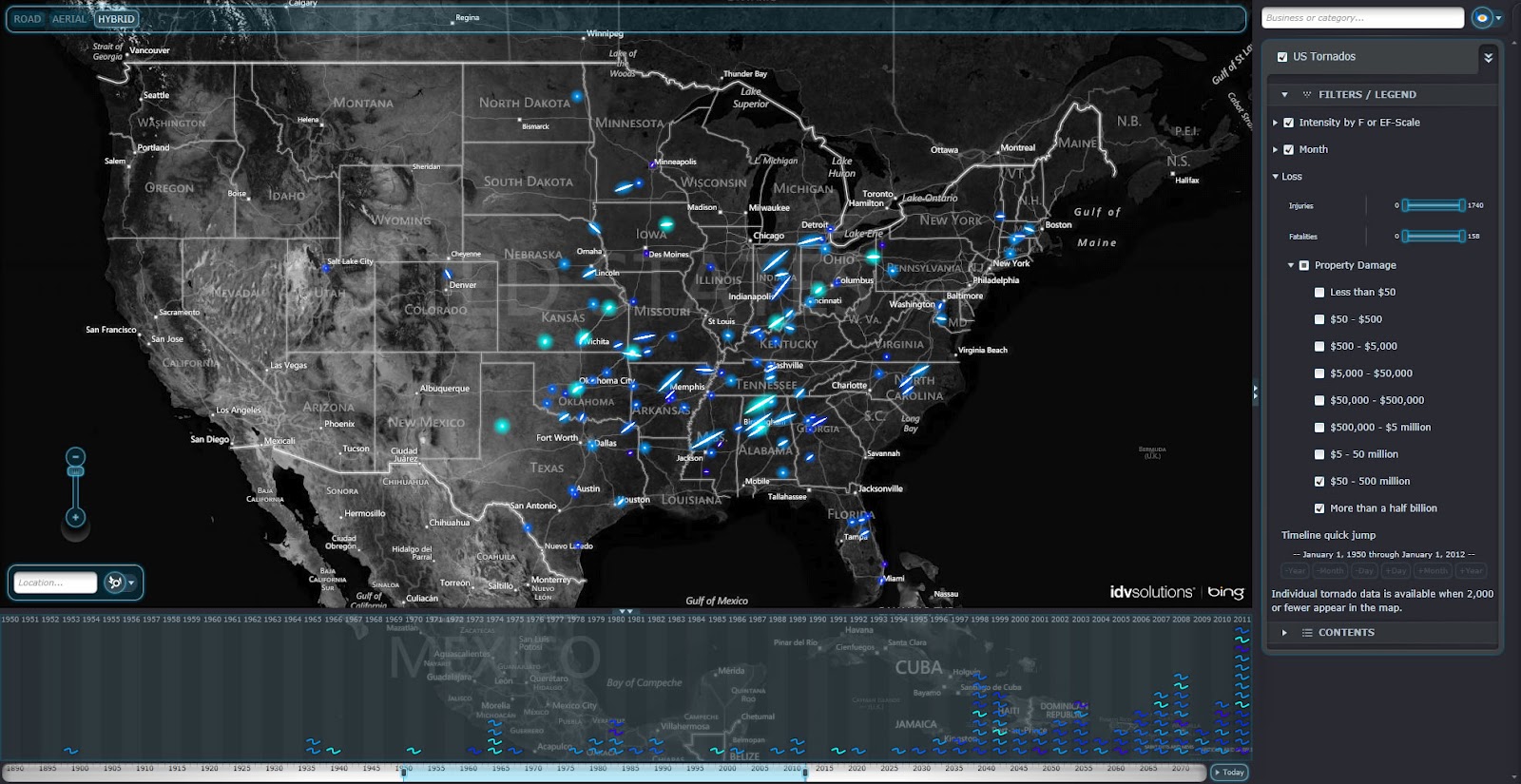
As for ohio, I count 6 tornados on there, maybe 7? (i might be reading it wrong)
since 1950?
I'd say thats pretty low risk.
How many earthquakes have we had in that time?
How many hurricanes have caused billions of damage in that time? Floods/draught/etc
> which it doesn't sound like it was factored in to the ranking.
I dont think it was, it was ranked by natural disasters - so unless its a major blizzard it probably wouldnt be measured. (oh they probably didn't include hail either, which is uncommon, but more damaging to property)
I also dont think snow is on the same level as a natural disaster from an insurance risk perspective, but it likely results in greater or at least similar fatalities overall so i think its a fair point.
I'm not arguing the midwest is immune to all danger, i'm only saying living there puts you at lower risk of being affected by a natural disaster - /and/ - that the land there isn't already owned by 'rich people' (to take us back to why i commented in the first place)
Also - i wish that tornado map was interactive, would be great to see more of the filters
Doing the math, it's pretty easy to guess that all that midwestern land is probably owned by "rich people", too.
I put that in scare quotes because there is some element of circularity involved. If you own 120 acres of cornfields, you have over $500k worth of property. So do you own the land because you're rich, or are you rich because you own the land?
Now do that math with land values in Detroit.
I think its well accepted that land values are generally quite higher on both coasts than the midwest. Agricultural land values are not very useful for estimating the cost of residential land
Edit:removed some snark
Ted Turner didn't get to own 2M acres of land by buying in Atlanta. Much of that is bison ranches.
There are a lot of people out there that own no more than 0.25 acre, which is pledged as security for a mortgage.
If you own land outright, free of liens and mortgages, whether rural or urban or in between, you're already way ahead of most people. You may not be actual rich, but "rich" by comparison with your neighbors.
Peering under the covers of agribusiness in the U.S. was somewhat enlightening. It would appear that one should not attempt a farming start-up without at least $1M in the bank, and you will only get about an 8% return on it per year, on average. Small farms simply do not make money; you cannot run a small farm as your sole source of income and expect to earn the equivalent of minimum wage.
So the natural conclusion I reached from my cursory research is that the vast majority of raw acreage in the U.S. is probably owned by investment trusts, who lease it for farming, mining, ranching, and logging, to people who barely earn a profit, and mostly just immediately spend 70% of everything they earn on expenses.
There's a good reason why YCombinator invests in tech start-ups instead of plows and cows.
[0] http://bigthink.com/strange-maps/291-federal-lands-in-the-us