The biggest issue for most people is not that they don't know the difference between healthy and unhealthy foods. The problem is to eat the healty foods and stay away from the unhealty ones, which is quite a challenge.
It's hard to make healthy food choices when your food budget allows for 1 day of nutritionally complete meals or 1 week of macaroni and cheese.
I somewhat disagree. It may be "obvious" to well-informed HN readers. However, I don't think food nutrition is obvious to a significant portion of the population. Proof of this is how the food industry advertises and labels their products to take advantage of buyers' ignorance:
-- orange juice with labels saying that it's "fortified with extra vitamins and calcium". (Many people will associate oj with positive connotations of "fruit", and the vitamin supplement is a bonus. Result: unsophisticated buyers think of oj as "healthy" when it's really concentrated sugar water that will contribute to obesity and tooth decay.)
-- lean cuisine "low-fat" microwave dinners with a "heart healthy" icon on the box. (Naive buyers see the "low fat" as a signal for "healthy" but don't realize that manufacturers have to amplify the taste by adding lots of salt. The heavy carbs in those meals are also controversial.)
-- granola bars and "energy" bars. (The packaging has pictures of active hikers, bicycle riders, mountain climbers, etc. Some granola bars even prominently feature "fiber" as a benefit. The ignorant don't realize that these snacks are really glorified "candy bars" with clever marketing to lessen the guilt trip of eating a stick of sugar.)
-- fat free yogurt. (They took out the fat but now the yogurt has lots of sugar, which is another form of calories, which most people won't burn off, which then gets stored as fat anyway.)
-- photographs of celebrities with milk mustaches shown on billboards and magazine ads and associated slogans like "milk does a body good!". (Those ads are promoted by the dairy industry and it's questionable whether it's healthy for adults to drink milk.)
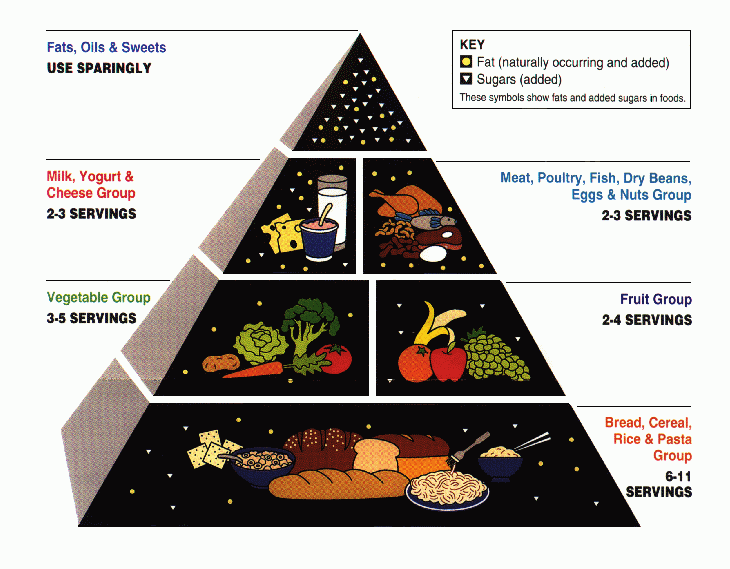
-- USDA food pyramid. (The uneducated don't realize that the USDA (and hence the chart) is influenced and manipulated by the meat & dairy industries. Because the nutrition advice is officially published by the government and plastered all over school walls, it feels authoritative. Naive consumers don't realize that if the food pyramid was designed by nutritionists not financially linked to meat & dairy, they would place vegetables as highest priority.)
For the consumers that get exposed to nutrition information in a passive way, they really don't know the difference between healthy and unhealthy foods. There's so much misinformation and manipulation that the American consumer is less knowledgeable about what's healthy than the African bushmen eating wild berries and hunting antelope.
Proving your point that this is non-obvious even further, high salt intake may not actually be as harmful as common knowledge suggests:
http://www.washingtonpost.com/news/wonkblog/wp/2015/04/06/mo...
http://www.scientificamerican.com/article/its-time-to-end-th...
Not enough salt is killing more people than too much salt iirc
Huh? Neither of the food pyramid[0] or its replacement[1] have meat and dairy as highest priority.
Edit: The pyramid that came in between[3] does have milk at a similar size to vegetables, is this the one you take issue with?
[0]: https://upload.wikimedia.org/wikipedia/commons/6/6d/USDA_Foo...
[1]: http://static01.nyt.com/images/2011/06/03/business/03pyramid...

[3]: https://upload.wikimedia.org/wikipedia/commons/thumb/e/eb/My...

I'm approximately 81% sure that such marketing is targeted at children and/or their parents.
> granola bars and "energy" bars. (The packaging has pictures of active hikers, bicycle riders, mountain climbers, etc. Some granola bars even prominently feature "fiber" as a benefit. The ignorant don't realize that these snacks are really glorified "candy bars" with clever marketing to lessen the guilt trip of eating a stick of sugar.)
This isn't universally true; there are quite a few brands (like Premier Protein) that specifically advertise low sugar and fat content.
> USDA food pyramid. (The uneducated don't realize that the USDA (and hence the chart) is influenced and manipulated by the meat & dairy industries.
And yet still prioritizes grains, fruits, and vegetables well before meat and dairy (at least until 2005, but my brain still refuses to comprehend the new "MyPyramid" as the One True Food Pyramid, seeing as it completely misses the fucking point of a food pyramid, but whatever). Not that it really matters that much, seeing as how the USDA has (as of 2011) migrated over to the whole "MyPlate" concept, which emphasizes "proteins" instead of meat specifically (and while it does emphasize dairy - with the implication that said dairy is meant to come from a glass of milk - I'd argue that the target audience has generally been children, not adults).
> lean cuisine "low-fat" microwave dinners with a "heart healthy" icon on the box. (Naive buyers see the "low fat" as a signal for "healthy" but don't realize that manufacturers have to amplify the taste by adding lots of salt. The heavy carbs in those meals are also controversial.)
Plenty of "diet" microwave dinners, including those from Lean Cuisine, prominently display low-carb advertising claims. Of course, they tend to swing back to high-fat, but so do most decisions involving the balance of carbohydrates, lipids, and protein.
Also, advocates of the paleo tend to think butter is pretty healthy.
But it doesn't matter, because you can find all kinds of studies that alcohol, chocolate, etc. is healthy. Amount of salt, eggs etc... those are basically all up for discussion. What I'm saying is that for the most part of your diet, it's pretty obvious what's healthy or not.
In my case I've never noticed any issues from dairy products so butter, yogurt, cheese, and milk get some place in my diet.
If there are health benefits to alcohol (and there may well be), I'm sure that adding rum to your coke won't suddenly make the drink healthy.
There is even some evidence that indicates that not only is pasture-fed butter better than trough-fed butter, but that regularly rotating the herd to a different pasture every N days is even better. But when the press talks about butter, all butter is the same.
And let's not get started on alcohol... I believe that the current story is that somewhat less than one normalized drink per day is now healthy, and that it does not even have to be red wine.
Do your vegetables have too much oxalic acid, biological contaminants, or residual farming chemicals? Is your fish farmed, or wild-caught (using slave labor)? Is this meat processed just a little bit, or so much that it is now unhealthy? Is this "pink slime" stuff okay, or not? Is this tomato bred for flavor and nutrition, or for uniformity, ease of processing, and visual appeal?
So it's not obvious. It is, in some cases, intentionally obfuscated, to protect business interests.
Most people do have a vague idea of what is healthy, and what is not. But they have no clue when it comes to subspecies, sources, processing, transport, preservation, and preparation.
I know that spinach is a supposedly healthy food. But I have no idea whether there is any significant difference between canned spinach, block-frozen spinach, or bagged fresh spinach. I don't know on an instinctual level whether it is better to sautee it in butter or to bake it in a pastry with feta cheese. I'm not sure where it comes from, or if it is a different variety than spinach grown from seed. Sure, the unhealthiest serving of spinach is probably going to be better than the healthiest serving of gummi bears, but I don't typically eat just one thing when I eat. That spinach might come with a sandwich attached to it, or salad dressing, or barbecued pork, or feta and phyllo.
So it's not always spinach versus gummi bears. Sometimes it's gyros with spanakopita versus pulled pork sandwich with side of greens. I literally have no idea which of those two lunches is healthier, or even if the same lunch plate from different restaurants will have a similar healthiness profile.
The only way I could possibly keep track would be to have a digital assistant that is able to automatically evaluate everything I might put in my mouth and give a recommendation for a healthier alternative that isn't so far from whatever it is that I want to eat that I will ignore it. If I want a burrito from Taco Bell, I might need a recommendation for a burrito from Los Cocineros Hermanos, rather than the good karma salad from Hippietown Vegan Lunchery.
Lots of things are highly non-obvious. Vitamins weren't discovered until the 20th century. Many baby's lives are improved by their mothers taking folic acid. I would never guess how few calories there are in things like raspberries or strawberries without having been told about it.
Certainly there is lots of terrible health advice, and it's a major issue, telling people to "only read good advice" seems like the worst advice I've ever heard -- obviously we would all only read the good advice if we knew what that was!