vbilopav
PostgreSQL REST API from SQL Scripts
Re:SQG (SQL to Code Generator) Now with Java Streams and List Type Sup...
on Monday March 09, 2026 @02:51AM (#47305581)
This was my first approach in realizing my PostgreSQL-centric, Db-first, or rather SQL-first vision of software development.
The project was call pgroutiner and it generated bunch of C# code for me out of PostgreSQL.
After doing couple of projects with it, I realized it wasn't enough. The new approach is a dynamic HTTTP REST API generation but, with plugin for code generation of frontend files (Typescript,. Javascript, HTTP files). This iw way better approach. Look it up, it's called npgsqlrest.github.io
Show HN: End-to-End Static Type Checking: PostgreSQL to TypeScript
PostgreSQL REST API Benchmark: 15 Frameworks Compared
Show HN: NpgsqlRest Automatic PostgreSQL Web Server
Re:Moving tables across PostgreSQL instances
on Thursday November 06, 2025 @01:44AM (#45832210)
Why not Foreign Data Wrappers?
Re:Ask HN: What Are You Working On? (October 2025)
on Monday October 13, 2025 @12:52AM (#45564779)
NpgsqlRest
Automatic PostgreSQL Web Server
Create REST APIs for PostgreSQL databases in minutes.
- one man project (me) - been doing it well over a year now - no sponsorship, no investors, no backers, no nothing just my passion - I haven't even advertised much, this may first ir second time I'm sharing a link - On a weekdays im building a serious stuff with it - On weekends preparing a new major version with lessons learned from doing a real project with it
Not going to stop. But I migh be seeking sponsors in future, not sure how that will turn out. If not that's ok, I'm cool to be only user.
Re:Moving off of TypeScript, 2.5M lines of code
on Thursday September 18, 2025 @01:07AM (#45285645)
It looks to me team is clueless about database development.
Typescript ORMz lol.
Soft deletes make indexing, well, problmatic to say at least. Use temporal tabls instead for point in time recovery. Nevertheless it could have been solved on a database level without any help from ORMs, lookup RLS. Still, screws up indexing strategy.
Re:SQL Needed Structure
on Thursday September 11, 2025 @05:00AM (#45209370)
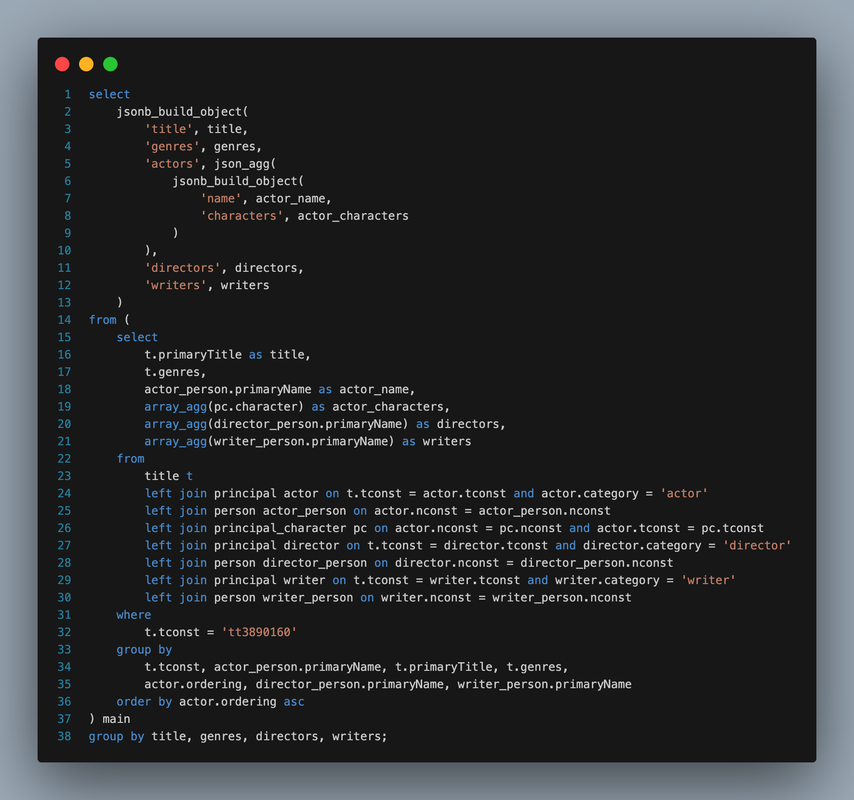
What an awful query example! This should and is simple. Here:
select jsonb_build_object( 'title', title, 'genres', genres, 'actors', json_agg( jsonb_build_object( 'name', actor_name, 'characters', actor_characters ) ), 'directors', directors, 'writers', writers ) from ( select t.primaryTitle as title, t.genres, actor_person.primaryName as actor_name, array_agg(pc.character) as actor_characters, array_agg(director_person.primaryName) as directors, array_agg(writer_person.primaryName) as writers from title t left join principal actor on t.tconst = actor.tconst and actor.category = 'actor' left join person actor_person on actor.nconst = actor_person.nconst left join principal_character pc on actor.nconst = pc.nconst and actor.tconst = pc.tconst left join principal director on t.tconst = director.tconst and director.category = 'director' left join person director_person on director.nconst = director_person.nconst left join principal writer on t.tconst = writer.tconst and writer.category = 'writer' left join person writer_person on writer.nconst = writer_person.nconst where t.tconst = 'tt3890160' group by t.tconst, actor_person.primaryName, t.primaryTitle, t.genres, actor.ordering, director_person.primaryName, writer_person.primaryName order by actor.ordering asc ) main group by title, genres, directors, writers;
Re:Bypass PostgreSQL catalog overhead with direct partition hash calcu...
on Thursday August 28, 2025 @12:32AM (#45048395)
I did some testing on PostgreSQL 17 and found out that this special function 8s not needed.
Re:EventQL: A Query Language for Events
on Monday May 12, 2025 @02:42AM (#43960242)
why does it look like SQL?
I Always Use PostgreSQL Functions for Everything
Automatic Temporal Tables Schema Management with PostgreSQL
Re:Soft Deletes with Ecto and PostgreSQL
on Saturday August 17, 2024 @03:09AM (#41272558)
It's already built into code to check does trigger exists, check it out.
As far as changes(alter table ) goes, I need to take history tables into consideration when writing migration scripts. Since I'm doing my migrations always with SQL scripts that not an issue.
However, there's a concept of system event triggers in PostgreSQL that can intercept alter table statements, so I'm thinking to expand my solution to alter history tables automatically. Check it out: https://www.postgresql.org/docs/current/event-triggers.html
Re:Soft Deletes with Ecto and PostgreSQL
on Saturday August 17, 2024 @01:53AM (#41272366)
Please don't do this. It's a design/ architectural sin. It messes up your queries, commands and indexes and it's constant source of trouble.
Here's a better way: https://medium.com/@vbilopav/custom-temporal-tables-in-postg...
Re:Most of Europe is glowing pink under the aurora
on Sunday May 12, 2024 @11:33AM (#40335258)
I thought it was because of Eurovision
Re:The API database architecture – Stop writing HTTP-GET endpoints
on Saturday May 11, 2024 @02:19AM (#40326365)
Here's an alternative I've built for myself
https://github.com/vb-consulting/NpgsqlRest
Re:Svelte 5 release candidate (RC)
on Wednesday May 01, 2024 @02:08AM (#40220065)
I'll just keep on using Svelte 4
Automatic REST API from PostgreSQL Databases, Implemented as .NET8 Middleware
How DDD is screwing up your SQL
NpgsqlRest
Pg_schema_tools
Re:I Hate NestJS
on Wednesday October 25, 2023 @01:54AM (#38009582)
He hates TypeORM but loves Prisma and Prisma can't even do joins, it's doing N+1 by default and always.
What does TypeORM do then?
Re:Versioning data in Postgres? Testing a Git like approach
on Saturday October 21, 2023 @01:22AM (#37964309)
Just use temporal tables
https://github.com/vb-consulting/blog/discussions/7
Re:Empathy in open source: be gentle with each other
on Thursday September 28, 2023 @12:41AM (#37685307)
I wonder how our ancestors ever managed to do anything let alone build a world we live in without having someone to teach them empathy.
It's ridiculous.
We have a pandemic of narcissism thanks to social media and when they see this they go, great I can use that thing called empathy to get what I want.
On other hand I know people who have too much empathy living in constant depression, because, you know, there's suffering in the world. Somewhere.
Re:Recursive Hierarchical Queries in SQL: A Deep Dive into Employee Level
on Wednesday September 20, 2023 @02:22AM (#37581000)
Re:Recursion with PostgreSQL, Follup 1, Perfomances
on Sunday September 17, 2023 @09:43AM (#37544988)
I wrote a follow-up on yesterday's article on tree processing and recursion with PostgreSQL. This one: https://github.com/vb-consulting/blog/discussions/1
SQL was never intended for this kind of stuff; I'm sure that Fabian Pascal will tell us all about it.
And indeed, recursive CTEs are awful, confusing, and severely limited ... but they look cool and smart, and smart people use them (I hate them).
In any case, I used a procedural approach to this problem and, with a few smart optimizations, managed to squeeze some really spectacular performances (757K tree records with 20K unique nodes in just 5 seconds without any indexes, so it probably can go even faster).
Recursion with PostgreSQL, Follup 1, Perfomances
Re:A Different Type of SQL Recursion with PostgreSQL
on Sunday September 17, 2023 @09:31AM (#37544880)
A follow up on this article was written today
[Recursion with PostgreSQL, Follup 1, Perfomances](https://github.com/vb-consulting/blog/discussions/4)
I managed to get some really good perfomances (757K records in 5 seconds).
Also, method 1 contained a nasty bug :(
That's why next time I'll try to focus on debugging and testing.