tannercollin
Re:Show HN: Mutable.ai Codebase chat that uses a Wiki for RAG
on Monday July 15, 2024 @11:57PM (#40973562)
This is really impressive! Would you mind running it on:
https://github.com/Protospace/spaceport
This is a member portal for my local makerspace. Having a knowledge base will help other makerspace members contribute to the code.
Re:Connecting a 1980s Pinball Machine to the Internet
on Wednesday February 22, 2023 @03:15PM (#34901956)
Yes, it should. As long as you can figure out the correct memory addresses to look at, you can tell the ATmega to send you the data.
Re:Connecting a 1980s Pinball Machine to the Internet
on Wednesday February 22, 2023 @02:27PM (#34901254)
Amazing, we are currently doing something very similar at our makerspace on a 1987 Road Kings pinball machine.
We first replaced the original RAM chip with a IDT 7132 SA100P dual-port RAM that sits on a breadboard:
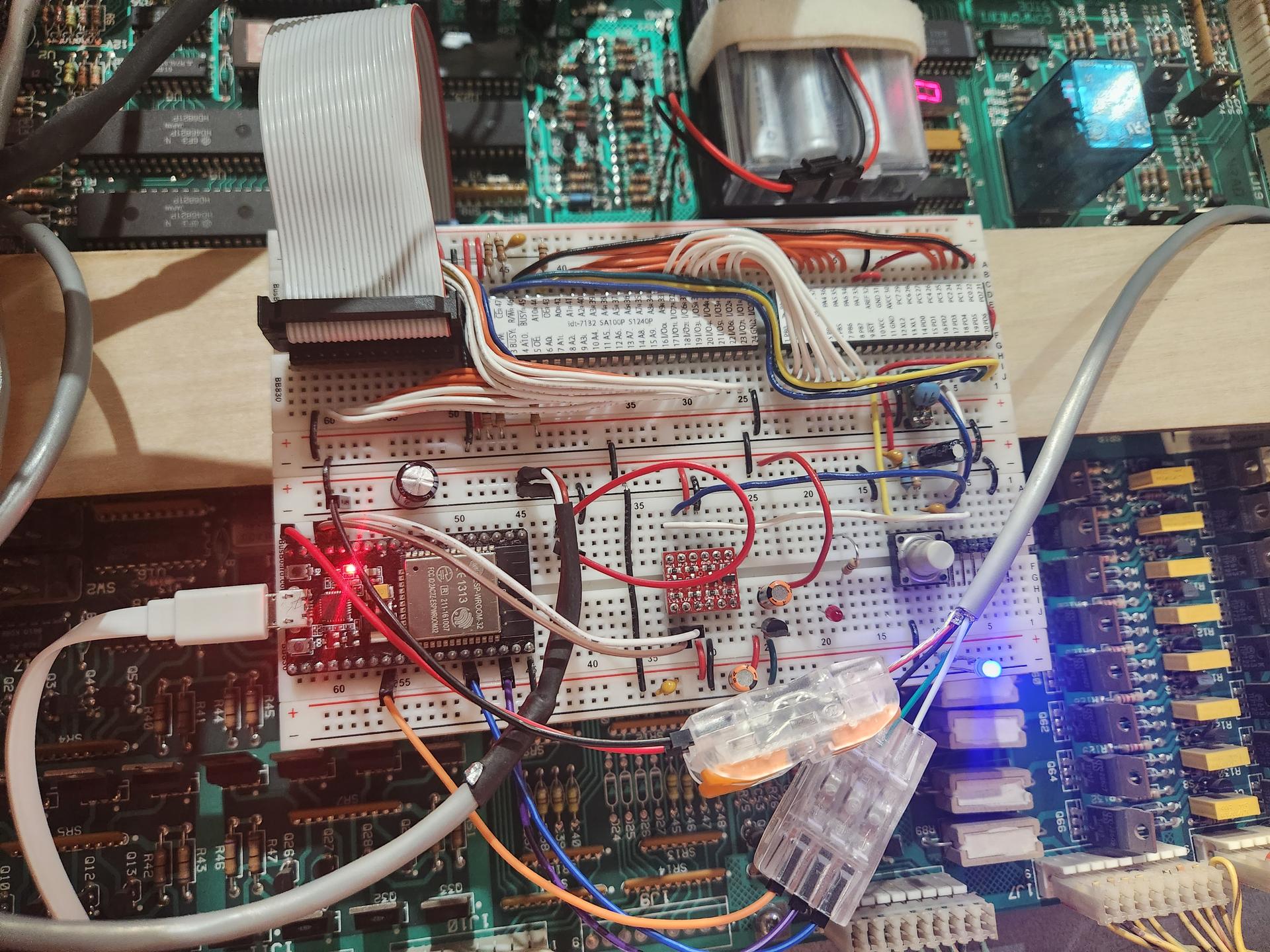
The other port is accessed by an ATmega 1284 to the left of it. Its code responds to simple serial commands and can read and write to the RAM.
An ESP32 talks to the ATmega over UART and frequently asks it to dump 16 bytes at 0x00A0 to tell the game state and player number, and 0x0100 to get the four player scores. When it detects a new game, it offers the player a chance to scan their RFID member card and keeps track of their score:
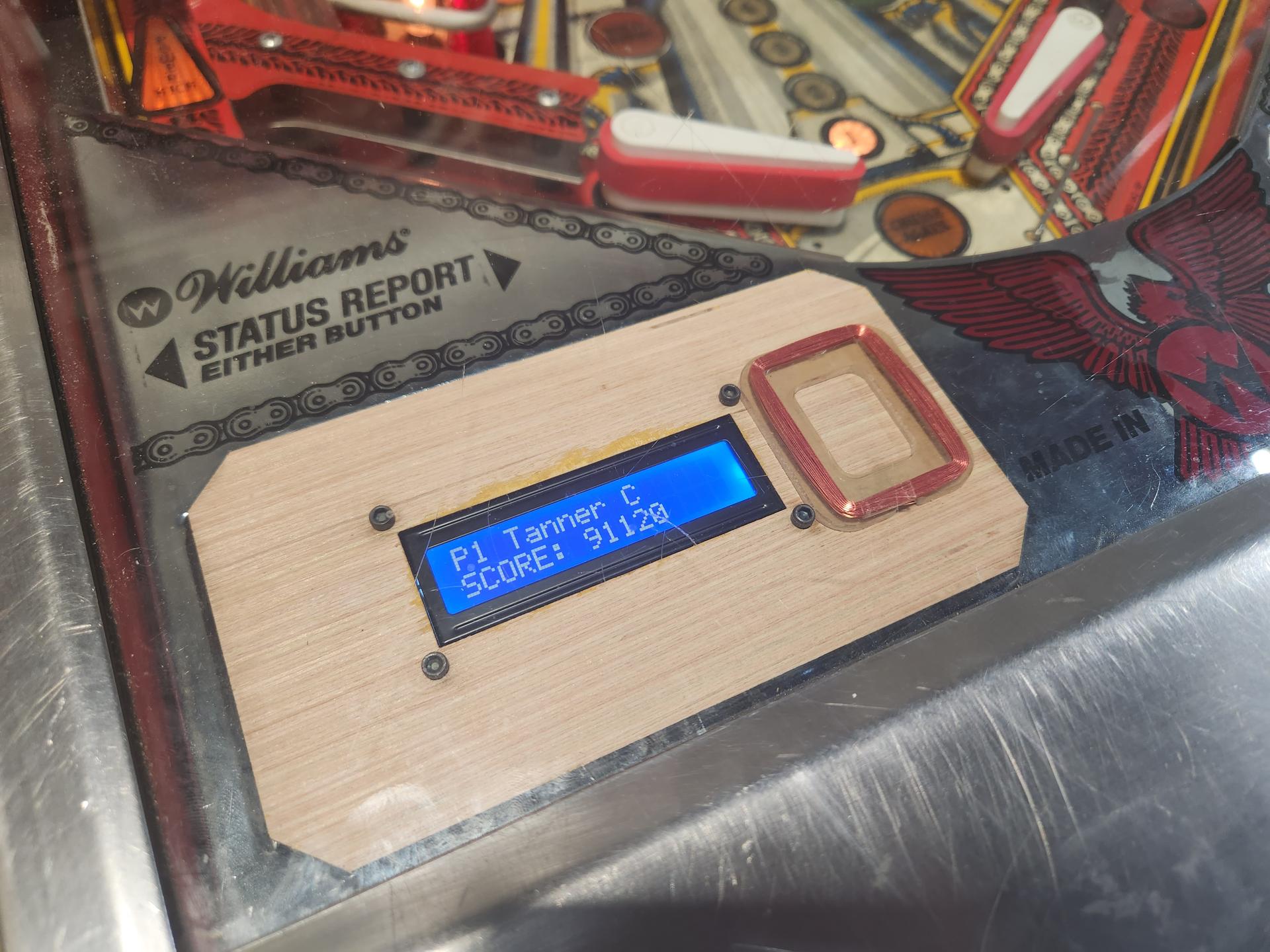
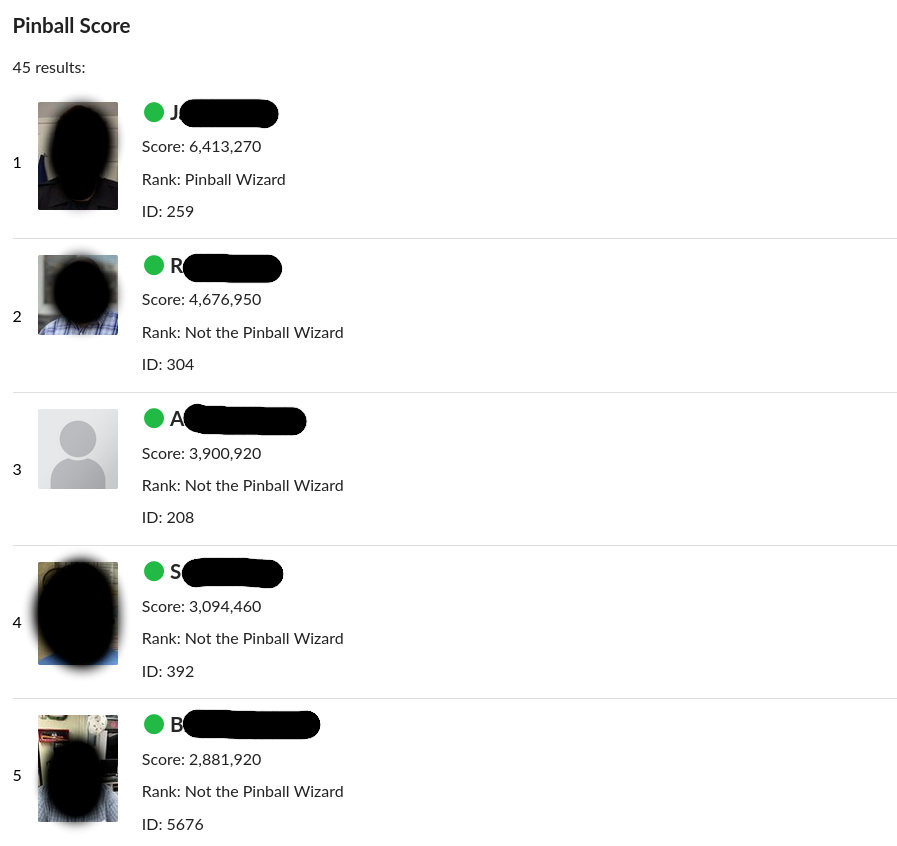
After the game is complete, any players who have scanned in get their scores uploaded to our member portal where we can sort them by personal best:
We found there were sometimes read collisions and the ATmega would block the pinball machine from writing to RAM which would cause crashes or odd behavior. The latest version uses two RAM chips, one acting as a shadow copy -- similar to yours.
Eventually we'll make a PCB for it and open source everything. Currently only half the code (the ESP32) is on Github: https://github.com/Protospace/pinballwizard
Fake Dog for Home Security
Fake Dog for Home Security
Re:Show HN: A tool to send push notifications to your phone, written i...
on Wednesday December 29, 2021 @03:42PM (#29729747)
Here's a good collection of tricks like that:
Re:Show HN: A tool to send push notifications to your phone, written i...
on Wednesday December 29, 2021 @03:41PM (#29729727)
Oh wow, and your pcopy / ppaste combo is a similar set up to my other project, https://reg.t0.vc
I use it like this:
  cat example.txt | push
  pull > example.txt
Re:Show HN: A tool to send push notifications to your phone, written i...
on Wednesday December 29, 2021 @03:56AM (#29723142)
Nice work, Philipp! I wrote something similar at: https://notica.us
I didn't write an app, however. I rely on the browser notification API which doesn't have the best support on mobile unfortunately. It works great on desktop.
My inspiration was the same though. I do most of my work over ssh, and wanted a local desktop notification when a slow command was finished running.
Re:Show HN: Alert yourself after a long-running task in terminal
on Thursday February 25, 2021 @12:58AM (#26260152)
I wrote Notica (https://notica.us) to do something similar. It uses web browser notifications so it works on the servers you are SSH'd into and also to your phone.
Re:Ask HN: What's are your personal automations?
on Friday December 11, 2020 @02:13AM (#25383229)
I wrote https://notica.us to do something similar. It needs a web browser open, but works over SSH and to your phone.
Re:Show HN: Textdb.dev – simple data sharing for fun projects
on Saturday July 25, 2020 @03:53PM (#23951899)
Great work! I wrote something similar at:
It's useful if you set up bash aliases like "push" and "pull" so you can quickly move snippets of text across servers.
Re:Show HN: isEven API – tell if a number is even SaaS
on Monday March 09, 2020 @09:41PM (#22531958)
Beautiful! We'll begin work on this as soon as we finish planetzero's idea, the isBool API.
Re:Show HN: isEven API – tell if a number is even SaaS
on Friday March 06, 2020 @05:12PM (#22507824)
Excellent idea, this will be our first milestone after we raise our seed round!
Re:Show HN: isEven API – tell if a number is even SaaS
on Friday March 06, 2020 @04:33PM (#22507523)
I got tired of seeing programmers struggle to tell if a given number is even, so I built this solution.
You can see an example here: https://github.com/BraydonKains/is-even/blob/master/python.m...
I'll be around for questions!
Show HN: isEven API – tell if a number is even SaaS
Re:How to Take Smart Notes
on Sunday February 16, 2020 @05:35PM (#22344171)
> If anyone has any suggestions in the context of what I’ve posted, I’m all ears.
I wrote this tool for accessing Standard Notes on the command line:
https://github.com/tannercollin/standardnotes-fs
I imagine it would integrate with bash_log quite well.
Back your data up first, and I'm guessing you could just `cd` into your notes folder then use bash_log straight from there. You could also set LOG_DIRECTORY in your .bashrc to be where ever you mount Standard Notes.
Re:Ask HN: How do you share/organize knowledge at work and life?
on Monday October 21, 2019 @05:18AM (#21310462)
I wrote standardnotes-fs, if you'd like to mount your notes as a file system:
Re:Show HN: Morning Cup of Coding – A curated newsletter of programmin...
on Sunday May 06, 2018 @02:33AM (#17005491)
Can I just get a permalink I can bookmark to the latest article?
Re:Cloudflare's new DNS attracting 'gigabits per second' of rubbish
on Friday April 06, 2018 @03:16AM (#16771520)
What's in it for you guys? How do you make money off of 1.1.1.1? Thanks!
Re:To Save Drowning People, Ask “What Would Light Do?”
on Monday January 15, 2018 @04:55PM (#16153784)
That's a misconception. Electricity takes ALL paths in amounts proportional to each path's conductance.
If you have a 1000 Ω path and a 10 Ω path (in parallel), current will go through both paths. However, much more current will go through the 10 Ω path.
The current through each path ends up being the voltage applied across the path, divided by its resistance.
Re:Becoming a Haiku Poet (2003)
on Sunday January 07, 2018 @08:30PM (#16093998)
Here's my attempt after reading the article:
  open the lid
  bits of tissue all over
  my laundy