syl_sau
Re:What's Happening Inside the NIH and NSF
on Wednesday February 05, 2025 @08:32AM (#42948218)
Some people here seem to be upset. I don't get it.
More than 40% of US adults are obese. The rates of chronic diseases are through the roof. There's obviously a systemic problem in these institutions who are tasked with the well-being of the country. We know of many fraud in social sciences (ever heard of priming research?), medical science (eg. alzheimer researchs) and nutritional science (eg. saturated fats). In fact I'd argue it has become systemically untrustworthy. Robert Kennedy Jr vowed for: (a) dedicating 20% of science funding to replication studies, (b) systemic publication of peer reviews alongside papers, (c) publication of null results. Which seems like a very good improvement over what we have now. The field is in dire need of a reform.
Am I missing something?
PS: I am not from the USA.
Re:The Role of Diet on the Gut Microbiome, Mood and Happiness
on Thursday April 27, 2023 @04:41AM (#35725046)
From the last paragraph of the Discussion section, it makes it clear that fat isn't to blame:
> This pilot study examined correlations between diet composition, mental health, mood and happiness, and the gut microbiome to find that fat and protein reduce anxiety and depression while carbohydrates have the opposite effect.
As I'm understanding it, this is funded by the public health institution in the USA. Health institutions all around the world have been especially sensible to the "cholesterol is bad" myth. I guess they kept it politically correct in the Abstract to save face, even though their study says the opposite.
Now it should be noted, as others' have, that it's just a n=22 study.
Full paper available for free here : https://www.ncbi.nlm.nih.gov/pmc/articles/PMC10055576/
Re:The Day Windows Died
on Monday April 03, 2023 @04:01AM (#35420068)
And that was just the install process. Soon you'll start using it and you'll quickly come to despise anything Windows-related.
A good tangent is this absolutely marvelous video put out by the Microsoft Teams people, where they compare the performance of the "classic" version to the brand-new version. A sight to behold: https://www.youtube.com/watch?v=CT7nnXej2K4
Re:I don't read web articles anymore, but I read books
on Monday January 09, 2023 @11:10AM (#34311937)
The good things about books is they compel you to truly engage in an argument, an idea, a conception of the world. You can't opt out easily, and that means you ought to be focused. And that's incredibly important, because quality almost always mean quantity. Not only the amount of knowledge in the average book far surpasses 90% of what's on the web, but more importantly information does not come easy, and never has. If it's easy to digest, you most likely won't remember it, which essentially makes the whole thing a loss of time. Learning takes time and reflection. If you don't do either of these you're just consuming things on a surface level: you're losing the attention war waged against your brain.
Re:Are we on information overload? (2012)
on Wednesday January 04, 2023 @11:21AM (#34247513)
Yes, there's in fact an incentive mismatch here between the creator and the media. But it doesn't mean it wasn't there before to some extent. There are still great resources out there. So how do you spot them?
Information does not come easy, and never has. If it's easy, you most likely won't remember it, which essentially makes the whole thing a loss of time. What I would aim for is focus. This is the big difference I think. If the content is selected for its quality, I'm in. And quality almost always mean quantity. Learning takes time and reflection. If you don't do either of these you're just consuming things on a surface level.
Replace Twitter with internet forums, replace articles with books, instructional videos with real documentaries, etc. All these things call for your full attention, and that is, I believe, the most important. Paradoxically, I've found that the best "content producers" instinctively know this and don't spend much time on YT/social media.
Re:The mid in fake midcentury modern
on Thursday December 08, 2022 @06:20AM (#33906714)
Look at the buildings in this painting: https://fineartamerica.com/featured/view-of-washington-dc-ed... . Do they look exceptionally ugly?
To be fair they look almost exactly like the ones in the "old town" part of the city where I live (just more red and less orange), which is by far the most-visited part of my city (because it's pretty and also walkable).
People take pictures right outside of the places were I live. There are photography events in my neighborhood all the time.
The buildings in the painting sure look more appealing than the brand-new district in my town: https://www.lyon-entreprises.com/wp-content/uploads/confluen...
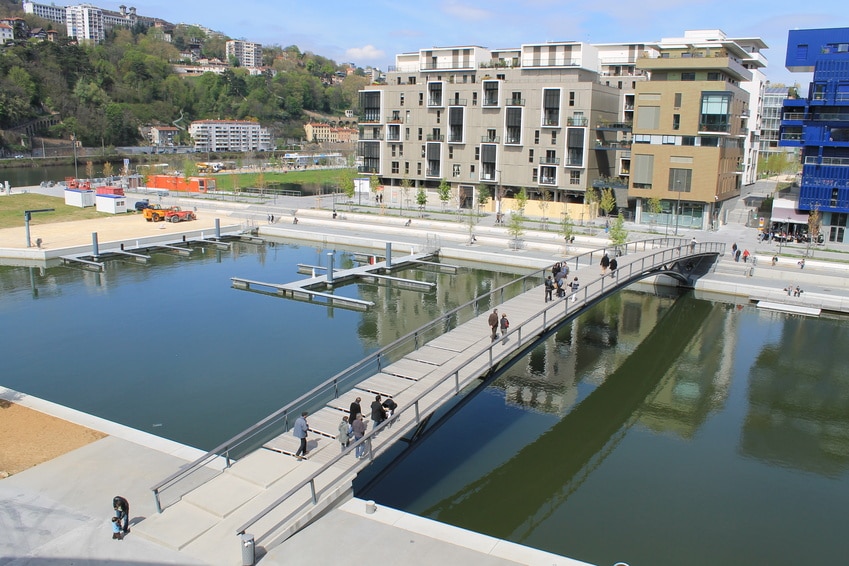
And yes, the past was much more ornate because architecture was a vector of communication -- administrative/state buildings and religious edifices in particular obviously. Which, as a side effect, produced beauty still revered millennia after its creation. So maybe we should ask: what's modern ideology saying? And what does it says aesthetically? The answer is for all to see, and for all to debate.
Re:The mid in fake midcentury modern
on Thursday December 08, 2022 @06:01AM (#33906596)
On the subjectivity of "beauty" in modern architecture:
- if you average the "subjectivity" of most people (in the USA at least), you get "we prefer traditional architecture": https://www.civicart.org/americans-preferred-architecture-fo...
- when you study "composition" in painting or photography, it's obvious that there are some "rules" to make some pictures better than others. Of course there is intent, but there's also this aspect of making things pleasant to look at. Maybe it's the intent of harmony, I don't know. What these rules would be is subject to debate, but it's not unusual to think there aren't natural aesthetics rules in architecture. It ultimately stems from our interaction with the world and the patterns we see in nature. To me this untold magic is best shown in one of the most famous greek sculpture "Laocoon and His Sons". An upside down Chrysler Building would look incredibly off.
On survivorship bias: look at the buildings in this painting: https://fineartamerica.com/featured/view-of-washington-dc-ed... . Do they look exceptionally ugly? To be fair they look almost exactly like the ones in the "old town" part of the city where I live (just more red and less orange), which is the most-visited part of my city (because it's pretty and also walkable).
"It was WWI/WWII" -- Modern art debuted before WWI even happened. Marcel Duchamp's first oeuvre was in 1912, his famous Fountain is from 1917. The fracture didn't happen with WWI/WII even though people keep hammering these points. What started however at the start of the century was the rise of global ideologies: Communism mainly. This is not to say it's communism's fault, it's simply to say that the idea of a bright egalitarian future seem to have coincided with a general renounciation to beauty. And as the brilliant (communist) essayist Lukacz puts it, artistic expressions are reflections of the consciousness of a people at any given time. Modern aesthetics is modern ideology.
"Modern architecture is cheaper" -- It's really not. There's plenty of projects everywhere that were built "classically" and are still comparatively cheaper to their modern counterparts.
Some of you have mentioned Scott Alexander's piece (https://astralcodexten.substack.com/p/whither-tartaria and the very important follow-up https://astralcodexten.substack.com/p/highlights-from-the-co...). The only comment who did argue at length for an opposite case was from... an architect. (Yes I've read all of the comments on both articles, yes this topic is my pet-peeve). Of course, he argues that beauty is subjective ("that's your opinion man") and when challenged on the fact that most people seem to find the buildings he champions as frankly repulsive, he defers to the usual "well you have to understand the point of view of the architect"... And no, no I really don't, and in fact nobody ever needed to do that for any building, ever. Except a certain class of architects when it comes to modern buildings.
I could write an essay on this topic, but I've got to stop here.
Re:FTX’s Collapse Was a Crime, Not an Accident
on Thursday December 01, 2022 @05:07AM (#33814382)
Is this ironic ?
You give the example Yglesias, one of the most famous independent journalists in the US, and litterally the first paragraph of your article is about how he turned down SBF's money:
> Several months ago, I found myself having a few mocktails and splitting vegan snacks with Sam Bankman-Fried at a restaurant near my house.1 We touched on, among other things, his proposal to create a new publication featuring writers he liked, including me.
> I declined, which obviously in retrospect was the right choice. I told him that I like my Substack just fine and make plenty of money, though he was happy to offer more. But I also told him that given the extent to which we agree on a lot of important issues, I thought it was a lot more valuable to these causes for me to maintain credibility by not accepting any of his money.
Re:Memento Mori
on Friday November 18, 2022 @03:27AM (#33651887)
This always sounded incredibly scary to me, especially when I was in my early 20s. I guess when you're that age you don't like the idea of things having an end, you are sort of overwhelmed by a feeling of infinity, of never-ending youth.
Now I'm not even 30 but this kind of memento mori doesn't strike me as scary but as liberating. "Here's your precious, finite time in this world, and it's up to you to make it worth it." This is one of those things when knowing you're in charge makes you better, kind of how taking responsibility empowers you inside.
> The most important thing I discovered a few days after turning 65 is that I can't waste any more time doing things I don't want to do. --- Jep Gambardella, La Grande Bellezza
Re:The Ethereum merge is done
on Thursday September 15, 2022 @03:43AM (#32848525)
As someone pointed out to me recently when I argued the same thing, crypto and blockchain does have a use case: funding organizations and people through anonymous means as to circumvent the scope of the law/avoid the eyes of state or corporate authorities. This includes funding politically persecuted groups or terrorist groups as well as buying drugs or other more or less recommendable things. After all it's mostly what it's been used for so far (if we ignore speculation and various scams).
I think it's hard to argue with this.
Re:There aren't that many uses for blockchains
on Thursday August 11, 2022 @05:24AM (#32423335)
I agree, it's probably the one use-case where it can be useful and ease the process: funding things anonymously as to circumvent the scope of the law/avoid the eyes of the authorities, far easier with Monero really. This includes funding politically persecuted individuals as well as buying drugs or other things. After all it's mostly what it's been used for (if we ignore speculation), though so far mostly through BTC and the dark web networks of obfuscation.
Re:There aren't that many uses for blockchains
on Thursday August 11, 2022 @04:13AM (#32422890)
It seems to me that this whole issue is fairly simple: does the blockchain technology solve any real-world problem that people have?
A mere analysis of its logic says it does not, actually, solve any meaningful problem whatsoever. Secure transactions are already feasible, it doesn't prevent mischief and the way to settle a dispute is always the same (through the legal system) and decentralization prevents it from scaling.
C. Muratori puts it more elegantly than I do: https://www.youtube.com/watch?v=kbYutOsrpvs
Re:It's worse than you think
on Wednesday June 29, 2022 @11:15AM (#31921358)
I'm not sure what you're referring to with the Jan 6th hearings (I don't really follow US news), but in my opinion it's certainly the case that politics, media and administration are the privileged domains for which the phrase "everyone is winging it all the time" makes the most sense.
It's infuriating but I gather it's unlikely to be true for most other things in life which require, as the parent comment pointed out, actual expertise.
When I think of all my models, whether directors, writers, painters or engineers, they've always struck me as especially smart, and this feeling seems to always correlate with how humble they are and how old the interview I am watching is. I guess they mostly talk about the thing they do for a living. Also, I've noticed a decrease in global intelligence, and that probably makes people look much more stupid in comparison.
In fact, I don't believe expertise makes you brilliant on all fronts -- arguably, it may signify the exact opposite. Take an artist, e.g. an actor or a painter, that is someone who spends most of their time learning their own specific craft, why should we listen to their takes on things unrelated to their activities more than the average person? It makes no sense, but sometimes we hear musicians, actors, etc. give their undue opinions on various matters. And so we stumble upon the fact that they have, like most of us, no clue on most things in life, just like us. And that's okay I guess.
Re:Shotcut is a free, open-source, cross-platform video editor
on Thursday June 09, 2022 @04:19PM (#31686250)
I agree, although it has to be noted that that you can preview most ffmpeg commands using ffplay. The syntax is the same as the ffmpeg command, without the final output filename obviously.
Re:Xerox PARC’s engineers on how they invented the future and Xerox lo...
on Sunday June 05, 2022 @07:00AM (#31629835)
You've got to appreciate the irony of how an article about historical revolutionary technologies is buried under what has to be one of the most obnoxious web interface I've ever seen. And on top of all that, you realize the website is affiliated with the IEEE.
This thing is not even properly printable, even with Print Friendly. I like to imagine Alan Kay stumbling upon this and what his reaction would be...
Re:The Publishing Industry
on Wednesday May 25, 2022 @04:42AM (#31501962)
> The issue is more that literary scenes don't really exist any more, in the sense of groups of people who all know each other and have common values.
This is a very good point. It's especially striking in visual arts; we used to have groups of more or less young people obsessed with certain ideas and aesthetics. They would meet up in old Parisian flats, write manifestos and plot against their rivals. Nowadays it's all about individual genius. I'm not making a judgement here-- it simply seems we've lost a sense of community attached to this (which certainly relates to the broader social fabric too).
I guess you could say furries are an art movement in this regard. Though they meet up sometimes (I guess), when they do it's not really the same thing. They communicate through a Discord server; it's no longer a public forum, it has become an echo chamber.
Re:Long-Term Building in Japan
on Friday May 20, 2022 @02:58AM (#31444200)
Yes, I guess the remarks on population density and on workers' wages make sense. Thanks for clarifying.
Re:Long-Term Building in Japan
on Thursday May 19, 2022 @08:52AM (#31433953)
I live in the old Lyon district and I agree entirely, but it's hard to buy into the argument that "we can't build this anymore because it'd too expensive", as if the people at the time were all incredibly rich. As far as I know people back then were much poorer than we are today, especially in the cities.
Now I'm not saying I understand why it was done this way -- it's honestly quite puzzling how we seem to have abandoned these myriads of techniques that made everything we built so beautiful.
My theory is that it was more likely a culture thing -- back then, you wouldn't conceive of an entrance door without some wood sculpture or at least some elegantly carved stairs. That just wasn't something any architect or artisan/builder would do.
Also in these times of "climate crisis" it's striking how old urban planning makes the temperature much more balanced and the air flows much more nicely. There's a 3°C difference between the town center and my old district, because mine has very few concrete (old paved ways), no cars and has stone walls. My friend in the city center has 27°C in her kitchen. I'm still at 20°C.
Re:The Tools I Use to Write Books (2018)
on Thursday May 19, 2022 @04:34AM (#31432127)
Obsession over tools, and the more trendy obsession over productivity ("My secret to be 10x more productive!!") ultimately seem tautological in the end: most people hooked up on these techniques will never stop talking about it, and sometimes even write books on the topic.
Take the 2 most well-known authors on these topics: Tim Ferriss and Cal Newport. And look at their list of published works.
I've only very rarely seen actually productive people talk about the way they do things -- probably because they know there isn't a one technique, and have tailored their own things to themselves entirely. Balzac used debt to keep motivation alive, Hemingway wrote while standing up and used the counter of his chimney -- who cares?
Re:Emerging evidence that mindfulness can sometimes increase selfish t...
on Thursday May 12, 2022 @05:38AM (#31351424)
You'd probably enjoy reading Christopher Lasch's "The Culture of Narcissism". It makes all sort of great points about yesterday's hippies' and pop culture personalities' ability to recycle their (frankly) egomaniacal tendencies, and analyzes what gave rise to those in the first place (material abundance, mass media, "youth culture", etc.).
Re:Show HN: Oldest Search – Search for the oldest result on internet
on Wednesday May 11, 2022 @08:33AM (#31338983)
>The key to this is just searching the archives of Usenet
That's interesting... but how exactly do you do that? Seems like the search engines I tried never return anything more than 5 years old.
Re:I'm a fucking webmaster (2016)
on Monday May 09, 2022 @08:31AM (#31313285)
This, I believe, is the essence of the whole point.
Re:Why is selling software so weird?
on Friday April 15, 2022 @03:31AM (#31037470)
>I really don't see a material difference between recording an album in a recording studio and writing a program at a desk, or writing a book for that matter.
You don't write an album on the computer (unless you're a DJ, which is, one would argue, not real music). My point was that things on a computer all exists in a realm where you can "right-click > copy" things. Like, that's it. Still the initial point of building things in the real world, that you can see and touch, stand.
From the OP:
>Software is a great business because, if you can build something that’s useful and provides $10/month of value to someone, it’ll probably cost you a lot less than $10/month to provide that value to a second person. Multiply that by 1,000 and you’re getting paid to do a full time job, even if you only work 5 hours per week. Multiply that by 10,000 and you can retire in a few years. It’s an extremely high leverage business.
>This makes software a weird anomaly.
Yes, software is a weird anomaly, because everything is scalable, because you can right-click copy. Software is a miraculous exception to reality because internet and the computer space is, frankly, some miraculous exception to reality.
Though I may be biased you know, I work in architecture and the software is absolutely horrendous. The added layers of complexity just brings endless frustration -- although in more theoretical fields (like finance) it may work much better, I see your point.
Now I don't see highly-specialized software having a hard time being sold to customers. Most definitely these things sell like crazy, and make their owners ostentatiously rich, which is not the case of the OP. But maybe he should have talked about centralization and monopolies, a logical consequence of scalability, which is what happens when everything is constantly connected as it is on the internet -- because, again, the computer space is a weird space -- and how it makes it much more difficult for small players to gain traction. I use Blender whenever I can -- it is a fantastic software, capable of doing many things, and it's held up by a global foundation where all the actors of the industry play their part. I'm not saying it's the ideal business model, but it sure is the only software client I respect.
Going to work is not really "giving up rights" as much as it is not having the choice. On the computer space, you have the choice, all the time, that's why it's contradictory. Maybe we need to create a completely locked-down computing environment, maybe that's the solution.
Re:Why is selling software so weird?
on Thursday April 14, 2022 @07:23AM (#31025417)
Concerts and plays are a real things that happen in the real world. So is teaching. They don't exist in a virtual space where everything is duplicable ad infinitum and where the next machine is just as capable as the first.
Do you pay for music and movies on the internet? I don't, and most people do not directly. They go through platforms because otherwise people just avoid paying for them. Copyright and the Internet are kind of conflictual by nature, you probably know that. I'm not saying it's good or bad, i'm just saying things on a computer... it's weird to us. Everything is scalable on a computer, nothing really is in the real world, it feels like cheating. To me the debate is really about proprietary software and and the nature of computers.
Where I live education is mostly free anyway, and artists are heavily subsidized by the state. Greatest artists of the past had benevolent patrons, for a reason.
Actually I'm fairly familiar with Marx, not in a classic leftist way though. Not sure he could have predicted the whole information industry thing but I've always seen the whole GNU/Linx/free software paradigm as the only True Communism™ that exists, and maybe that's why paying for software is a difficult thing.
Re:Why is selling software so weird?
on Thursday April 14, 2022 @04:58AM (#31024661)
I'd predicate the answer to this question on a much more materialistic basis than the author : it's weird to sell software because it's doesn't really exist. I mean, it's barely tangible.
You can copy it indefinitely. It doesn't exist physically. It's much more natural really to buy, say, a painting or a house. You can hang it, see it, use it. You have exactly one house, exactly one of this painting. Software, compared to that, just feel lazy.
One could argue that most software in history did not really improve anything, and that true innovation came from advancements in hardware, which software just took time to adapt to.
Re:Fornjot – The world needs another CAD program
on Monday March 28, 2022 @08:17AM (#30829662)
This is a really exciting to me.
As a libre-enthusiast who happens to be working in architecture, it seems I have been cursed by fate. Architecture is probably one of the least penetrable field of FOSS. I work in both 2D (for "classical" architectural plans) and 3D (for renders) and even though I make my photorealistic renders in Blender, I still have to rely on extremely locked-down and frankly annoying proprietary software (namely from the Autodesk brand), and there's no sign of improvement anywhere.
Tangentially, I have reached the conclusion that spending less time in front of the computer is the surest way to feel better about and (actually) improve the quality of my work.
I've been testing a new workflow involving Wings3D (as a SketchUp-replacement) but it's a tough call.
Anyway I'm happy to see this kind of projects even if I don't use "CAD-code"-oriented modelers (isn't it kind of similar to OpenSCAD?).
In any case I will consider paying for any FOSS project if it proves to be a viable alternative to Autodesk bloatwares.
Re:Twitter makes it harder to choose the old reverse-chronological feed
on Friday March 11, 2022 @04:37AM (#30638031)
May I suggest the FF extension Minimal Theme[0] by Thomas Wang, which simplifies the UI by removing those enormous blobs of texts everywhere and also by hiding the "trends" panel.
Very good addition: it can also hide engagement counts (replies, RTs and likes), so you can scroll sanely without feeling obliged to like a stupid tweet just because it has 100 likes already.
[0]: https://addons.mozilla.org/en-US/firefox/addon/minimaltwitte...
Re:What Was the Ted Talk?
on Monday February 07, 2022 @04:04AM (#30242123)
The pontification on Ted talks wouldn't be complete without a mention of Sam Hyde's prank talk "2070 Paradigm Shift": https://www.youtube.com/watch?v=SmicRDpS5Gk
Re:Managing Dotfiles with GNU Stow (2016)
on Thursday May 13, 2021 @06:45AM (#27140654)
I think that in this case like in many others, the more the tool approximates the behavior of something you already know, the easier it is to use. I don't want to lose time learning yet another tool just for syncing 7 dotfiles from a machine to another.
I've been going with `vcsh`[1] for 2 years now -- essentially a wrapper git that works with a home directory git repo without all the annoyances. To be fair I don't even exactly knows how it works (which may be a testament to how nicely it is done). It's just basic git commands and it doesn't create a .git in your home folder.
As simple as : $ vcsh {name_of_repo} status # check changed files $ vcsh {name_of_repo} add .. $ vcsh {name_of_repo} commit .. $ vcsh {name_of_repo} pull .. $ vcsh {name_of_repo} push ..