stutonk
  CNoise noise => LPF lpf => dac;
  noise.mode("flip");
  lpf.freq(120);

  while(true) {
   1::second => now;
}[1] https://bellard.org/quickjs/ [2] https://github.com/saghul/txiki.js/
https://janet-lang.org/api/spork/netrepl.html https://github.com/Olical/conjure
Personally, I use a non-systemd distro because my computers all have tiny-sized HDDs by today's standards and I hate having to read a bunch of documentation every time I want to create a new system service. To me, it's easier to just write an ordinary shell script. I don't need all the ridiculous logging capabilities that systemd offers. Regular old plain text is enough for me.
[0] https://wiki.haskell.org/wikiupload/d/df/Typeclassopedia-dia...
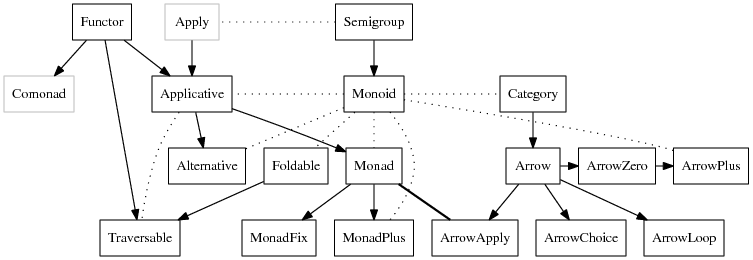
The ironic thing is that these algabraic effect systems have a feel/control flow pattern that's quite similar to exception handling from the OO languages or interrupt handlers in low-level code.
It's much easier to just say "this piece of code is impure, it may do X, Y, and Z and if so then ..." than to try and shove everything ad-hoc into the abstract math tree. But then you lose the purity of your language and it's really awkward in a language whose primary concern is purity. That may be a reason why algebraic effects seem a bit more natural in OCaml.
Personally, I wonder if uniqueness types in languages like the sadly forgotten Clean (a close relative of Haskell) would have been better than the whole Monad/Arrow thing. All of that abstract theoretical stuff is certainly fascinating but it's never seemed worth all the bother to me.
On the other hand, in SML you get all the benefits of strong HM type inference/checking, immutability by default, etc, etc.. while also still being able to just `print` something or modify arrays in place. SML's type system isn't higher-order like Haskell's so its solution to the same problem Haskell solves with type classes isn't quite as elegant but otherwise SML is the C to Haskell's C++.
A few of pieces of the Erlang OTP infrastructure are actually just an elaborate mechanism to reintroduce global mutable state i.e. the process registry or Mnesia.
https://gitlab.freedesktop.org/xorg/xserver/commit/50c0cf885...
Inner platform/walled garden: Almost all Smalltalk systems basically implement their own operating system complete with their own integrated graphics system/window manager, process scheduler, and so on. It's an amazing environment for creating applications but it doesn't play well with the outside world and there isn't a straightforward way to 'shake' an image down to just your application. Deployment usually comes with the overhead of the entire Smalltalk system and interop with native can be somewhat limited. Imagine if Java applications only ran within Eclipse.
Zipf's law: The popular languages are so popular that their communities generate their own gravity (i.e. lots of effort tends to attract more effort). Despite Smalltalk's many appealing qualities (ergonomics, simplicity, maturity, robustness..) it stands in the shadow of giants; many people don't even know it's there or can't invest the effort to give it a shot so it never achieves critical mass.
Programming in Pharo is usually done either in the class browser or the debugger so that you're only ever seeing the code for one method (called a message in Pharo) at a time. Pharo and other Smalltalk variants tout simplicity of syntax but leave off the fairly complicated class hierarchy and message coupling semantics ergo the necessity for an extremely powerful browser. In the browser, messages for each class are further separated into 'protocols' such as methods for 'accessing' or 'initialization' (these are not part of the Smalltalk syntax, just a convenient layer of organization). At each level in the hierarchy, the Pharo code browser gives you a nice template to edit when you want to make a new package, class, or message. The overall effect is that you're only ever working with a handful of lines at a time and, indeed, Pharo will warn you if it thinks your message is too complex. Doing things this way actually makes everything quite manageable. One of the nice features of being pure OO is that everything is a pure black box so you just need to know that a class exists and take a peek at its interface to use it effectively.
To that end, Pharo actually has an excellent search tool that's not present in other Smalltalk variants like Squeak or Cuis. It does some kind of intelligent voodoo and can find anything from definitions to instantiated objects to senders and receivers of a certain message and so on. You can also open up a playground window to experiment with whatever code in the REPL style. But it's actually a little bit more robust than a traditional REPL because of the pure OO nature of Smalltalk. The thing you get back from evaluation isn't just some text. It's an object with all the associated possibility of reflection and manipulation (which can all be done from a UI, not just from evaluating more code).
One of the things Pharo does better than almost every other language is debugger integration. Pharo is like LISP in the sense that you can start an application, have it encounter an error (or just pause execution at will), drop into the debugger and change some stuff, reify whichever execution stack frame, then resume the program as if nothing ever happened. This is the essence of the other common Pharo workflow: write some partial code and then fill it in incrementally in the debugger until you have a fully functional and bug-free application. In addition, Pharo has its own robust unit testing system called Sunit that, coupled with the debugger workflow, creates a fantastically ergonomic TDD experience.
No matter where you are in the Pharo environment, Smalltalk code gets full treatment (E.G. syntax highlighting, code completion). So what does the syntax look like? Well, it actually has that concatenative elegance of Forth plus a few other constructs. Pretty much everything is a message send. Message sends come in three flavors: unary, binary, and keyword. Constructs like conditionals are also just message sends. In addition, there are first-class lambdas (called blocks in Smalltalk). Here's the canonical factorial program:
"Factorial function" fac := [ :n | (n = 0) ifTrue: 1 ifFalse: [ n * (fac value: (n - 1)) ] ].
where " ... " is a comment, ':=' is assignment, '[ ... ]' is a block, ':n' is the block's argument, arithmetic operators are actually binary message sends, things like 'ifTrue:' are keyword message sends (unary message sends are similar but don't have colons or parameters e.g. 'SomeObject new.'), and the statement is terminated with a period. Apparent recursion is fine because Smalltalk uses late binding. Aside from some syntax for strings and class declaration, that's basically it.
Pharo also has a lot of other nice features such as keeping a log of code changes in case of program crash or power outage, an integrated package manager/version control system, and optional git integration. It's all pretty easy to use and overall the system is quite impressive with a high degree of polish and decent performance (comes close to or exceeds node in my experience). However, as others have stated, it's a walled garden. All UI interaction happens within the Pharo environment with no option for native. If you want to break out on UNIX, you have write some kind of server and use sockets or the filesystem (which isn't a huge handicap in the grand scheme of things). On the other hand, application deployment is a little iffy. There's no readily apparent scheme to pare an image down to just what your project uses and then distribute that; users would have to install your package from within their own Pharo environment.
Data is both highly alluring and addictive as evinced here by Mozilla potentially willing to shoot itself in the foot to get some. What's to keep this from becoming a frog in a boiling water kind of situation? How can I trust that Mozilla is going to adhere to their own stated standards? The easiest answer is that I won't have to because I can just use something else. Personally, the only reason I use Firefox is because it's slightly less convenient to set up a secruity-patched version of Chromium.
Other people in this thread have made the excellent points of the fact that not enough people opting in to data collection is in itself a critical piece of data. Moreover, things such as "Which top sites are users visiting?" can be answered by looking at data from page ranking services and then they can go to those sites on their own testing equipment to answer their other questions. A little investment in acquiring this data by not spying and maybe getting a wider array of testing equipment is probably less costly than the potential for loss in market share that they're already struggling to hold.