sdabdoub
Re:Linus Torvalds on mRNA Vaccines
on Thursday June 10, 2021 @06:44PM (#27466859)
The "central dogma"[1] of biology:
DNA -> RNA -> Protein
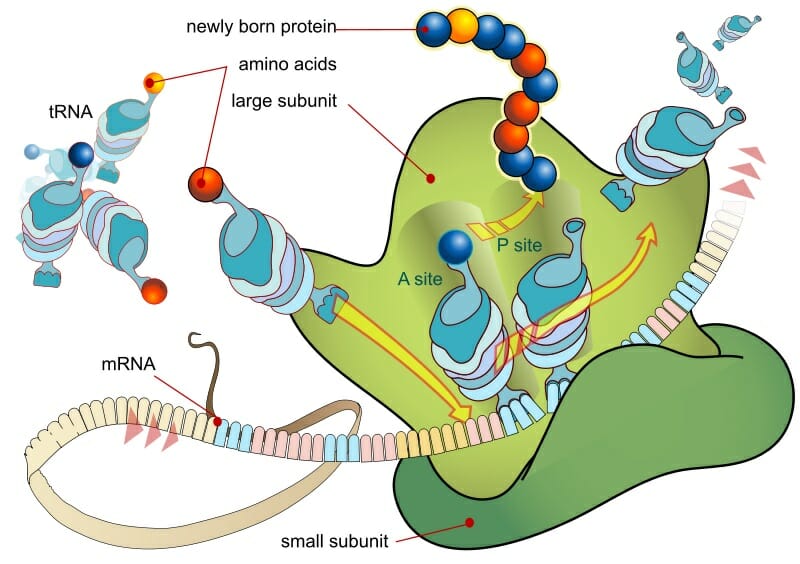
So the mRNA in the vaccine simply contains the instructions to produce a copy of the spike protein from the COVID-19 virus. When your body produces enough copies of that protein, your immune system takes notice that a foreign protein is floating around and begins the process to recognize and memorize it for future use. (that last part is super simplified).
[1] https://en.wikipedia.org/wiki/Central_dogma_of_molecular_bio...
[2] https://biologydictionary.net/wp-content/uploads/2017/01/Rib...
Re:Data on 53 Patients Treated With Investigational Antiviral Remdesivir
on Friday April 10, 2020 @08:46PM (#22838819)
Unfortunately it also appears to be extremely difficult to make[1] which may limit its usefulness.
[1] https://www.acsh.org/news/2020/03/26/problem-remdesivir-maki...
Re:Facebook has been paying people to install a “Research” VPN
on Tuesday January 29, 2019 @08:50PM (#19031852)
> For some people this money could be incredibly important.
That's exactly the problem. In Human Subjects Research this might be considered a violation of Informed Consent in the form of undue influence. From the Belmont Report [1]:
An agreement to participate in research constitutes a valid consent only if voluntarily given. This element of informed consent requires conditions free of coercion and undue influence. Coercion occurs when an overt threat of harm is intentionally presented by one person to another in order to obtain compliance. Undue influence, by contrast, occurs through an offer of an excessive, unwarranted, inappropriate or improper reward or other overture in order to obtain compliance. Also, inducements that would ordinarily be acceptable may become undue influences if the subject is especially vulnerable.
Note the "especially vulnerable" part at the end there.
[1] https://www.hhs.gov/ohrp/regulations-and-policy/belmont-repo...
Re:The Bugs Are Winning
on Monday June 18, 2018 @12:07PM (#17339324)
You are correct, however with new sequencing technologies like the MinION[1] we have access to real-time sequencing in something roughly the size of a cell phone.
They are still in development and there are some technical hurdles, but before too long cheap, fast, and accurate strain typing should be ubiquitous. The next issue is then creating the specific phages, but the first stage is pretty close at hand.
Re:A newcomer’s (angry) guide to R
on Thursday June 14, 2018 @01:36AM (#17309549)
Hadley Wickham's R for Data Science[1] is a generally good starting reference.
Re:A newcomer’s (angry) guide to R
on Thursday June 14, 2018 @01:34AM (#17309540)
Absolutely agree with #3. R is by far the most accepted and expected implementation language for statisticians. I remember reading a blog post where the author had submitted a manuscript to a statistics journal that ended up being rejected, in part, because he had implemented the code in julia instead of R.
I use python for most things, but there are so many packages that can only be found in R (especially in the bioinformatics world), so it becomes a necessity.
Re:A newcomer’s (angry) guide to R
on Thursday June 14, 2018 @01:28AM (#17309521)
try
pip install --user
Re:California to Introduce 'Right to Repair' Bill
on Thursday March 08, 2018 @03:08PM (#16547222)
You shouldn't need to replace the glass/LCD to replace the battery on the 6P. Once you get the back off (which is definitely not easy, the battery is exposed.
Re:Nest launches an outdoor security camera
on Wednesday September 20, 2017 @02:16PM (#15296697)
Unfortunately (at the moment) your only option is to use their recording services.
Re:Teacher spends two days as a student (2014)
on Tuesday May 09, 2017 @12:45PM (#14301582)
I'm guessing it's the "could of" instead of the correct "could have" in the GP.
Re:Princeton’s Ad-Blocker May Put an End to the Ad-Blocking Arms Race
on Friday April 14, 2017 @05:13PM (#14117454)
There's a lot of background work to keep uBlock and other services current. A hosts file needs updating when domains change or new ones are added.
That's part of the appeal of this approach, it doesn't matter what domains ads are served from.
Re:Patent troll tales: Lee Cheng, Newegg
on Tuesday September 27, 2016 @01:59PM (#12591564)
One of the main issues is, despite that decision, the USPTO is understaffed and underfunded, so stuff will still get patented that should have no grounds for patentability.
Re:Multi-process Firefox brings 400-700% improvement in responsiveness
on Tuesday September 06, 2016 @02:32PM (#12438172)
The actual pageset appears to live on build.mozilla.org[1], but is down atm (for me at least). The actual list of pages is on the areweslimyet github repo[2].
[1]https://build.mozilla.org/talos/zips/tp5.zip
[2]https://github.com/mozilla/areweslimyet/blob/a42e69eaac4c764...
Re:FDA Orders Antibacterials Removed from Consumer Soaps
on Friday September 02, 2016 @02:57PM (#12415345)
To quote from a review article[1]: "Antiseptics are biocides or products that destroy or inhibit the growth of microorganisms in or on living tissue". So antibiotics are a type of antiseptic.
>In many centuries of use, bacteria have not developed resistance to antiseptics. There's no danger of them developing resistance to these soaps either
This is not really true. In fact, the substance under question here, Triclosan, is a small 24-atom molecule so, in principle, there's no reason microbes couldn't develop resistance to it.
"TCS inhibits FabI, an enoyl-acyl carrier protein reductase (ENR). The FabI protein catalyzes the elongation cycle in the synthesis of fatty acids, an essential process for cell viability "[2]. Thus, one known mechanism of resistance is to alter the protein that TCS binds to:
"Mutation occurs whereby single or multiple amino acids are changed in the fabI gene, resulting in TCS-resistant FabI proteins"[2].
And it's not even just a matter of "well TCS is ineffective, so why not just leave it alone?". Triclosan is implicated in multi-drug cross resistance:
"In studies done on E. coli and P. aeruginosa, resistance to chloramphenicol and tetracycline increased 10-fold following TCS exposure"[2]. In addition, a survey of Acinetobacter baumanii (an increasingly common opportunistic pathogen found in hospital acquired infections) clinical isolates found that those that could resist low concentrations of TCS also exhibited "increased tolerance to amikacin, tetracycline, levofloxacin and imipenem."[2].
So in fact having TCS everywhere is actively harming our ability to use other effective antibiotics.
[1] McDonnell G, Russell AD. Antiseptics and Disinfectants: Activity, Action, and Resistance. Clinical Microbiology Reviews. 1999;12(1):147-179. https://www.ncbi.nlm.nih.gov/pmc/articles/PMC88911/
[2] Carey DE, McNamara PJ. The impact of triclosan on the spread of antibiotic resistance in the environment. Frontiers in Microbiology. 2014;5:780. doi:10.3389/fmicb.2014.00780. https://www.ncbi.nlm.nih.gov/pmc/articles/PMC4295542/
The Sargasso Sea
Alphabet's Sidewalk Labs Wants to Help You Navigate Smart Cities
Engineering Surfing Waves
Re:RIP Kuro5hin
on Monday May 02, 2016 @04:15PM (#11615167)
Thanks for the link! For a while, the K5 fiction section was my main reason for going to the site.
The Value of Multi-Typeface Design
Estonia wants to become a 'country as a service'
In defense of webfonts
New Full Duplex Radio Chip Transmits and Receives Wireless Signals at Once
Re:Computers in your clothes? A milestone for wearable electronics
on Wednesday April 20, 2016 @11:15AM (#11535010)
Fabrication of Textile Antennas and Circuits With 0.1 mm Precision (IEEE Antennas and Wireless Propagation Letters)
http://ieeexplore.ieee.org/xpl/articleDetails.jsp?reload=tru...
Computers in your clothes? A milestone for wearable electronics
Re:What It’s Like to ‘Wake Up’ from Autism After Magnetic Stimulation
on Wednesday April 13, 2016 @10:06PM (#11493850)
Unless your phone is a giant electromagnet, probably nothing.
IBM's Power9 Receives Boost from Google and Nvidia
The memorial to Newton that would have eclipsed the pyramids
Re:Amazon’s Echo Brims with Groundbreaking Promise
on Wednesday March 09, 2016 @09:21AM (#11253081)
> the F.B.I.’s battle with Apple over encryption should prompt deep questions about a future of Internet-connected devices spread around our homes. Amazon has strong privacy protections in the Echo. It doesn’t stream anything without the wake word and it has a physical mute button that electrically disconnects the microphone but, as with all groundbreaking technology, there is no doubt we are entering new territory here.
At least there's minimal thought given to this issue...even if it is at the end of an article claiming the Echo is the next best thing since anything.
Re:Let’s ban elementary homework
on Wednesday March 09, 2016 @09:14AM (#11253046)
> I worry greatly about what my child is going to do. Will she be able to compete against kids from other countries (and we shouldn't forget robots) if she isn't doing 2 hours of extra homework every night?
On the other hand, is that extra 2 hours actually valuable? Or at the very least, more valuable than 2 hours of physical activity and enjoyment that may lead your child to enjoy school more and get further later in life? The data presented in the article seem to agree with the latter.