s-phi-nl
Re:Krazam OS
on Tuesday April 23, 2024 @09:58PM (#40139602)
If they did that, everyone would worry about registering all the domains with a Levenshtein distance of 1 from theirs, in case of typos.
Re:Anatomy of a credit card rewards program
on Friday April 05, 2024 @01:50PM (#39945174)
A paragraph from the previous essay by the OP comes to mind:
> Less sardonically, there is a lesson here: systems which intermediate between cultures are useful. Intermediating between cultures is a thing the world urgently needs and is extremely prepared to pay for.
https://www.bitsaboutmoney.com/archive/financial-systems-tak...
I don't think decentralized currency will actually solve the issues travelers have with this, at least without reproducing much of the infrastructure already in place for traditional currencies.
Re:Pitcairn Island Immigration
on Wednesday April 03, 2024 @06:41PM (#39924238)
Mandatory citation of XKCD: https://what-if.xkcd.com/48/
Re:Code is run more than read
on Friday December 01, 2023 @07:53AM (#38486113)
It sounds like the symbol "≹" just means "incomparable", which is a well-known concept in math. https://en.wikipedia.org/wiki/Comparability
This symbol for it may be useful, but it's the concept that matters.
Re:Bibi-Binary
on Saturday November 04, 2023 @10:20AM (#38141226)
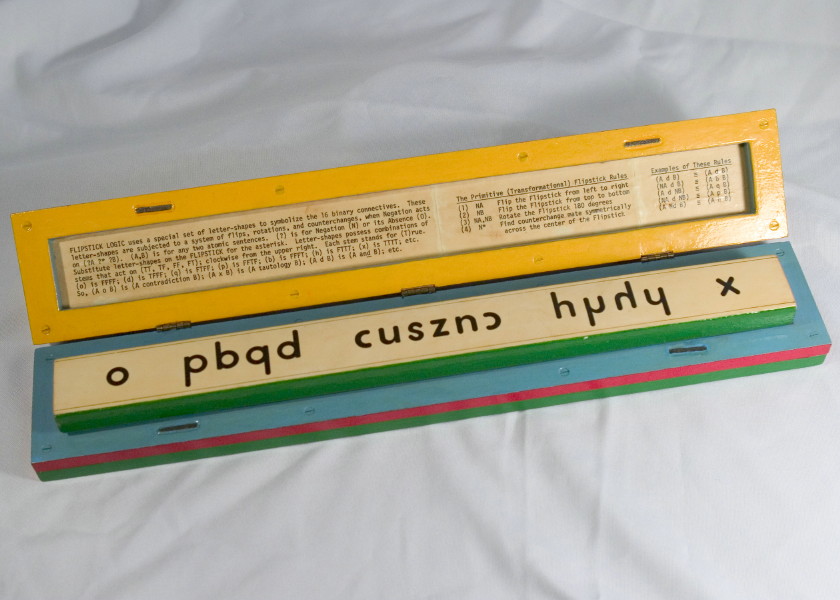
The Logic Alphabet (linked to above at http://www.logic-alphabet.net/images/flipstick_2347_2.jpg), which has a similar concept, seems to have better support: it can represent twelve of the symbols using Latin letters (o, p, b, q, d, c, u, s, z, n, h, and x, although z, u and n seem a bit forced) and the others seem to have decent Unicode equivalents (ɔ or ⊃ (superset), μ (Greek letter mu), ɥ or ч, and maybe ʎ).
Re:On Hubris and Humility
on Wednesday December 08, 2021 @10:12AM (#29485663)
A bit late to the party, but you have written excellent documentation at https://hubris.oxide.computer/reference/. It immediately answered the questions I had after reading 'Animats several comments on IPC. This is particularly impressive since "right now we are laser focused on shipping Oxide's product": I, at least, often don't prioritize documentation.
Re:Debate between sheep and grain
on Friday April 06, 2018 @03:39PM (#16776666)
There's a (10 year old) post saying it could support utf-8.
Re:U.S. nationals born in American Samoa sue for citizenship
on Thursday March 29, 2018 @02:07PM (#16709419)
Point taken, although there, of course, is at least one exception https://en.wikipedia.org/wiki/Falkland_Islands_sovereignty_r...
Re:Donald Knuth's Christmas Lecture: A Conjecture That Had To Be True ...
on Monday December 11, 2017 @03:56PM (#15900354)
I once sent him a letter (snail mail) addressed to Donald Knuth, c/o Stanford Computer Science Department (address at bottom of http://www-cs.stanford.edu/). He got back within a couple of weeks, so it seems to have reached him fairly efficiently.
Re:Category 5 Hurricane Irma Brings 180-MPH Winds to Bear on Caribbean...
on Tuesday September 05, 2017 @03:28PM (#15178370)
FiveThirtyEight had an interesting piece on how politicians have stronger incentives to provide relief after disasters than prepare for them before hand.
You can read it at https://fivethirtyeight.com/features/disaster-politics-can-g... .
Re:Bubble Sort: An Archaeological Algorithmic Analysis
on Monday August 28, 2017 @01:19PM (#15118289)
Do you know of any source that compares the coefficients for bubble sort, insertion sort, and selection sort? This sounds interesting.
Re:Bubble Sort: An Archaeological Algorithmic Analysis
on Monday August 28, 2017 @12:41PM (#15117939)
Anecdotally, the professor of my algorithms class had us all sort cards manually and asked us to describe the algorithm we used when we began studying sorting algorithms. Most of us used either selection sort or insertion sort.
Re:New features you can't use unless you are in Python 3
on Wednesday June 14, 2017 @01:07PM (#14554136)
That's true, but many users are still affected by that Python 2 remains the default. Any user can install a tool for Python 2 with pip install --user but the user might need root privileges to install a tool for Python 3 if the system administrator never intentionally installed it.
Re:STON – Smalltalk Object Notation (2012)
on Wednesday March 15, 2017 @11:19AM (#13876689)
Your untrained eye took the # for comments, but I'm not sure that generalized to anyone's. Plenty of languages use # for other things: Smalltalk uses them for symbols, Clojure uses them for reader macros, OCaml uses them for method calls, Haskell can use them as an arbitrary operator, Lua uses them for length, C and C++ use them for compiler directives. See https://en.wikipedia.org/wiki/Number_sign#In_computing for a list.
Admittedly, Python, Bash, Perl, and Ruby use # for comments, so you do have a point, especially since Python is such a common teaching language.
Re:Neanderthals were people too
on Thursday January 12, 2017 @11:35PM (#13388418)
According to the US State Department
> Gibraltar is adjacent to known drug trafficking and human smuggling routes, but the territory is heavily policed on land and at sea due to the risk of these activities occurring within its borders or territorial waters
https://www.state.gov/j/inl/rls/nrcrpt/2014/supplemental/227...
Re:OpenPGP really works
on Thursday January 12, 2017 @05:38PM (#13386825)
I think my question is now answered by https://news.ycombinator.com/item?id=13383171, in particular https://news.ycombinator.com/item?id=13383211.
Re:OpenPGP really works
on Monday January 02, 2017 @07:43PM (#13305742)
Could you give an example of "problems you'd otherwise use AES passphrase-encrypted ZIP files to solve"? Do any of them involve sending the data anywhere (i.e., the sender and receiver are the same person)?
Re:2017 is not just another prime number
on Sunday January 01, 2017 @08:48PM (#13298542)
   All throughout the talk there were statements like "Let p be an odd prime and…"

   My friend asked, “what is an odd prime?”—thinking it must be special in some way. The answer back was: not 2.
Re:The Holy Trinity: Logic, Languages, Categories (2011)
on Monday November 28, 2016 @03:37PM (#13058195)
Thanks! Yes, with excluded middle is what I meant.
Re:The Holy Trinity: Logic, Languages, Categories (2011)
on Monday November 28, 2016 @03:29PM (#13058124)
Could you point to a reference for the non-confluence of logic without excluded middle? It sounds interesting and a quick Google search did not find anything.
Re:Disney Open Source
on Monday October 17, 2016 @07:10PM (#12730677)
Because that's what the US Constitution requires [1]:
"To promote the Progress of Science and useful Arts, by securing for limited Times to Authors and Inventors the exclusive Right to their respective Writings and Discoveries" (Emphasis added)
[1] https://www.constituteproject.org/constitution/United_States...
Re:How to Write a Spelling Corrector
on Thursday September 08, 2016 @11:46PM (#12459523)
Along similar lines, "The King's English" http://holyjoe.org/poetry/anonA.htm
Re:An account of a serious medical emergency on a transoceanic flight
on Friday September 02, 2016 @11:14PM (#12417554)
To add some data to this discussion, in 2015 FiveThirtyEight found that Delta flights typically took 4 minutes less compared to other airlines, whereas Southwest flights typically took 1 minute more. This takes delays and cancellations into account.
You can see the analysis at http://projects.fivethirtyeight.com/flights/. The explanation, linked to at the top of that page, is at http://fivethirtyeight.com/features/how-we-found-the-fastest....
Re:Build System Rules and Algorithms (2009) [pdf]
on Friday September 02, 2016 @06:23PM (#12416699)
You might look at YAML: it is a superset of JSON that allows unquoted strings.
Re:Ask dang: How many HN comments per day do you read?
on Tuesday May 10, 2016 @05:23PM (#11670771)
I trust you are aware of http://news.ycombinator.com/bestcomments ?
Re:Show HN: 19 Tone Equal Temperament Piano in Web Audio
on Thursday March 31, 2016 @09:34AM (#11396994)
There are some mathematical reasons.
In particular, the two most consonant (best-sounding) intervals are the octave and the fifth. The frequencies of the two pitches in an octave have a ratio of 2.0, and the frequencies of the two pitches in a pure fifth have a ratio of 1.5.
We would like the pitches we obtain from powers of these two ratios (stacking these intervals on top of each other) to be the same. However, since the integers are a unique factorization domain, they will never be (except for 2^0 = 1 = 1.5^0, of course). [1]
Thus, we pick powers of the two that are 'close enough' and call those the same pitch. The following Python (3) code subtracts the log-base-two of the powers of 1.5 from the integer they round to in order to find the closest ones:
  from math import log

  fifth = log(3/2, 2.0)

  print(0, 0.0)

  minDist = 0.08
  for i in range(1,100):
      pow = i* fifth;
      dist = abs(pow - round(pow))
      if dist < minDist:
          minDist = dist
          print(i, pow, dist)
  0 0.0
  5 2.924812503605781 0.07518749639421918
  12 7.019550008653875 0.019550008653874684
  41 23.983462529567404 0.01653747043259557
  53 31.003012538221277 0.003012538221277339
(As an aside, a scale with 5 notes is also common around the world, called the pentatonic scale [2])
[1] For an explanation of this, see http://blogs.scientificamerican.com/roots-of-unity/the-sadde...
Re:Graph Isomorphism Algorithm Breaks 30-Year Impasse
on Tuesday December 15, 2015 @03:45PM (#10740339)
FWIW, Babai (the author) has a very small Erdos number: 1:
Re:Should kids learn to code?
on Friday December 04, 2015 @12:01PM (#10677442)
For some reason, this reminds me of Richard Feynman's comments about science education in Brazil: http://v.cx/2010/04/feynman-brazil-education
"'I have discovered something else,' I continued. 'By flipping the pages at random, and putting my finger in and reading the sentences on that page, I can show you what’s the matter – how it’s not science, but memorizing, in every circumstance. Therefore I am brave enough to flip through the pages now, in front of this audience, to put my finger in, to read, and to show you.'"
Re:A 'Binary' System for Complex Numbers (1965) [pdf]
on Monday November 30, 2015 @08:28PM (#10653118)
Essentially, this defines a homomorphic pairing function[1] for the integers. A Gaussian integer can be seen as the pair (a, b) where a and b are integers. This assigns a unique natural number to each one.
One can use this to show that pairs of integers have the same cardinality as natural numbers.
Further, since one can sum the binary representations of two numbers and get the representation of the result, this is homomorphic under addition. I have never before seen a pairing function with that property (not that I have seen many).
[1] https://en.wikipedia.org/wiki/Pairing_function#Cantor_pairin...