s-macke
s-macke on Hacker News
Posted by
s-macke on Sunday September 27, 2026 @04:58AM
from the show-hn dept.
https://github.com/s-macke/maniac-mansion-3d
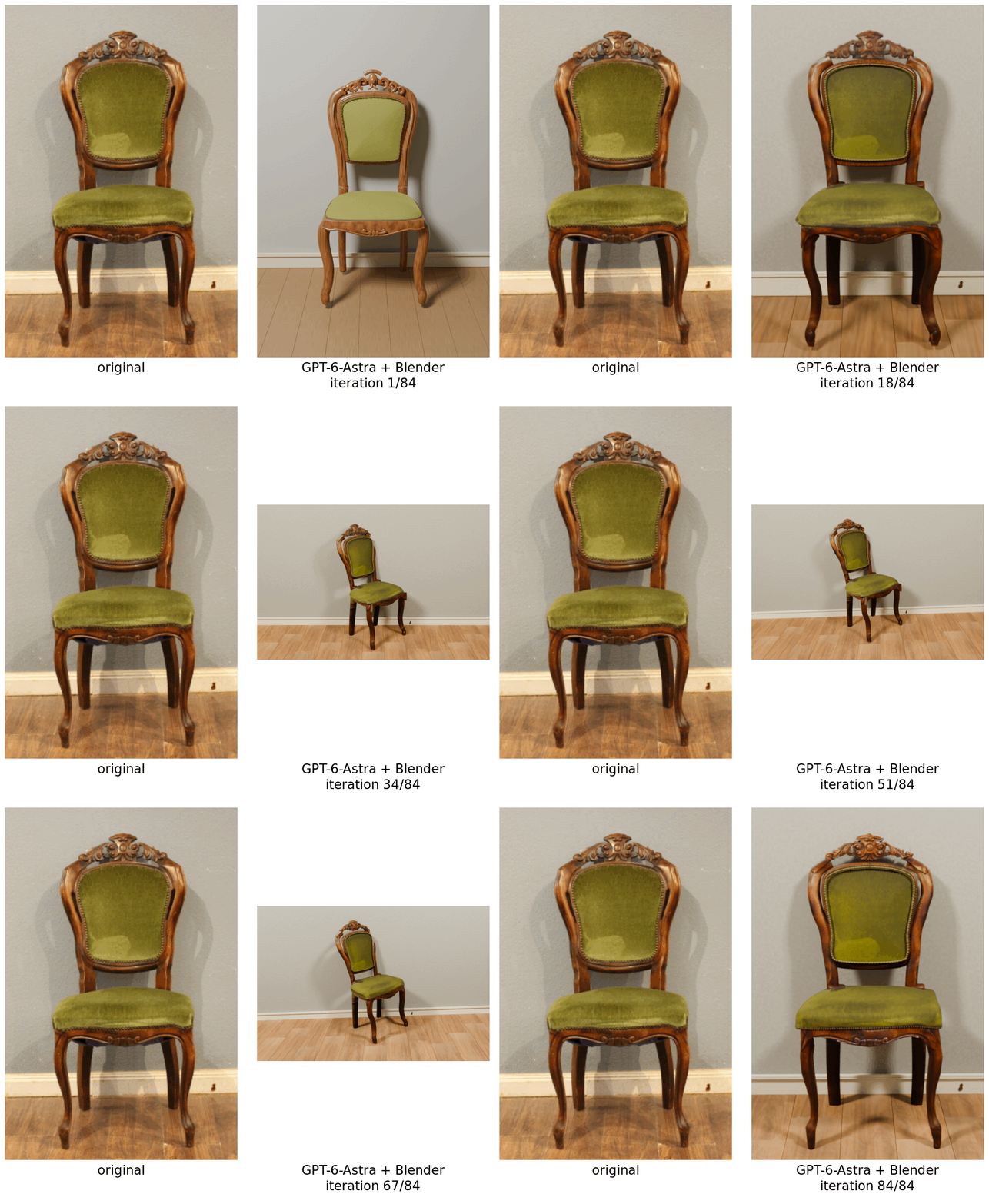
I originally started experimenting with reconstructing real world objects from images with GPT-6 Astra and Blender. One of those experiments was this chair:https://simulationcorner.net/chair/chair-evolution.gifThat made me wonder what would happen if I tried the same idea with old computer game graphics instead.Maniac Mansion seemed like a perfect test case. The DOS EGA version consists of a...
Thanks. I’ll pass the feedback on to Opus 5.5 :-)
There isn’t that much to say. Start with an empty directory, put the XKCD image in it, add your ElevenLabs API key, and set up a Python virtual environment. Install ffmpeg.
Then start Claude. From that point on, it’s mostly prompting and evaluating the results. Like any good engineer, you shouldn’t simply start with “Create a video from this comic.” Instead, take a step-by-step approach: discuss the visual style, animations, ask for audio examples, create a script, and then develop a storyboard (ask for a .html document).
The important part is to break the whole generation process down into small, manageable steps. I also used the brainstorming skill from Superpowers for the discussions. It makes the whole process much easier when the AI asks the questions and I just have to answer them.
The result is 4500 line python code generated by Opus 5.5 and a lot of video and audio files.
Exactly. I just give Astra an image such as furniture, and it creates an 3D reproduction in Blender. You don’t even need computer use. Codex and Blender’s scripting engine is enough.
I use a step-by-step approach:
1. For each topic, write a result Markdown file in `spec/`.
2. Identify the file formats.
3. Reverse Engineer and extract all assets, followed by manual review. This works in 90% of the cases.
4. Determine the compression/packing used for the executable. Most binaries used one of roughly five common executable packers.
5. Unpack the executable manually.
6. Use an ancient free IDA-Pro for disassembly, or a modified DOSBox to determine all code/data blocks and the relevant segment-register values for the 8086 architecture.
In the second case I use my vibe-coded disassembler.
7. Identify the major functional domains in the disassembly and split the files accordingly.
...
Stunt Car Racer from Geoff Crammond published by MicroProse, not Stunts from Distinctive Software.
I would like to see all of them :-)
One of the most difficult reverse-engineering projects from that era for me was Stunt Car Racer on the C64 (also ported to DOS). It features a highly optimized 8-bit 3D graphics and physics engine. Fable was the first one that was able to generate a complete port of the game.
Now I am trying of Flight Simulator 4 and Wing Commander 1. Then maybe Frontier Elite 2. So much fun ....
Ask a coding agent to decode the assets. Works pretty often for such old games.
Posted by
s-macke on Saturday June 13, 2026 @09:23AM
from the twitter.com dept.
What I find fascinating is the fact that you can implement those few lines in an esoteric language such as FRACTRAN or Game of Life and even boot Linux on them. Seems doable now. In theory.
Yes, I’ve tried it. For example, this was my winning entry from a year ago [0].
The LLM only performs trivial obfuscation, not advanced transformations.
For example:
if (x == 1 || x == 2) { ...
can be transformed into:
if (!(2+x*x-3*x)) { ...
An LLM will do this if you explicitly ask it to, but not on its own.
[0] https://github.com/ioccc-src/winner/blob/master/2024/macke/p...
Yes, you haven’t tried it. LLMs are actually awesome at deobfuscation, but terrible at obfuscation. They just can’t do it yet.
They also lack the creativity needed for those entries. Obfuscation is only one part of it. Coming up with the idea is another. Many entries also have special qualities that make them true works of art.
Posted by
s-macke on Saturday June 06, 2026 @04:53PM
from the github.com dept.
Posted by
s-macke on Saturday June 06, 2026 @03:01PM
from the youtube.com dept.
Because I haven't found the special case in the disassembly for these "flying" objects. Probably I misinterpret the object coordinate somehow.
Sorry, the maps are rendered in 3D so that you can fly around. I can of course make top-down screenshots of the maps. Thanks for your feedback.
Author here. The Ross’s Game Dungeon video was, to some degree, a motivation for me to start the reverse-engineering process, just for fun. The analysis took place over many years, and I figured out 95% of the format myself. AI helped me then with the coloring, which is pretty complex. I have read the Accursed Farms forum, of course. But it didn't help much.
The map mentioned there can be found as “Unknown Map” in the dropdown. However, I haven’t yet connected that map to the menu screen. It might be called “Tom’s Test Track,” because that string appears in the disassembly.
Integration into noclip might be easy, because I also have the geometry as a standalone .obj file.
On weekends, yes. During the week, that’s also true if they arrive within a short time frame, e.g., three minutes. Almost no one looks at “New”. That is the real issue.
Posted by
s-macke on Sunday May 31, 2026 @05:45AM
from the show-hn dept.
Posted by
s-macke on Sunday May 31, 2026 @04:45AM
from the github.com dept.
Author here. Yes, it is integral. I chose this approach to first show how to draw it from back to front, because the code is easier to understand this way.