reerdna
Re:Tensor Is the Might
on Tuesday July 14, 2026 @11:28AM (#48908337)
Cool, but I find rather than just shapes and indexes, tensors with labels are much easier to use and reason about. E.g.:
  {
      {user:bob, movie:"Heat"}:0.1,
      {user:alice, movie:"Frozen"}:0.9,
      {user:carol, movie:"Top Gun"}:0.3,
  }
Re:Brunost: The Nynorsk Programming Language
on Saturday April 18, 2026 @02:31PM (#47818270)
This brings back good memories from when a friend made C in nynorsk: https://www.pvv.ntnu.no/~andreer/nynorsk/
Re:Teenage Engineering's PO-32 acoustic modem and synth implementation
on Tuesday March 31, 2026 @09:44PM (#47595768)
I was able to get part way some years ago by demodulating the bitstream with gnuradio and then making small changes (like replacing one note with the next higher one) and noting the differences. So that is one possible, but probably too inefficient way.
I never got close to finishing or publishing anything. Awesome to see this released and I'll have to play with it!
Re:Smallest transformer that can add two 10-digit numbers
on Saturday February 28, 2026 @01:22AM (#47191170)
I couldn't help but laugh out loud at the notion of a "held-out test set" for addition of 10-digit numbers.
Re:Setting Up a Cluster of Tiny PCs for Parallel Computing
on Saturday January 24, 2026 @03:39AM (#46742014)
No, not beyond what I already put in the twitter thread. I wanted to wait until I had some cool distributed software running on it too, but then I ran into trouble with the plan 9 wifi drivers for the rpi being unstable and so I'm still working on fixing that. It does serve as a great test bed for that purpose too, as with 8 nodes I can get much more reliable data about how often the driver gets stuck
Re:Setting Up a Cluster of Tiny PCs for Parallel Computing
on Thursday January 22, 2026 @01:30AM (#46715966)
Wanted to reply to you directly also to increase the chance you see this because I think I had exactly the same intrusive thought as you, and actually built such a cluster recently. Would love to hear what you think: https://x.com/andreer/status/2007509694374691230/photo/1
Re:Setting Up a Cluster of Tiny PCs for Parallel Computing
on Thursday January 22, 2026 @01:18AM (#46715905)
I recently built a Plan 9 cluster of 8 raspberry pi zero (2w). From my supplier (digikey) the 2W was the same price and has 4X the cores!
I think it looks quite cool: https://x.com/andreer/status/2007509694374691230
Instead of having to use lots of dongles and usb ethernet, I just wired them all up using brass rods, a small 5V power supply in the base, and boot them over WiFi (just the kernel and wifi config on the sd card).
Raspberry pi's are cheap, easily available, and there is an absolutely massive trove of information about them on the internet. And the scale means that the linux implementation is very stable and "just works" to a degree that is extremely hard for other SBCs to match.
Sure, VMs are the logical choice, but not everything has to be logical. Real hardware does feel more real :-)
Re:UMichigan study: EVs are cleaner than ICEs over average vehicle life
on Thursday August 28, 2025 @06:37AM (#45050531)
Yes, but it turns out it doesn't matter much.
What _does_ matter is the huge reduction in the much more dangerous brake dust, as electric vehicles convert the kinetic energy back to the battery charge via generation instead of wasting it via friction: https://news.ycombinator.com/item?id=44666157
Re:UMichigan study: EVs are cleaner than ICEs over average vehicle life
on Thursday August 28, 2025 @06:06AM (#45050366)
Same experience in Norway. 95%+ of new cars sold are electric.
I've been riding my bike to work along the same road for 15 years. I used to have to hold my breath along some sections of my ride. Now the air in the city is almost as fresh as in the countryside.
Re:Ask HN: What are you using to parse PDFs for RAG?
on Tuesday July 30, 2024 @06:59AM (#41107862)
For use in retrieval/RAG, an emerging paradigm is to not parse the PDF at all.
By using a multi-modal foundation model, you convert visual representations ("screenshots") of the pdf directly into searchable vector representations.
Paper: Efficient Document Retrieval with Vision Language Models - https://arxiv.org/abs/2407.01449
Vespa.ai blog post https://blog.vespa.ai/retrieval-with-vision-language-models-... (my day job)
Re:Pg_vectorize: The simplest way to do vector search and RAG on Postgres
on Wednesday March 06, 2024 @09:22AM (#39616233)
Sounds a little like this recent paper;
"RAPTOR: Recursive Abstractive Processing for Tree-Organized Retrieval"
Re:Matryoshka Representation Learning
on Thursday February 01, 2024 @07:42AM (#39215341)
Analysis by dhruv___anand in https://twitter.com/dhruv___anand/status/1752641057278550199 suggests that there are three different "resolutions" in the embeddings, for the first 512, 1024 and full 1536 dimensions in text-embedding-3-small.
You can put a subset of the dimensions in your vector database, thus saving a lot of cost by reducing memory/compute when retrieving nearest neighbors.
Then you can optionally even re-rank the most promising top-k candidates by the full embeddings. At least one database supports this natively: https://twitter.com/jobergum/status/1750888083900240182
Re:Lilygo T-Deck: 2.8-inch IPS LCD display, mini keyboard, and ESP32 p...
on Thursday January 04, 2024 @03:39AM (#38864611)
You can turn this into a pocket "lisp machine" by following the instructions on http://www.ulisp.com/show?4JAO - although I don't think this can make use of the LoRa interface (yet).
The hardware is cool, but its just a PCB and the edges of the display are vulnerable. I would recommend 3D printing a case to protect it, especially if you are planning to bring it around with you. There are .stp files for one in the official github repo.
Re:Advent of Tensors 2023 – 24 challenges
on Friday December 01, 2023 @07:51AM (#38486103)
I've been lucky to get to work through a few of these already, they do give a decent introduction in how to use Vespa tensor expressions.
I believe it's one of the most flexible ways in any vector (or other) database to express how to rank your query results, and it's compiled down to fast native code for execution, using openblas etc. where appropriate.
Re:Low Power Challenge: The PotatoP Runs Lisp for Months Without Recha...
on Friday March 10, 2023 @05:00AM (#35092539)
(It later did, in https://news.ycombinator.com/item?id=35074233 )
Re:Lisp-Powered Laptop with a Battery Life Measured in Years
on Friday March 10, 2023 @01:32AM (#35091130)
Sorry to have caused you pain!
I thought this video would get maybe 100 view at most, or I would have put more effort into it (like implemented paren matching in the editor first).
I like lisp (and apparently it's good HN bait). But the language is not really the core of this project.
It is more about making a truly personal computer. One that doesn't require you to think about charging or software updates. That is always fast and responsive and ready to use as it is never doing something strange in the background. Simple enough for me to feel like I understand how everything works.
And writing your own OS for it is easy if you wanted to - you could implement forth, lua, a small C compiler - whatever you wish, and these properties would still be preserved.
Useful? Probably not. Fun? At least for me it is.
Re:Lisp-Powered Laptop with a Battery Life Measured in Years
on Wednesday March 08, 2023 @09:29PM (#35077685)
Yes, I'd love some help with it, or it would probably take me years. Schematics and stls (made in tinkercad) will be coming once I find the time. For now I'm spending too much time replying to comments but I'm enjoying the dopamine
Re:Lisp-Powered Laptop with a Battery Life Measured in Years
on Wednesday March 08, 2023 @09:03PM (#35077514)
No, I did spend some time reading eink datasheets but in the end it seemed too hard for me to do on my own. There's the Kindle and Freewrite so it seems possible
Re:Lisp-Powered Laptop with a Battery Life Measured in Years
on Wednesday March 08, 2023 @08:56PM (#35077472)
Yes, I'm running the display SPI at 2MHz which is ~25 fps. Overclocking it to twice as fast works just fine but uses significantly more power as expected. I did not try to go further.
Approximately 25%-50% of the total power depending on refresh rate. Worst case seems to be alternating black and white pixels, maximizing the number of transitions?
Re:Lisp-Powered Laptop with a Battery Life Measured in Years
on Wednesday March 08, 2023 @08:38PM (#35077329)
More RAM, a higher resolution display, a proper keyboard, solar power and much easier to program (for me at least). But yes, it is essentially the same sort of thing, and much more poorly made at that. :-)
I loved my TI-83, wrote games and crude 3D graphics on it high school math class.
Re:Lisp-Powered Laptop with a Battery Life Measured in Years
on Wednesday March 08, 2023 @08:33PM (#35077287)
Using the FPU I believe but quite inefficiently, most cycles are probably spent in integer operations and chasing linked lists for the lisp parser. http://forum.ulisp.com/t/barnsley-fern-in-ulisp/1087
48MHz is the most power efficient mode, you can run it at 96Mhz "burst mode" but apparently it uses disproportionately more power, I have not measured how much.
Re:Lisp-Powered Laptop with a Battery Life Measured in Years
on Wednesday March 08, 2023 @08:29PM (#35077256)
Thank you! Yes, I've had this in mind for a while, I have some pictures of beginning the first prototyping by dismembering the keyboard back in 2020, although what I was thinking at the time is not recorded.
I would not be surprised if it's simply the availability of the good-enough CPU that caused the idea to take root in multiple heads independently.
initrd has gathered a lot of resources in https://hackaday.io/project/177716-the-libre-autarkic-laptop and https://github.com/EI2030, he sent me a link to your writing a while back and it made me think of using an sd card for storage, which I had previously rejected for taking too much power. But I have since managed to only power it when reading/writing files and it works quite well.
Re:Lisp-Powered Laptop with a Battery Life Measured in Years
on Wednesday March 08, 2023 @08:16PM (#35077151)
Yeah, matching pretty well the advertised 5mW. But uLisp is probably not using the CPU very efficiently and so not driving it to the max that could perhaps be seen with something like a well-implemented FFT.
Re:Lisp-Powered Laptop with a Battery Life Measured in Years
on Wednesday March 08, 2023 @08:08PM (#35077083)
Yes, it's nearly always in active mode now. I haven't done much to use the sleep modes at all, only "sleep until next keyboard interrupt" when the program calls (get-key). Measurement, selected portion is while rendering a fractal - so "100% cpu" - at 1.5mA. https://cdn.hackaday.io/images/4389961676068300828.png
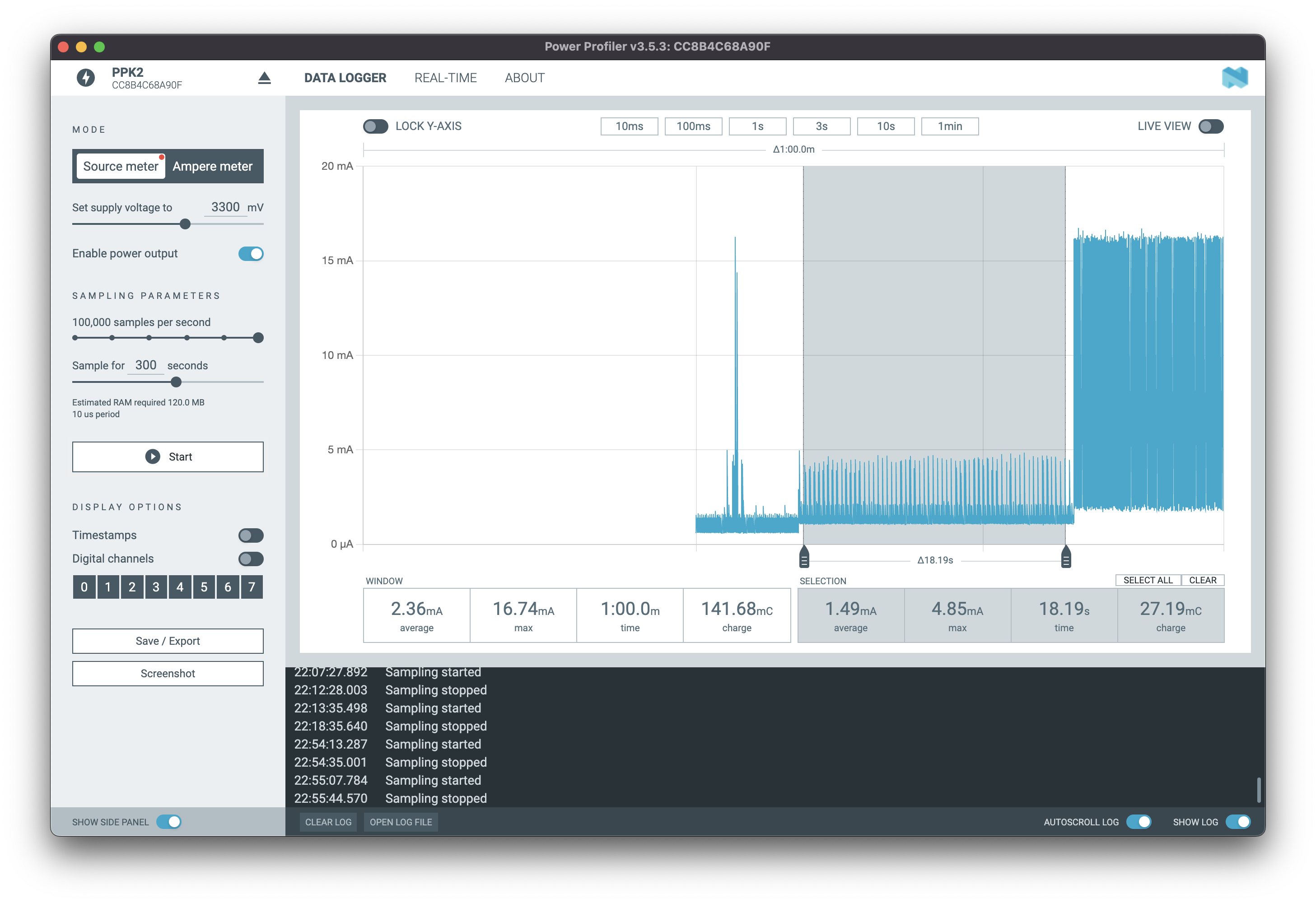
I'm sure other uCs could sleep at lower power, but active mode was what I wanted to optimize for.
Re:Lisp-Powered Laptop with a Battery Life Measured in Years
on Wednesday March 08, 2023 @08:00PM (#35077010)
Perhaps 200 days? This was already discussed in another thread. But you wouldn't be able to read the screen in darkness, it is reflective and not backlit.
I have SSHed into a Microvax II some times, this is 50 times faster. So possible, definitely.
No network stack yet, although the chip has bluetooth so it'd be possible to make that work, perhaps with a "gateway" device. But it would likely increase power use by 5X.
Re:Lisp-Powered Laptop with a Battery Life Measured in Years
on Wednesday March 08, 2023 @07:55PM (#35076952)
Yes. The Apollo3 cpu is probably at least 50-100 times faster than you'd need for that. Maybe even the emacs lisp version could be ported easily.
Re:Lisp-Powered Laptop with a Battery Life Measured in Years
on Wednesday March 08, 2023 @07:15PM (#35076611)
I'm pretty sure 53 characters is slightly less than ideal though :-)
Re:Lisp-Powered Laptop with a Battery Life Measured in Years
on Wednesday March 08, 2023 @07:10PM (#35076573)
As do I. We had a 286 which this would easily outperform. It could probably run DOOM (with dithering) quite well if someone put their mind to it.
Re:Lisp-Powered Laptop with a Battery Life Measured in Years
on Wednesday March 08, 2023 @07:08PM (#35076560)
Yes. A smaller, but higher resolution display is available from Adafruit, and they made a calculator tutorial for it which helped me a lot in the beginning: https://learn.adafruit.com/diy-rpn-desktop-calculator-with-c...