petoi
Re:What 30k robot dogs taught me about degrees of freedom, shipping a ...
on Tuesday September 29, 2026 @10:28PM (#49903656)
10 years ago, I built that 14-DoF (degrees of freedom) OpenCat prototype in my university dorm room. Since the Nybble campaign in 2018, we've shipped more than 30, 000 quadrupeds.
I want to walk through: - What the difference really is between a demo and a delivered product - How those units are actually used, and what they did to our support desk - A simple formula I ended up deriving, plotting a product's feasibility against its active DoF How that formula turned into a robot with only 4 servos
What 30k robot dogs taught me about degrees of freedom, shipping a real product
Browser-based robot dog simulator: walking controller
Robot Dog Sees Me
Re:Petoi Bittle – a programmable robot dog
on Tuesday April 30, 2024 @01:47PM (#40213795)
Here's an example of running a Raspberry on Bittle robot dog https://gitlab.com/sdv.bot/bittle:
"Attempts to get SOAFEE Software Defined Vehicle architecture working on the Petoi Bittle robot. Tested on Raspberry 5 w/ 8GB."
So instead of running on a real(much more expensive) vehicle, Darwin Sanoy experimented with running SOAFEE on Bittle.
Re:Petoi Bittle – a programmable robot dog
on Thursday April 25, 2024 @02:30AM (#40154142)
Normally, we recommend users to be 10+ years old.
But if you are already experienced with coding, you can help your grandson get started with block-based coding(https://www.petoi.camp/forum/software/web-api-to-control-nyb...) after he builds the robot.
He can also code some simple commands to move servos just with the mobile app: https://docs.petoi.com/mobile-app/controller#customized-comm...
He can even make a Petoi robot sing some melodies: https://docs.petoi.com/applications/melody-creation
Re:Petoi Bittle – a programmable robot dog
on Thursday April 25, 2024 @02:26AM (#40154123)
Because all of Petoi robots run on OpenCat, our users have created alternative ways to control Petoi robots:
use XBox controller - https://www.petoi.camp/forum/general-discussions/using-xbox-...
Web API - https://www.petoi.camp/forum/software/web-api-to-control-nyb...
Re:Petoi Bittle – a programmable robot dog
on Thursday April 25, 2024 @02:21AM (#40154102)
You can control the robot with the included remote control or the Petoi mobile app with 35+ built-in commands.
We have the APIs through OpenCat(https://github.com/PetoiCamp/OpenCat). You can control every servo movement via coding.
You can program the robot to move around and perform new skills to mimic a real dog's behaviors.
The overview page has more information: https://www.petoi.com/pages/bittle-open-source-bionic-robot-...
Re:Petoi Bittle – a programmable robot dog
on Tuesday April 23, 2024 @11:20PM (#40140134)
Bittle has a tiny body, but it has strong and fast servos for running and even backflipping(check this video https://www.youtube.com/watch?v=FRE-sp05ia8&list=TLGG0bKEfuY...). We custom-designed our own high-quality servos which are half of the prices of any comparable servos.
We already had a prototype with 3 degrees of freedom on the legs. But the structural complexity and price would have increased substantially. We are not releasing it at this moment.
You can check Petoi robot joint index documentation at https://docs.petoi.com/petoi-robot-joint-index
Re:Petoi Bittle – a programmable robot dog
on Tuesday April 23, 2024 @10:23PM (#40139772)
Our first robot Nybble cat was born as a maker project https://www.indiegogo.com/projects/nybble-world-s-cutest-ope... with crowdfunding in 2018.
Bittle was also born from our crowdfunding project on Kickstarter https://www.kickstarter.com/projects/petoi/bittle in 2020.
You can read about our history there.
In addition to the points you raised, one of the big challenges is to manage the supply chain and the bill of materials. For example, during covid, we faced the challenges of chip shortage.
For any hobbyist project, people don't really need to worry about things at scale.
Re:Petoi Bittle – a programmable robot dog
on Tuesday April 23, 2024 @10:15PM (#40139709)
It's a programmable robot dog that you can program in C++/Python/block-based coding.
You can check the application links on the side bar menu at https://docs.petoi.com/
Re:Petoi Bittle – a programmable robot dog
on Tuesday April 23, 2024 @10:08PM (#40139663)
We will roll out a newer version of robot cat around July.
If you are interested in getting a notification, you can subscribe to our newsletter via our website.
Raspberry Pi AI Projects
IoT Puppy Park: Connected Worker Safety with Terraform, Bittle Robot Dog Fleet
Tutorial for simulating robot dog Bittle In Isaac SIM – Hackster.io
IEEE Video Friday: Humanoid Soccer, DIY Robot Cat
Re:Robot Gift Guide 2022
on Friday December 16, 2022 @12:08AM (#34010616)
Check out Petoi Bittle robot dog(https://www.petoi.com/products/petoi-bittle-robot-dog) for under $270. It has a complete set of tools for entry-level robotics. The motion controller is a Arduino-like controller and can connect to many third-party sensor modules such as camera, gesture & microphone. It supports C++ and Python API
It runs on open source software OpenCat and can integrate with Pi or ROS.
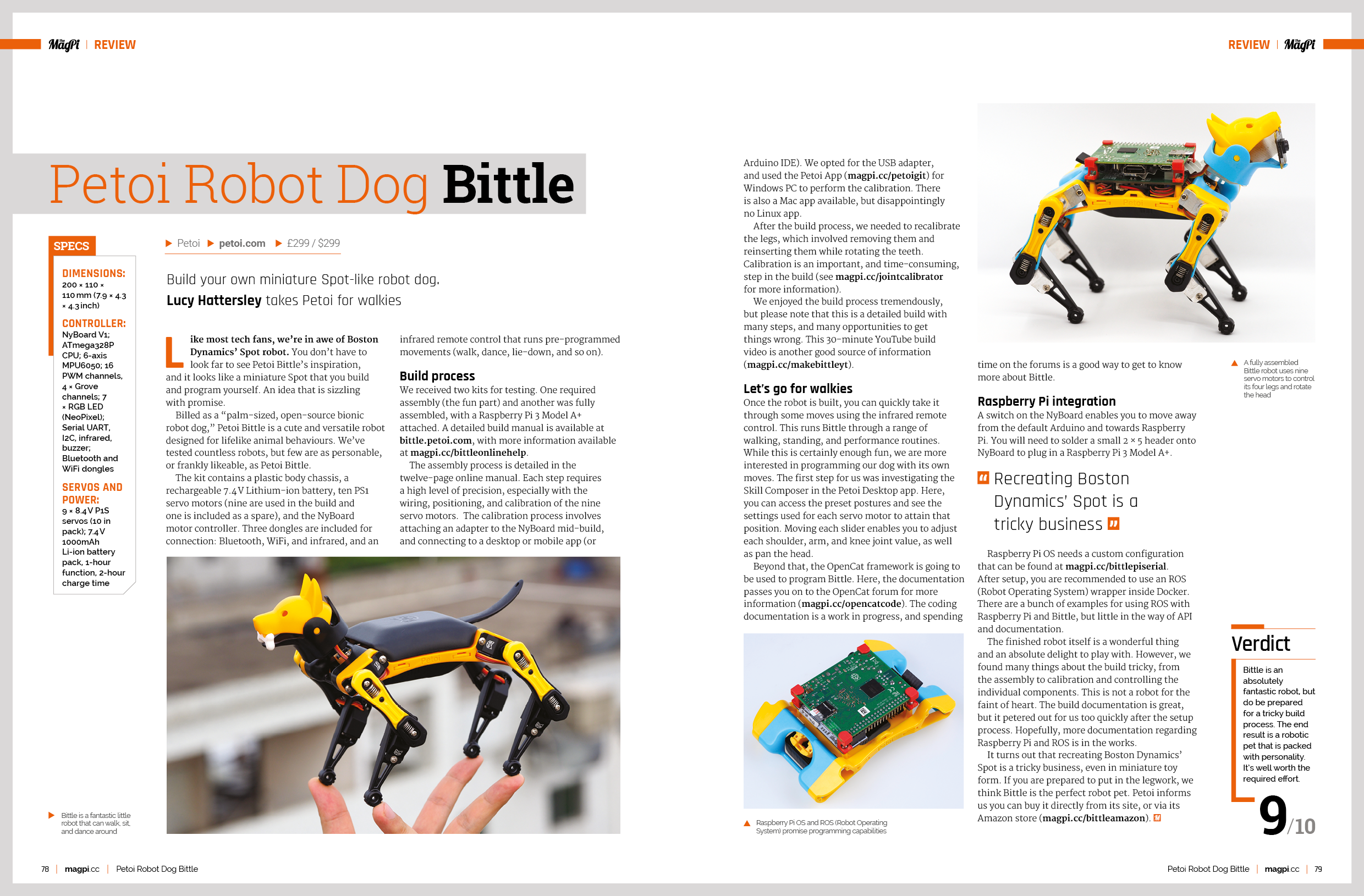
Here's the review by MagPi in its Nov 2022 issue: https://images.ctfassets.net/2lpsze4g694w/2A12bpCahduZNgNQZv...
Robot Gift Guide 2022
Teach Nybble robot cat to learn from human moves – robotics imitation learning
Voice Control for Bittle Robot Dog with Raspberry Pi – Hackster.io
Bittle, a pet robot dog that will teach you how to code – BBC Science Focus Mag
Re:Petoi Bittle: A Palm-sized Robot Dog for STEM and Fun for less than...
on Thursday August 27, 2020 @07:33PM (#24299879)
Please check out our open source project: https://github.com/PetoiCamp/OpenCat