merkitt
Re:Show HN: Gargl – Create an API for any website, without writing a l...
on Friday February 21, 2014 @12:38AM (#7275620)
It's possible OP didn't realize what he was proposing would have a negative impact. Rather than assuming that, we could've just said something like: "Do NOT do that! Because of {these things}. And {these other things} will happen to you and other people."
There are plenty of ways to say politically incorrect things without being rude. One thing I like about HN (as opposed to reddit) is the information density -- it's higher because jokes and snark are frowned upon.
Re:Did English ever have a formal version of “you”?
on Tuesday February 11, 2014 @10:33AM (#7218041)
If you're addressing mother, then it is second person. This is exactly how I would say this to my mother (translated to English of course). Some of the kids in the newer generations use the more familiar "oya".
Re:Did English ever have a formal version of “you”?
on Tuesday February 11, 2014 @10:30AM (#7218025)
It is in fact a great language. For one thing, our alphabet is fully phonetic. And it's even arranged in a logical grid: http://www.omniglot.com/writing/sinhala.htm
It's also a great language to tell jokes in. We have a lot of delivery-based humor that gets completely lost if only the meaning is translated (which is often the case when the destination language is English).
Some of our original deficiencies: we didn't have punctuation or even spaces before they were introduced by European colonists (Portuguese, Dutch and British, in that order). So our ancient writings LOOKEDKINDOFLIKETHISANDWENTONFORPARAGRAPHS.
Re:Did English ever have a formal version of “you”?
on Tuesday February 11, 2014 @03:14AM (#7216475)
Greetings from a speaker of a linguistic oddity that doesn't have a universal form of the word "you".
My native language -- Sinhalese -- has two forms: written and spoken. The written form, which has a grammar very similar to Latin, does have a universal "you", but the spoken form, which is largely grammer-less except for tense, does not. You literally cannot address someone without knowing their status/relationship to you. This leads to some difficult and sometimes hilarious situations:
- Children, family members and lovers are often addressed "oya". Using this on your boss or teacher could lead to problems. More acceptable when used by women and girls than by men.
- There's no way to informally address a superior without a salutation or a name. This leads to people repeatedly using a person's name or salutation in the same sentence. E.g. "Sir, should I have that report sir asked for on sir's desk before sir leaves for sir's doctor's appointment?"
- Some old fashioned couples have entire conversations (and sometimes marriages) without using second person pronouns because they don't have a single version they feel comfortable with.
- Male friends of roughly equal age tend to call each other "machang" -- a term that is well known to those who have known Sri Lankans, and roughly translates to "dude".
- There's no safe version of "you" that a young man can use on another that he has just met. Most risk using "machang", but could result in offense if addressing someone of higher social standing. This is solved by constructing sentences that avoid the word entirely.
- Most children, especially from my generation, do not feel comfortable using second person pronouns on their parents. They just repeat "mother/father" wherever the word "you" is supposed to appear.
- Sometimes the sentences are spoken with the word entirely omitted (like in Latin) -- "Can come over here?", "Did lock the door?"
Re:Your most important skill: Empathy
on Sunday January 19, 2014 @08:56PM (#7087083)
On second thought though, technology has allowed us to share our views about this topic right now. The text medium and relative anonymity has enabled us to share a lot more than we would have a hundred years ago.
Re:First light images emerge from Gemini Planet Imager
on Wednesday January 08, 2014 @02:19AM (#7022218)
Is visible light interferometry possible with multiple small reflectors in orbit?
Re:10k+ API directory
on Friday December 13, 2013 @09:02AM (#6900476)
i just visited mashape.com. i was there just in time to see the API call counter hit exactly 1,300,000,000.
Re:Much of what investment bankers do is socially worthless (2010)
on Wednesday December 04, 2013 @03:22AM (#6845675)
Could online peer-to-peer banking replace this whole mess someday?
Re:My Roommate's a Genius
on Tuesday December 03, 2013 @01:49AM (#6839013)
He's a MacGyver. I wonder what he'll build if he is unleashed on a large American junk yard.
Re:Ask HN: What would Excel's formula language look like if you invent...
on Monday December 02, 2013 @10:55AM (#6834381)
  $(1,1) = $(1,2) + $(1,3); // cell value ref: $(row, col)

  $('sheet1').onready(function() {
  }); // you get the picture
replace fill handle based formula extension with parameterized formulae:
  for (int i = 0; i < $('name_range').length(); i++)
    $(1,i) = $(2,i) + $(3,i); // and so on and so forth
How I finally (mis)understood Bitcoin
Re:Recursive raytracer in 35 lines of JavaScript
on Tuesday November 19, 2013 @04:29AM (#6760108)
I just looked at this childhood drawing of yours: http://www.gabrielgambetta.com/img/1986-listado.jpg
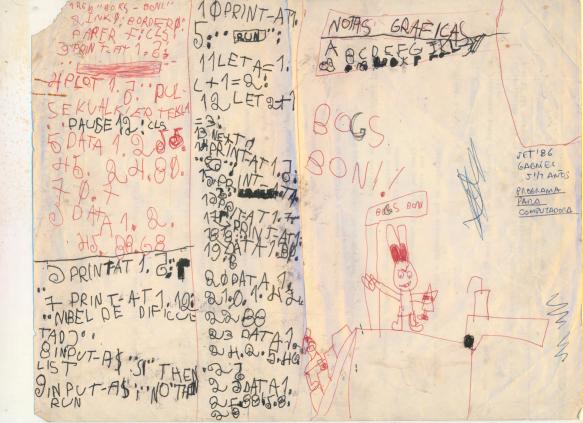
Is that BASIC CODE mixed in with bugs bunny??! Raytracer or no raytracer, this is exceedingly cool.
Re:A Holiday in Honor of the Korean Writing System
on Friday October 11, 2013 @12:21PM (#6534078)
Sinhalese, spoken only in Sri Lanka, naturally has some of these features: http://en.wikipedia.org/wiki/Sinhala_alphabet
1. Fully phonetic
2. Syllables are formed by a logical and consistent system of vowel signs that can be attached to consonant characters
3. Uses pure vowels and largely un-accentuated except for some minor stress on the first syllable of words
4. Alphabet order is logical -- a grid arranged by tongue position and nasalization
The biggest bad thing about the language: the formal grammar is very much latin-like, and equally difficult to master. Fortunately, the spoken version is largely grammar-less.
Source: I speak it.
Re:How to tell your mother and bosses why they should protest surveill...
on Sunday September 22, 2013 @01:14PM (#6427175)
The real issue is that it really doesn't matter that government knows your personal data unless you've something to hide. The problem is that government does not care about one person. The data becomes a threat only in large scale, when it can be used to predict and control society: https://medium.com/surveillance-state/f16655a5879f