mayne
mayne on Hacker News
I've tried it, but it didn't work well together, still looking for a solution, CRDT is the hard part, haha.
I sorry for your experience. It works smoothly for me and hasn't been fully tested yet
I carefully designed the architecture, which is very flexible. The "backend" is currently running on web worker & service worker. It should be possible to deploy it to a web-standard runtime environment for self-hosting.
P2P synchronization based on CRDT is on the roadmap.
Currently, it can only run on high-version chromium-based browsers, and it's compatible with Android, but not iOS. Apple is killing web apps.
What you want is also what I'm working on. Eidos is a personal open-source project focused on individual needs. It respects everyone's privacy. It does not collect any information. Since there is no account system, no need for a logout button
I really love this name. If I use Eidos Space, will there be trademark issues?
It's okay to change the type of title field. I will patch an update.
Interesting, I'll give it a try.
- Eidos has an Airtable-like table, but Obsidian does not.
- Eidos and Obsidian are both file-based.
- Eidos is based on SQLite, and Obsidian is based on Markdown.
I developed an extension to implement the import function, it's still in development and lacking documentation. You can try it out, but I'm not sure if there are any bugs. Feel free to join our Discord to stay updated.
https://github.com/mayneyao/eidos-extension-importer
You can use Eidos with Wi-Fi off. when you add a bookmark, it won't display a rich information card, but just a URL. if you don't like this part, I can provide options to disable them. All of this can be solved through Electron, but I think PWA is enough, and Cloudflare generously provides some services.
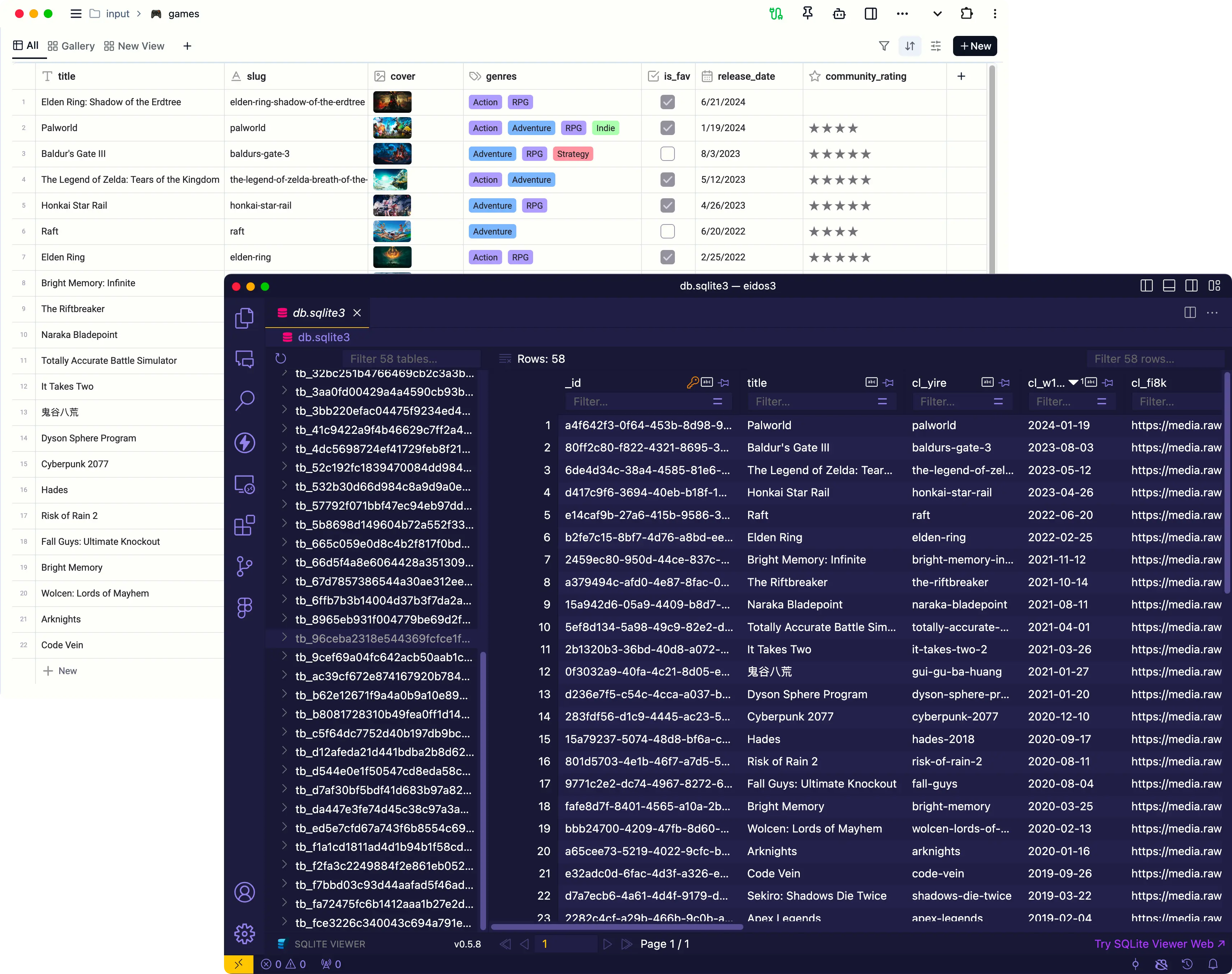
A key idea of Eidos is to make each table a real SQLite table, so users can view and modify it through other software or visualize it with tools like Metabase
https://eidos.space/show/sqlite.webp
good idea. all documents are currently stored in the eidos__docs table. The `content` field is used to store the state of lexical documents in JSON format. Additionally, there is also a `markdown` field. This can be viewed by any sqlite software. Every time a document is updated, both fields are updated simultaneously, making it easy to convert to a file.
Thank you for the information. Eidos Space should be safe. I will consider this issue carefully.
I know many note-taking users like the concept of markdown and plain text. So do I. However, I think plain text has its limitations. There are many other types of structured data in life. Just like Word and Excel, they have different responsibilities. No one worries that Excel will not work in a few decades because it's just an offline software. Similarly, no one worries that SQLite will be unable to open or view because it has already been running with billions of instances, becoming part of the infrastructure.
Sorry for lacking documents and guidance. When you enable a script, you can trigger it by typing 「/」 in command palette (cmd + k). Currently, the selected text only works with the prompt. You reminded me that the script should also be able to handle selected text, and I will add this feature.
Sync is on the roadmap.
Thanks for your advice. Eidos is more like a PDM tool rather than a PKM tool, but it can be used as a PKM with some extensions, just as the introduction says, it's an extensible framework.
I've used the tools you mentioned and more. None of them have a powerful table, which is one of the reasons I decided to create Eidos. Eidos can handle large amounts of data like Excel. Anytype/Outline cannot do this.
I plan to follow Obsidian's model, with the core being always free. here is some plans:
- publish service (subscription-based)
- peer-to-peer data synchronization (One-time payment, like Resilio sync)
- an extension store that benefits developers (still a rough idea in my mind)
Thanks for the reminder. I know this makes SEO more challenging, and it also reminds people of a certain game company, but I really love this concept, which originates from the Plato's theory of forms, and it pairs perfectly with the eidos.space domain name. While it may not be a great business name, the concept itself is exciting.
Eidos is deployed on Cloudflare Pages. it's a purely frontend project and the web is only used for distribution. In order to iterate faster, I didn't use GitHub's release yet.
There are some enhanced experience services running on serverless, but they are not necessary. For instance, adding a bookmark block to a document requires fetching extra information through a URL. This relies on https://github.com/mayneyao/link-preview . Most of the CORS related work is implemented through Cloudflare worker. These services are not necessary. Moreover, they are open-sourced and can be self-deployed. For more details, see https://github.com/mayneyao/eidos/blob/main/lib/const.ts#L64
Posted by
mayne on Friday June 21, 2024 @02:30AM
from the show-hn dept.
https://github.com/mayneyao/eidos
I'm a big fan of Notion, having used it for 7 years. When I first met Notion, it was just a block document editor, and it didn't excite me until it released the Database. Later, I learned about Airtable, and a bunch of similar products, all of them are SaaS, with such powerful tables but poor performance. Why isn't there a personal offline version table? Most of the time, I don't need to...