mark_round
Re:Writing a Demoscene Intro for the ZX Spectrum
on Tuesday October 13, 2026 @10:22AM (#50072250)
Well, I needed that beep-tastic AY sound chip! The 128K model is what the Speccy demo scene kinda gravitated towards, although there are some VERY impressive demos that run on a 48K machine - see https://www.youtube.com/watch?v=W7PX7YBac8k for what you can do with just a beeper!
When I said "stock" I really meant a basic 128K/+2/+3 machine and not one of the interesting Soviet/Eastern European clones with advanced capabilities that some portions of the demoscene adopted.
Re:Writing a Demoscene Intro for the ZX Spectrum
on Tuesday October 13, 2026 @02:06AM (#50067433)
Even after reading the background, and watching the presentations on how it was done, I'm still like "nah, mate, this is straight up witchcraft"
Re:Writing a Demoscene Intro for the ZX Spectrum
on Tuesday October 13, 2026 @01:50AM (#50067299)
Holy CRAP. That is some ground-breaking stuff - One can only imagine what people would have made of it, had they seen something like that back in the Speccy's heydey.
Re:Writing a Demoscene Intro for the ZX Spectrum
on Tuesday October 13, 2026 @01:48AM (#50067281)
This is it exactly! I wrote this back in 2019 on my "Back To The Floppy" post[1]:
  I’ve been thinking a lot recently about what it is exactly about the Amiga that captures me in a way that no other computer ever did. Part of it is I think because the Amiga was the last system that was simple enough that one person could reasonably hold the entire machine in their head.

  It was complex, true, but with enough studying and time you could know pretty much everything about every single bit of the Amiga’s memory space, workbench, the custom chips and so on. That’s what makes it so special and endearing.

  That simply doesn’t exist on other platforms. I mean modern systems are amazing - and I’ve worked on some serious big-iron hardware in my time - but you could spend an entire lifetime now simply becoming an expert in one tiny piece of the whole system. Modern computers just don’t have the accessibility that the Amiga had, and it straddled the divide perfectly between being simple enough to know it and love it, yet powerful enough to do things you’d never dreamed possible.
Re:Writing a Demoscene Intro for the ZX Spectrum
on Tuesday October 13, 2026 @01:46AM (#50067265)
For a perfect blend of the old & new, take a look at https://youtu.be/Lw4W9V57SKs?si=MAHCYx0X9luu6fwu&t=5719 - Razor 1911s 40-year retrospective, starting from the C64, and progressing through Amiga, DOS, and the modern PC scene. I've heard old sceners were literally in tears during the live competition with all the throwbacks, music morphing from C64 SID chiptune to Amiga MOD and onwards, inside references... It's pretty much a love letter to all the phases of the scene's life to date.
Re:Writing a Demoscene Intro for the ZX Spectrum
on Tuesday October 13, 2026 @01:36AM (#50067198)
It's a bit after my time, but I still enjoy showing people new to the demoscene just what is possible with 4Kb of code - https://www.youtube.com/watch?v=ro5grR_efG0
I love the crowd reaction. Would have loved to have been there. There's some great behind the scenes details here: https://iquilezles.org/articles/function2009/
Re:Writing a Demoscene Intro for the ZX Spectrum
on Tuesday October 13, 2026 @01:30AM (#50067158)
Hi! This hit HN after I had gone to bed so only picking up on it now. Thanks for finding that link and letting me know, I've updated the article with a note and your link.
One of the uncomfortable realities I've encountered being involved in the retro scene is that so many of the resources are slowly disappearing, either because the original authors age out of the scene or loose interest (or sadly, many are approaching that age where natural causes are taking them from us), old companies are long since defunct and resources slowly disappear into a legal quagmire or no-one ever thought to archive them in the first place.
Re:AI agent bankrupted their operator while trying to scan DN42
on Friday June 12, 2026 @07:33AM (#48502778)
That was where I started, too. I was fine with VLANs, routing in general and so on from datacenter/DevOps/Sysadmin work, but BGP and how the wider internet fitted together beyond the basics was mostly beyond me.
DN42 is a great playground for this thing - as long as you're prepared to put the effort in, it's a very friendly and helpful community. It's fun to build things for the heck of it and there's a lot of weird and wonderful stuff being worked on there.
Re:AI agent bankrupted their operator while trying to scan DN42
on Friday June 12, 2026 @06:24AM (#48502210)
Strangely enough, that's one of the big draws for me. I'm "on the spectrum" and often find face-to-face socialisation and making new contacts very draining. I tend to prefer systems to people - although as time went on, I realised one of the things I really enjoy about DN42 is making the human contacts!
After getting started with the various "auto peering" systems, I've been making much more of an effort to find individual operators[1], and add myself to the peerfinder and hang out on IRC.
It really does feel like the "old internet" and while the technology and learning opportunities are great, it's the people that really make the network.
[1]=If you're interested, I'm more than happy to peer with you - details at https://markround.com/dn42
Re:Writing Z80 assembly, 4 decades later:-)
on Monday May 18, 2026 @03:15PM (#48184160)
It does indeed work! You can see it running here on my +3 in my "retro cave" :)
https://share.markround.com/sphere.jpg
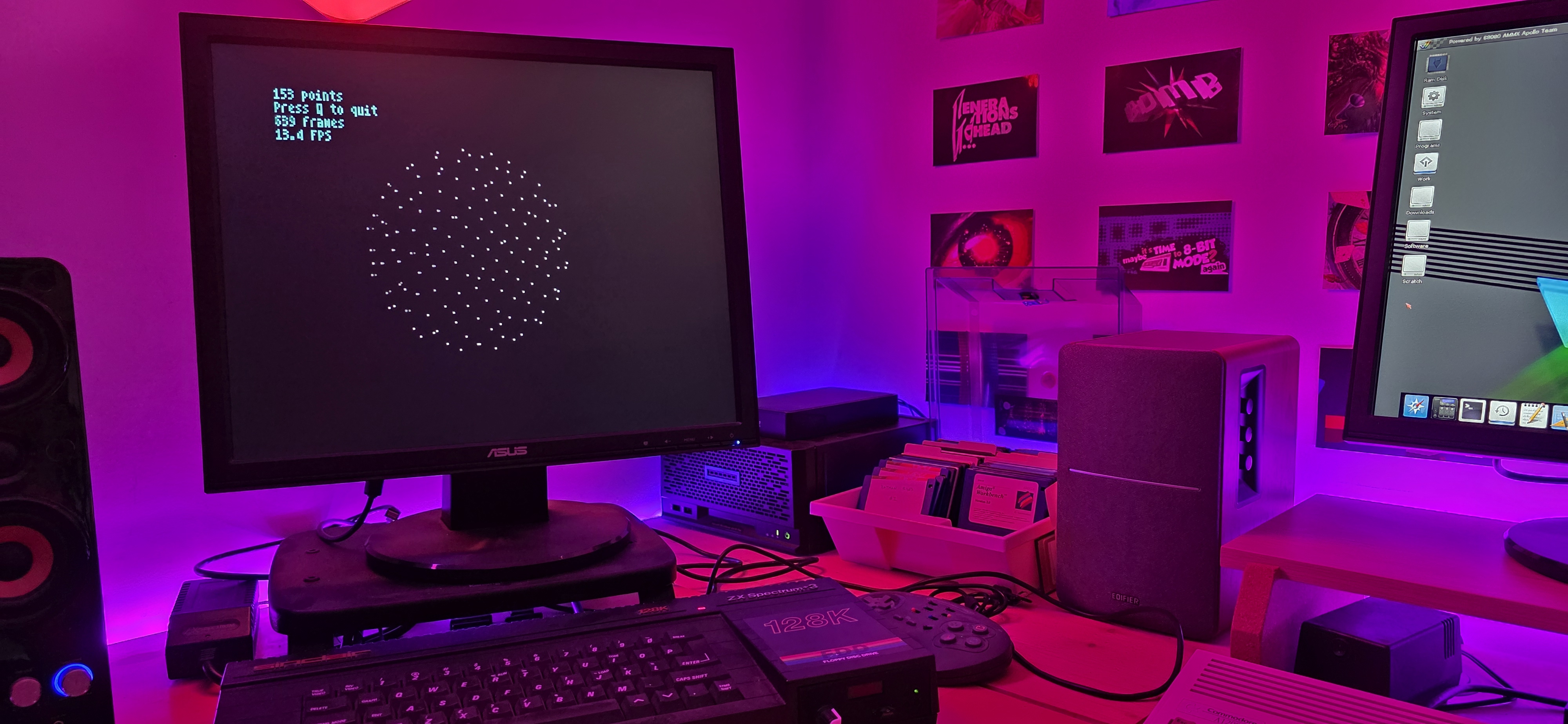
I have also uploaded it to my TNFS site[1], which you can also access through an emulated Speccy in a browser (or a real Spectrum if you have a Spectranet/Spectranext card fitted):
https://jsspeccy.markround.com
Press option 4 on the main menu when it loads for recent uploads.
It's really cool and very, very smooth. I wasn't quite sure what to categorise it as on my site, so I filed it under "demos" as I think it's a very impressive bit of code :)
Thanks for sharing!
-Mark
[1]=More details at https://tnfs.markround.com or on my "DevOps for the Sinclair Spectrum" series of articles which are linked from both sites.
Re:Lets Encrypt Stopping Issuance for Potential Incident
on Friday May 08, 2026 @04:05PM (#48068042)
"We have been made aware of a potential incident and are shutting down all issuance" seems to lean towards the latter and not simply a technical issue :(
Re:Lets Encrypt Stopping Issuance for Potential Incident
on Friday May 08, 2026 @04:03PM (#48068011)
That's really not good. Fortunately I'm not using any short-lived certificates like the recently announced 6 day certs, so have some breathing room. Without further details, I'd imagine anyone with a short-lived cert is getting a bit sweaty right now.
Let's Encrypt has become one of those pieces of critical Internet infrastructure that just quietly hums away in the background, the fact that they've stopped ALL issuance is deeply concerning.
Re:Sloppy Copies
on Monday April 27, 2026 @01:31AM (#47918023)
I do really enjoy working on the site, it's great to have an outlet and playground for ideas and do things just for fun. There never was (and never will be) any commercial angle for this, as I said in a footnote in the "Sloppy Copies" post, I have other motives for writing code and I appreciate I am very fortunate that I have the opportunity to be able to do that.
There's always been a tendency amongst the "priesthood" of any in-group to hoard knowledge and use it to maintain their position. So, regarding the "democratizing" of creating software - I mostly agree with you, and also agree that it's probably a good thing. I think it's pretty neat that someone without any coding experience can create their own bespoke tooling to solve a problem. I have caveats and concerns, but that's a topic for another day.
I also agree with the "that's art" part of your comment. I learned to program by reading other people's code, learned to build infrastructure by watching what my peers were doing, and learned to play an instrument by listening to and copying musicians I admired. Heck, I play in a covers band!
The problem is that this isn't just someone being inspired to create their own thing and put their own spin on it, which could be cool.
Even "nice idea, I'm going to do that and see if I can charge for it" isn't really an issue, free market and all that. This is cloning and copying on an automated, industrial scale, apparently sometimes for malicious, criminal purposes too.
That's a far cry from creative copying of ideas.
Re:Sloppy Copies
on Monday April 27, 2026 @12:50AM (#47917803)
This is the issue.
I posted more or less the same thing in a comment over on lobste.rs[1] - being able to create your own bespoke software tools, without any developer experience is (mostly) a really cool thing.
This isn't someone being inspired to build something: It's the automated "drive-by" cloning and scammy, dubious nature of these clones that bothers me along with the copying of personas & identities to spam them across social media.
Re:Returning to Rails in 2026
on Thursday March 12, 2026 @05:03AM (#47348157)
You're about the 5th person now in as many days who has recommended Elixir when I mentioned I was building a project in Ruby. I'll definitely have to check it out for my next project (whatever that may be!)
Can you expand on why you found it so appealing or "holy crap, this is awesome" things I should look at first ?
Re:Returning to Rails in 2026
on Thursday March 12, 2026 @05:00AM (#47348139)
The "one-person framework" thing is a big draw. I'm amazed at how productive I was in it, and it's not just at the code level. Even though I've been doing sysadmin/devops/architect work for over 25 years now, it's just so damn nice now not to have to think about e.g. standing up a HA PostgreSQL cluster or Redis and deployment is largely a solved problem.
Re:Returning to Rails in 2026
on Thursday March 12, 2026 @03:45AM (#47347677)
Author of the article here (hi! Anxiously watching my Grafana stack right now...)
I've only just noticed that on the Rails homepage, and while I acknowledge everyone's chasing that sweet sweet AI hype, I gotta say that's... disappointing[1]. The reason I fell in love with Ruby (and by extension, Rails) is because it enabled me as a human to express myself through code. Not to become a glorified janitor for a LLM.
[1]=Well, I had a stronger response initially but I toned it down a bit for here...
Re:Returning to Rails in 2026
on Monday March 09, 2026 @07:00AM (#47307438)
Definitely. It really makes me wish it was getting more attention - and I know I'm late to the party having only picked it back up over a year after Rails 8 was released! It's just such a smooth experience and I haven't found anything like it that compares.
The thing that really impresses me is how it's become a "one person framework"[1] and thanks also to the "batteries included" approach, you can run everything with zero external service dependencies. I have no problem with managing other services like a cache or DB, but it's just so damn nice to be able to focus on the code and not have to context switch!
[1]=Tons of posts and presentations I'm discovering now referring to that. EG https://mileswoodroffe.com/articles/rails-the-one-person-fra...
Re:Returning to Rails in 2026
on Monday March 09, 2026 @06:48AM (#47307339)
Author here, thanks for posting this! Any questions, comments or "You're wrong and this is why" let me know :) I do find myself wondering about the future of Rails (and I guess the wider Ruby ecosystem) though. I'm definitely in the "you can prise it from my cold, dead hands" camp but after years of watching them both slide down developer surveys it does make me concerned.
I'm kinda attached to "odd" outsider technologies like the Amiga and BeOS (which does make me wonder if there's a common thread there) so am used to seeing old packages and documentation gradually fade away but that's clearly not something that points to a sustainable future.
There's enough of the core components still active and after 20-odd years you could just say "it's done" (as I allude to in the Wrap Up) but I do wonder how many here would start a new project on Rails or make a Ruby platform a critical part of a new start-up ?
Re:Running Your Own As: BGP on FreeBSD with FRR, GRE Tunnels, and Poli...
on Sunday February 08, 2026 @11:42AM (#46935948)
If you'd like to experiment with running your own AS in private address space, connecting to a friendly network of geeks over wireguard tunnels, check out DN42 https://dn42.dev/Home.
It's a great way to explore routing technologies and safely experiment with your own AS, running the same protocols as the "real" Internet, just in private space.
If you do get set up, give me a shout (https://markround.com/dn42), I'd be happy to peer with you if you want to expand beyond the big "autopeer" networks :)
Re:Stop Breaking TLS
on Wednesday December 10, 2025 @06:01AM (#46216386)
That was what I was thinking of (but worded it badly in the middle of my rant!)
If I wanted to intercept all your traffic to any external endpoint without detection I would have to compromise the exact CA that signed your certificates each time, because it would be a clear sign of concern if e.g. Comodo started issuing certificates for Google. Although of course as long as a CA is in my trust bundle then the traffic could be intercepted, it's just that the CT logs would make it very clear that something bad had happened.
Re:Stop Breaking TLS
on Wednesday December 10, 2025 @04:12AM (#46215668)
Author here, hi! Was just venting last night, but that's a very good point, I'll update it later with your correction :)
Re:Old Computer Challenge – Modern Web for the ZX Spectrum
on Tuesday October 21, 2025 @01:43PM (#45658924)
There is also Spectranet[1] and clones for the Sinclair Spectrum, which allows for a much richer Internet-connected experience. It can load and boot remote programs from a server which allows you to get quite creative and produce sites like my TNFS server[2]. You can also try it out from an emulated Spectrum in a web browser at https://jsspeccy.markround.com if you don't have the original hardware lying around to see the sort of stuff you can build!
There's also Telnet clients so you can access old-school BBSes, and a variety of interesting "bridges" that grant access to Gopher or even parse websites. Quite amazing to access the modern Internet on an 8-bit machine from the early 80s that originally loaded games from cassette tape :)
Re:Dual Kickstart ROM Replacement for Amiga
on Saturday April 12, 2025 @04:27PM (#43667689)
It's a lot of fun, still! I touched on it in my "Amiga Systems Programming in 2023" post[1] which had some discussion here[2]. In the few years since then there's been lots of development still across the whole scene. OS4 is largely stagnating (although I still fire up my X5000 whenever I have a chance) but the classic 68k scene is positively thriving.
Lots of great software & homebrew games, and the hardware options now are just amazing. There's FPGA, emulation, PiStorm accelerators, Vampire, re-amiga... and only this month, Hyperion released an updated OS3.2[3].
It was (and is) such a versatile, forward-thinking platform and I still very much enjoy seeing how far the community can take it.
[1]=https://www.markround.com/blog/2023/08/30/amiga-systems-prog...
Re:The legacy of NeXT lives on in OS X (2012)
on Sunday December 22, 2024 @04:08AM (#42485241)
A tangent I know, but looking at those old screenshots really made me miss that era of OS X. The first versions of Aqua with pinstripes were a bit busy for my liking, but by the Mountain Lion time frame it was just lovely. Actual buttons! Soft gradients! Icons that had colour!
Re:Ascending Mount FujiNet
on Saturday December 21, 2024 @07:54AM (#42479387)
Thanks! It was a lot of fun to put together, and the site has expanded in scope considerably since I wrote those articles. Whenever I get a few moments, it's one of my favourite projects to work on, there's just something very "zen" about going back to Sinclair BASIC and all the limitations which enforce some creative hacks. I was particularly pleased with the user preferences system[1] and articles code which mimics some of the early disk/tape magazines I remember from my early teens.
So many of us of a certain age started with those early 8-bit computers, I guess "booting" straight into a BASIC prompt encouraged that exploration and experimenting which is a little harder to get at these days.
I never played the original Starstrike, but Starstrike II is still one of my favourites - impressive to see a 3D engine running on an 8-bit micro with 48Kb of memory and makes you wonder what we're spending all those cycles on now!
[1]=https://spectrumcomputing.co.uk/forums/viewtopic.php?p=11776...
Re:Ascending Mount FujiNet
on Friday December 20, 2024 @06:00PM (#42475957)
The TNFS protocol used by FujiNet has also been used in other network cards for old 8-bit computers. My own ZX Spectrum is fitted with a Spectranet card which enables the same kind of connectivity and creativity. I wrote about it in my "DevOps For The Sinclair Spectrum" article[1] which featured here, and my TNFS site is now available through a JS emulator on a web page[2] if you want to see the kind of thing you can create. It's sort of like an old-school BBS, except the code is downloaded and run directly on your computer, which opens up a world of possibilities like multi-player games and even bridges to protocols like Gopher, Gemini and IRC which make communicating with the "modern" Internet possible even on an ancient tape-loading 8-bit micro from the 80s. Really fun stuff!
[1]=https://www.markround.com/blog/2021/12/21/devops-for-the-sin...
Re:ZX Spectrum Documentary 'The Rubber Keyed Wonder' Gets London Premiere
on Wednesday September 11, 2024 @09:10AM (#41511024)
Still got mine. Still write code on it, too[1] although it's now connected to the Internet with a Spectranet card. My 9-year old self would have been astonished that there's still a lively scene surrounding the Spectrum and some quality games still being released for it today. Or that I'd still be writing Speccy BASIC code projects[2] in the 21st century!
It's remarkably fun to tinker with still, and I don't think it's purely nostalgia for me. Although there's certainly an element of that at play, I think it's more the "zen" like simplicity that's appealing these days of hugely elaborate cloud-native stacks and hardware so complex there's no way anyone can hold it all in their heads. The Spectrum and other 80s home computers in contrast were so accessible and people did (and still do) astonishing things within those limits. The Speccy no doubt launched hundreds of thousands of careers, mine included.
Plus, with those limitations, games simply had to be playable to be successful as they couldn't on gimmicks! I honestly prefer a good game of Manic Miner over any modern title. The Spectrum & Amiga years were the glory days of old-school gaming for sure!
[1]=https://www.markround.com/blog/2021/12/21/devops-for-the-sin... - If you've ever wondered how to do CICD and client/server for an 8-bit computer from the '80s :P
Re:Roguecraft Devs on Developing for Amiga in 2024
on Monday July 29, 2024 @03:41PM (#41103096)
I wrote an article about the very subject : https://www.markround.com/blog/2023/08/30/amiga-systems-prog...
Which also featured on HN at the time, with some very insightful comments and discussion: https://news.ycombinator.com/item?id=37389376
TL;DR is I cross-compile using VSCode & Docker from Mac/Win/Linux mainly, but if I want to develop in the Amiga environment (e.g. on native) I use VBCC on 68k.