maouida
Re:Muse Spark Open
on Friday October 16, 2026 @04:20AM (#50115629)
I hate it that zuck is the one promoting open weight models.
Re:Ask HN: CAD for wood working with LLM support?
on Thursday October 15, 2026 @01:53AM (#50099727)
I have started tje POC 2 years ago without AI. When it reached a shape I like I started using AI. Now all code is AI written but I'm still controlling the overall architecture.
Re:Ask HN: CAD for wood working with LLM support?
on Tuesday October 13, 2026 @02:43AM (#50067681)
I'm a developer and hobbyist woodworker too :)
I'm also the developer of FluidCAD. It has an MCP you can wire to any LLM. It runs locally on your machine.
It is still missing features for splitting the model into parts, but that is coming in a future release.
MCP config (node.js required): https://fluidcad.io/docs/cli/#fluidcad-mcp
Re:OpenSCAD the Programmers Solid 3D CAD Modeller
on Saturday October 10, 2026 @03:52PM (#50036513)
Shamelss plug:
I have built FluidCAD[1] to overcome the issues of CAD by code, less mental effort to design by providing visual guidance. Slowly it became more of a hybrid CAD experience (mouse or code driven), almost all features now can be done by mouse and the code is generated for you. It'll pick the right selection filters for you.
Re:Is Claude 20x actually 20x?
on Tuesday September 22, 2026 @10:20AM (#49801755)
20x is only for the session limit not the weekly limit.
Re:FreeCAD in the Browser
on Tuesday September 22, 2026 @08:20AM (#49800060)
Online here: https://freecad.virtastic.app/
Re:Cartesian – AI 3D Modeling for Design
on Tuesday September 15, 2026 @03:35PM (#49717722)
From my experience trying to build parametric CAD modeling using FluidCAD [1] using its MCP, the biggest breakthrough is ASTRA. It seems to work well actually with any CAD if it has ways to verify its output. No otjer models was able to match its accuracy even Fable.
Re:Ask HN: What are you working on? (September 2026)
on Sunday September 13, 2026 @04:27PM (#49688340)
I published a big update to my open source project FluidCAD adding support for sketch constraint solver and assemblies.
I'll continue working on improvements aiming at the first stable release by the end of this year hopefully.
Re:Benchmark: CadQuery vs. OpenSCAD for agentic CAD work
on Sunday September 13, 2026 @04:15PM (#49688230)
I'm going to test this with FluidCAD later. Will post the result here.
Re:Ask HN: Who wants to be hired? (August 2026)
on Tuesday August 04, 2026 @06:31AM (#49166644)
Location: Tunisia
Remote: Yes
Willing to relocate: No
Technologies: .NET, C#, Node.js, Postgres, Angular,... Any tech/framework.
Résumé/CV: https://cv.marwan.dev/marwan-aouida-cv.pdf
Github: https://github.com/marwndev
Email: [email protected]
Re:Ask HN: What are you working on? (August 2026)
on Sunday August 02, 2026 @10:06PM (#49150419)
I continue working on FluidCAD, a hybrid CAD by code (JS) + mouse based modeling.
I'm focusing on improving the 2D sketcher this week.
Re:Ask HN: What apps are you building?
on Tuesday July 28, 2026 @02:48PM (#49088231)
I work on FluidCAD on my free time.
I published v0.0.40 last weekend with some big updates.
Re:CadQuery is an open-source Python library for building 3D CAD models
on Friday April 17, 2026 @08:38AM (#47805288)
Replicad is designed primarily to be used as a library with the web editor as a helper.
FluidCAD is designed to be used as full CAD package code + UI. I've outlined some of my motives in recent post: https://news.ycombinator.com/item?id=47721997
Re:CadQuery is an open-source Python library for building 3D CAD models
on Friday April 17, 2026 @07:50AM (#47804901)
Only step import at the moment. I'll add svg next.
Re:CadQuery is an open-source Python library for building 3D CAD models
on Friday April 17, 2026 @07:05AM (#47804596)
+1 for what adrian_b answered above.
All the promotion are for free open source projects and none of them is profitable.
I think this is totally fine, people like to know about alternatives and all these tools are for the purpose of learning and making parametric CAD more approachable to users. They have same goal with different implementation.
Re:CadQuery is an open-source Python library for building 3D CAD models
on Friday April 17, 2026 @04:51AM (#47803846)
CadQuery was an inspiration when I built FluidCAD. I wanted the workflow to be as close to traditional CAD as possible with more interactive UI.
The Physics of GPS
Re:Show HN: FluidCAD – Parametric CAD with JavaScript
on Saturday April 11, 2026 @05:42AM (#47729086)
I have added a caching mechanism; objects are computed only when their parameters change. When an object change, all objects after it will recompute. This will probably need to be revised in future with more efficient algorithm to find what objects are affected by the change and recompute only those.
Re:Show HN: FluidCAD – Parametric CAD with JavaScript
on Saturday April 11, 2026 @05:20AM (#47728971)
Yep, topological naming solving is a hard problem to solve. It took FreeCAD many years to get it to work correctly. That's why I went with indices for this version. You can also use filters like extrusion.endFaces(face().arc()) to get only arc edges.
Regarding the picking; that's exactly the region picking feature in this screenshot: https://fluidcad.io/img/region-extrude.gif
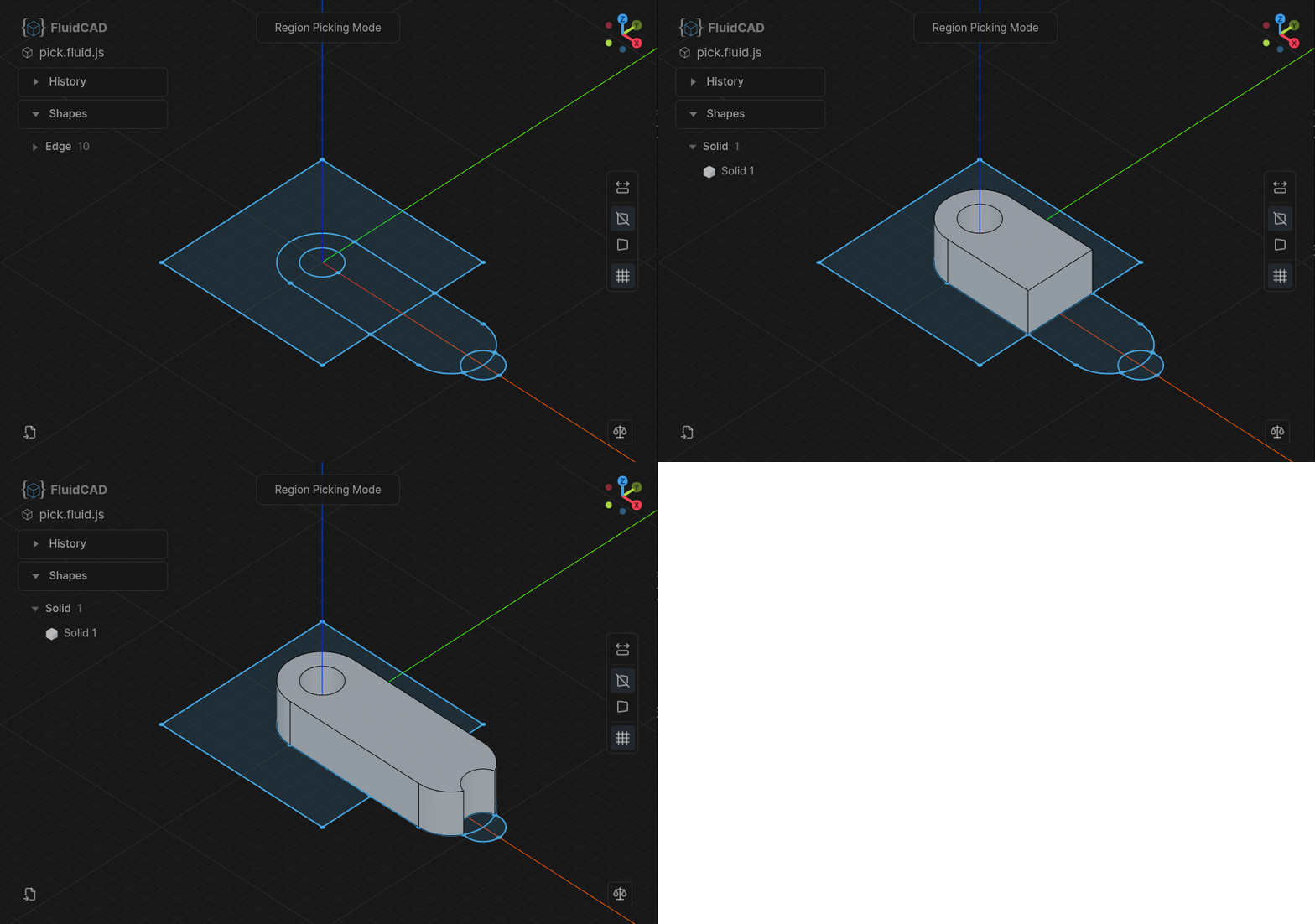
When the user click on a region we insert a 2D point, then the extrude feature will find the nearest face. I have experimented with adding this picking logic to selections too select().pick() which will probably be merged in future releases.
Re:Show HN: FluidCAD – Parametric CAD with JavaScript
on Saturday April 11, 2026 @02:16AM (#47727946)
The interactive region extrude feature is designed specifically for fast modeling at the expense of making the model "not so parametric". When user pick a region, the raycasted point is inserted/hardcoded in the code. e.g extrude(100).pick([100, 100])
So if the sketch dimensions change, there is a chance the point will fall outside the region boundaries which will break it.
It is preferred to use proper boolean operations in sketch mode to define regions while keeping it parametric.
The interactive region extrude is there for when you want fast modeling/prototyping.
Re:Show HN: FluidCAD – Parametric CAD with JavaScript
on Saturday April 11, 2026 @02:12AM (#47727925)
The constraints solving took a good amount of thinking while designing FluidCAD. At first I tried to make it all declarative where user just create unconstrained geometries then define constraints, something like:
const l1 = line();
const c1 = circle();
// define constraint
l1.length(100).position(x, y).tangentTo(c1)
...
Then I decided against this idea because it results in too much typing + the constraint solver implementation is not trivial and there is not much web based open source solvers. I went with a mixed approach instead between declarative and imperative. https://fluidcad.io/docs/guides/sketching/constrained-geomet...
Re:Show HN: FluidCAD – Parametric CAD with JavaScript
on Saturday April 11, 2026 @02:05AM (#47727893)
It seems from what you are describing your software is more like (replicad)[https://github.com/sgenoud/replicad]
The user can create planes with plane() command e.g plane("xy") or plane("xy", { offset: 10 }); but I have added some shortcuts for common planes (https://fluidcad.io/docs/guides/sketching/introduction#sketc...)
you can also sketch on faces sketch(extrusion.endFace(), ...) which will extract the plane from face and put the starting point on the center for convinience.
Re:Show HN: FluidCAD – Parametric CAD with JavaScript
on Saturday April 11, 2026 @01:58AM (#47727861)
Most of the CAD operations are supported, some are just basic implementations which will be improved soon.
https://fluidcad.io/docs/category/3d-operations
Assemblies will come but not anytime soon. I did some research and tests and it is going to be a challenge. You can still add multiple parts in one scene but no actual joints implementation.
Re:Show HN: FluidCAD – Parametric CAD with JavaScript
on Saturday April 11, 2026 @01:57AM (#47727854)
Yes, PRs will be open on v0.1.0
I just want to finalize some design decisions and create a roadmap first.
Re:Show HN: FluidCAD – Parametric CAD with JavaScript
on Friday April 10, 2026 @04:57PM (#47723572)
You are welcome.
There is a guide section and one tutorial: https://fluidcad.io/docs/guides/
This week will be all for documentation.
It is only a subset of features focused on solid modeling. Surface modeling will come in future versions
Re:Show HN: FluidCAD – Parametric CAD with JavaScript
on Friday April 10, 2026 @03:11PM (#47722347)
Based on opencascade wasm.
Features in the docs.
Api coming soon.
No it was not, I started this before I even started using coding agents. It took many iterations and rewrites before settling on the current shape. After building the core features I started using claude to add more features, improve test coverage and generte docs.
Show HN: FluidCAD – Parametric CAD with JavaScript
Hello HN users,This is a CAD by code project I have been working on on my free time for more than year now.I built it with 3 goals in mind:- It should be familiar to CAD designers who have used other programs. Same workflow, same terminology.- Reduce the mental effort required to create models as much as possible. This is achieved by: - Provide live rendering and visual guidance as you...
Re:Build123d: A Python CAD programming library
on Monday March 30, 2026 @03:03PM (#47578370)
I'm working on one with features you mentioned, with the main goal to make the workflow similar to mainstream CAD. Will release the first dev version in less than a month.
Re:Ask HN: When will LLMs generate professional-level CAD models?
on Wednesday February 04, 2026 @03:44PM (#46891464)
I'm working on a parametric, feature based CAD by code software which should be released next month.
LLMs are good at generating code. It should be able to handle any complex task given a good documentation. I'm planning to write an mcp for providing feedback to the LLM but that will come at a later stage.
The code is based on js and opencascade with a feature rich vscode extension.
I'll post it here on release day.