keth
Re:Today, Europe Lost The Internet. Now, We Fight Back
on Thursday September 13, 2018 @11:04AM (#17979160)
I believe you are looking for this: http://www.europarl.europa.eu/sides/getDoc.do?pubRef=-%2f%2f...
Additionaly there is also this picture from Julia Reda: https://pbs.twimg.com/media/Dm5kGq5X0AANQZs.jpg
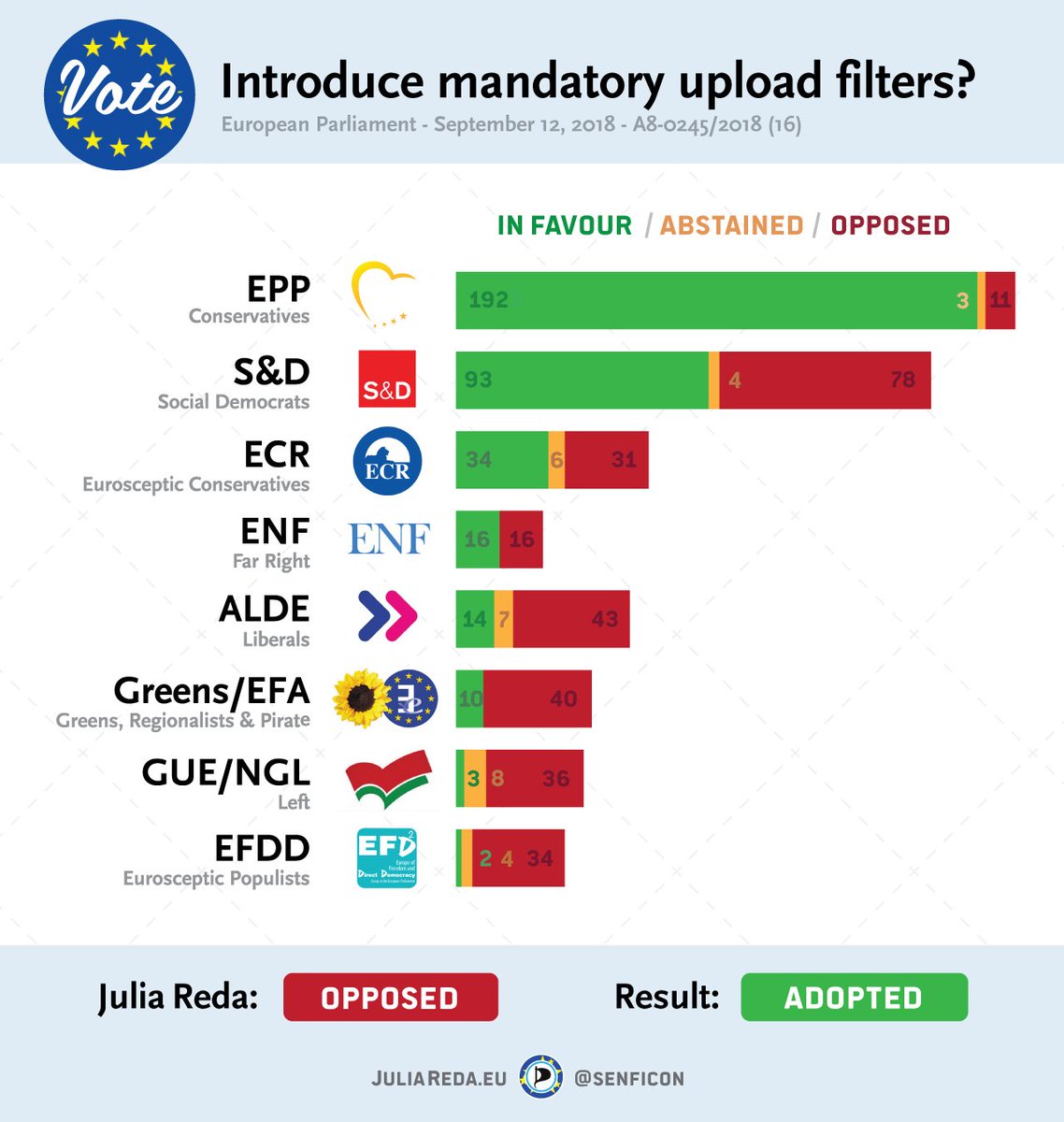
Source: https://twitter.com/Senficon/status/1039881088078958592
Re:Show HN: Layoutit – An interactive CSS Grid generator
on Thursday July 26, 2018 @04:38PM (#17620826)
I remember a video + blog post about this, and it was suggested to just ship a mobile layout for browsers that don't support css grid. At least for personal sites that seemed reasonable.
Re:YouTube’s Piracy Filter Blocks MIT Courses, Blender Videos, and More
on Monday June 18, 2018 @12:05PM (#17339305)
Terrific, I can't wait for what will happen with the forced content filter that will be voted on in the european parliament on june 20th. what could go wrong...
Re:70% Repetition in Style Sheets: Data on How We Fail at CSS Optimiza...
on Monday June 26, 2017 @07:06PM (#14641177)
Could you not just run uncss [0] on the framework and your own CSS? Or does it get tedious to exlcude classes that are used by js? Only ever used it (and other optimizations) for static sites in order to get 100 points on pagespeed.
Re:Java 10 – Specification for Value Types
on Monday June 19, 2017 @04:13AM (#14585317)
Don't Haskell and Scala also erase the types? If I remember correctly Martin Odersky even said erasure is better for some things in one of his videos/keynotes (?), but I'm not sure if I remember that correctly.
Re:Scala Native 0.3.0 released – including new garbage collector (Immi...
on Saturday June 17, 2017 @04:53AM (#14574951)
Thanks for the answer. I'm looking forward to it. Now I wish scala.js would also be able to compile the compiler. Would be a nice benchmark for the language runtimes since the compiler is a non trivial program.
Re:Scala Native 0.3.0 released – including new garbage collector (Immi...
on Friday June 16, 2017 @06:50AM (#14567883)
Could scala native be used to compile scalac in the future (if enough of java.* has a clean room implementation)? And could that speed up compile time of scala programs, or is compilation bottlenecked by IO (or other things) which may not be enhanced by scala native?
Re:Scala.JS 0.6.17 released
on Sunday June 04, 2017 @06:18PM (#14483936)
What's the generated file size after gzipping for the project compared to coffeescript + jquery if I may ask?
Also, can scala.js be used for progressive enhancement on static sites, or is it limited to single page apps due to the need to map scala semantics to js?
Re:Facebook's tentacles reach further than people think
on Friday May 26, 2017 @06:23PM (#14427626)
I have acquaintances like that as well. They are usually the "I have nothing to hide" kind of type. :(
Re:Europe is living under Microsoft’s digital killswitch
on Friday May 12, 2017 @05:59PM (#14328263)
I always wonder why the european countries don't work together to build their own software. Or at least a single country looking at germany, where each city seems to brew it's own stuff.
Imagination's New PowerVR Furian GPU Architecture
Re:AMD Collaborates with Microsoft to Advance Open Source Cloud Hardware
on Wednesday March 08, 2017 @05:15PM (#13824391)
Microsoft's Project Olympus platform design to incorporate the upcoming high-performance "Naples" x86 server processor
AMD Collaborates with Microsoft to Advance Open Source Cloud Hardware
Re:AMD Prepares 32-Core Naples CPUs for 1P and 2P Servers: Coming in Q2
on Wednesday March 08, 2017 @02:58PM (#13823197)
Here is the newest PDF about something like that: http://www.computermachines.org/joe/publications/pdfs/hpca20...
Re:Microsoft Pledges to Use ARM Server Chips, Threatening Intel's Domi...
on Wednesday March 08, 2017 @11:34AM (#13821338)
Maybe you mean Skybridge? The last I read K12 was only delayed until 2017/2018 (but Skybridge was cancelled).
Re:Microsoft Pledges to Use ARM Server Chips, Threatening Intel's Domi...
on Wednesday March 08, 2017 @11:31AM (#13821319)
Project Skybridge was cancelled as far as I know. [0] Not sure if we see something like that in the future, considering how quiet AMD is about their ARM plans. Although a ARM chip with really good power efficency would be nice below Ryzen.
Finally, we’ll note that this roadmap is empty of any mentions of project Skybridge. CEO Lisa Su has commented that AMD has decided to change their focus away from Skybridge based on customer feedback. Customers were telling AMD that they didn't necessarily need socket compatible solutions, so AMD is going to work on differentiated solutions. That said, given that Skybridge was announced last year and planned for 20nm, I suspect that it has also become a victim of the short lifespan (and underperforming nature) of 20nm, leading to it being downplayed in favor of 14nm prodcts.
Re:Softbank to sell 25% stake in ARM Holdings to Saudi-backed investme...
on Wednesday March 08, 2017 @10:50AM (#13821019)
Looking at Global Foundries, no.
Re:AMD Prepares 32-Core Naples CPUs for 1P and 2P Servers: Coming in Q2
on Wednesday March 08, 2017 @05:23AM (#13819296)
> 5. Between now and 2020, the roadmap has Zen+ and 7nm. Along with PCI-E 4.0. I am very excited!
Yes, and it's rumored that the top end 7nm chip will be 48 cores (codename starship). Exciting times ahead now that the competition is back.
Re:AMD Prepares 32-Core Naples CPUs for 1P and 2P Servers: Coming in Q2
on Tuesday March 07, 2017 @01:13PM (#13812966)
I'm looking forward to the benchmarks since the performance per watt of the desktop parts (Ryzen R7) seems to be really good. Quite curious how it will compare against Skylake-EP.
A quote from a anandtech forum post [0] reads promising:
"850 points in Cinebench 15 at 30W is quite telling. Or not telling, but absolutely massive. Zeppelin can reach absolutely monstrous and unseen levels of efficiency, as long as it operates within its ideal frequency range."
A comparison against a Xeon D at 30W would be interesting.
The possibility of this monster maybe coming out sometime in the future is also quite nice: http://www.computermachines.org/joe/publications/pdfs/hpca20...
[0] https://forums.anandtech.com/threads/ryzen-strictly-technica...
Re:Intel Is Trying to Manipulate AMD Ryzen Launch?
on Monday February 27, 2017 @09:00AM (#13744169)
> I sure hope Intel is not up to the same antitrust-worthy shenanigans again.
That's why I posted this even though it's nothing but a rumor at this point. I've met many colleagues over the last years who either didn't knew or had forgotten what Intel did in the past. This rumor should remind them to be wary when reading the reviews (just in case).
Intel Is Trying to Manipulate AMD Ryzen Launch?
First AMD Zen (Ryzen) cpu benchmarks leaked by french magazine
Re:Ask HN: What are the best practices for web authorization at the mo...
on Monday February 22, 2016 @04:47PM (#11154539)
Yes, I'm not always sure about what is what. The line between business rules and authorization rules seems to be thin/blurred at times to me.
Re:Ask HN: What are the best practices for web authorization at the mo...
on Monday February 22, 2016 @02:29PM (#11153552)
Your sense of smell might be on point here. I dont know. But I've noticed that I tend to sometimes over-engineer things. Maybe because I did the exact opposite in the past and had to rewrite large parts of a hobby project because it was to tightly coupled.
Took a while to answer because apparently I submit my comments too fast. :O
Re:Ask HN: What are the best practices for web authorization at the mo...
on Monday February 22, 2016 @12:29PM (#11152541)
Oh, cancan is alive? Cool. I already looked at the old CanCan repo and it's the best looking library for inspiration I've found so far. Maybe I should dig deeper to see how more complex authorization rules are handled.
Re:Ask HN: What are the best practices for web authorization at the mo...
on Monday February 22, 2016 @12:18PM (#11152436)
Do you know of more involved examples that use claim based authorization? So far I have only seen simple use cases that at most involve if a user works for a certain company, or that a user can only delete his own postings (userID == authorID), which I can easily handle with permissions. But I have not seen slightly more complex ones yet like the example in the OP or really complex ones. But will definetly look into it, the .net implementation seems fairly easy to understand (after skimming through some files).
Re:Ask HN: Pros and Cons of standing and coding
on Monday February 22, 2016 @12:09PM (#11152354)
I have noticed that I think better directly after the switch from sitting to standing, or vice versa. If I sit or stand too long it get's worse.
Re:Ask HN: What are the best practices for web authorization at the mo...
on Monday February 22, 2016 @11:53AM (#11152207)
Oh, the system that will be used in .net mvc? So far I've only seen that permissions and roles can be modeled with claims, but could that not lead to the same problem like with roles (e.g user.hasClaim("foo") || user.hasClaim("bar") || ...)?
Ask HN: What are the best practices for web authorization at the moment?
Hi,since authorization is important to me as a beginner, I want to ask what are the best practices for web applications at the moment if one needs more fine grained authorization rules than simple roles or permissions for a sideproject (which will probably never turn into something profitable, nor is it planned at the moment)?Until now I've seen role based authorization which works for simple...