jrullmann
For People to Trust You, Reveal Your Intentions – HBR
Vegas: Declarative format for creating and saving visualization designs
Web Accessibility Checklist – The Accessibility Project
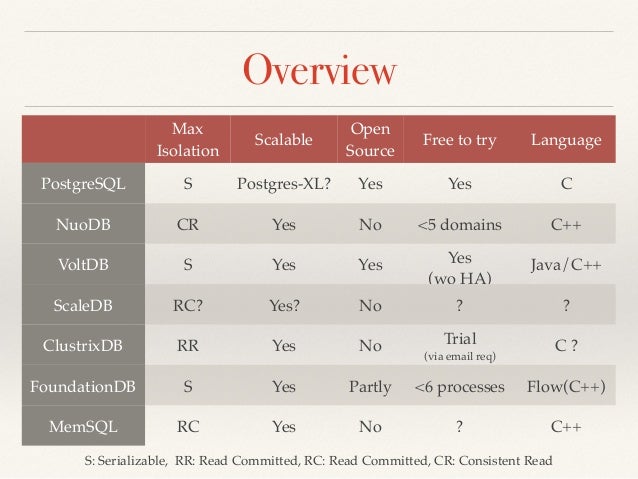
Re:NewSQL overview
on Friday February 13, 2015 @10:12AM (#9044686)
Take a look at the Overview slide of the presentation, where this information is listed for each database the author discussed: http://image.slidesharecdn.com/newsql-2015-150213024325-conv...
Re:Principal component analysis explained visually
on Thursday February 12, 2015 @02:05PM (#9040647)
Seeing how each visualization adjusts as I change the original dataset is so useful. The technique reminds me of Bret Victor's amazing work.
Ladder of Abstraction Essay: http://worrydream.com/#!2/LadderOfAbstraction
Stop Drawing Dead Fish Video: https://vimeo.com/64895205
This is awesome, thanks for sharing!
Horizontal Scalability, Response Time and Throughput with SQL
Re:The shipping network that keeps the world running
on Wednesday February 11, 2015 @11:13AM (#9033658)
Along those lines, this article about Malcolm McLean (often called the father of containerization) is a great read.
RegExpBuilder – Create regular expressions using chained methods
Graphity: An Efficient Graph Model for Retrieving the Top-k News Feeds for Users
Stop Drawing Dead Fish
Unexpected Use Cases and Possible Usages of an Event Store
The Most Common Problems Which Cause Outages of Production Servers
Fallacies of Distributed Computing Explained [pdf]
Why I Won't Relocate to Work for Your Startup
3 Tips for Selling a Geeky Idea to Everyone
Re:Conspire – Find the best path to any person or company
on Thursday January 29, 2015 @04:03PM (#8968815)
Looks cool. Would love to know what Conspire uses as their technology stack.
Re:Fake2db – Generate fake but valid data-filled databases
on Wednesday December 17, 2014 @06:02PM (#8764956)
Nice utility. I submitted a pull request for FoundationDB SQL Layer https://github.com/emirozer/fake2db/pull/4
Re:Hermitage: Testing the “I” in ACID
on Tuesday November 25, 2014 @05:29PM (#8660145)
Just submitted a pull request for FoundationDB: https://github.com/ept/hermitage/pull/1
Re:Hermitage: Testing the “I” in ACID
on Tuesday November 25, 2014 @01:26PM (#8658915)
Very cool - would love to see tests of FoundationDB!
FYI I'm an engineer at FDB, happy to help.
Re:The Network is Reliable
on Monday August 11, 2014 @02:38PM (#8164552)
Great article. A lot of engineers don't have personal experience with these kinds of network failures, so sharing stories of their consequences means more engineers can make informed (and conscious) decisions of how much risk can be tolerated for their applications.
One thing that you could gleam for this article-and I think that this is incorrect-is that the application or operations engineer is responsible for understanding the nuances of distributed systems. In my experience the number of people who are relying on distributed systems is much larger than the number of people who understand these issues.
So what we really need are systems we can build on whose developers understand how to build (and test!) the nuances of data convergence, consensus algorithms, split-blain avoidance, etc. We need systems to gracefully-and automatically-deal with and recover from network failures.
Full disclosure: I'm an engineer at FoundationDB
Re:Show HN: Realm (YC S11), a mobile database
on Wednesday July 16, 2014 @09:35AM (#8041891)
What kind of consistency do you expect to provide with this future syncing feature? I assume it will be eventually consistent. Is that right? How will conflicts be resolved?
Re:Data.sparkfun.com: A place to push your data
on Thursday July 10, 2014 @01:45PM (#8016026)
That's a pretty unusual setup :)
I'd be interested in a blog post about how you choose this architecture.
Re:Data.sparkfun.com: A place to push your data
on Thursday July 10, 2014 @01:38PM (#8015987)
Out of curiosity, what database are you using to store the data?
Re:Why You Need a Strategic Data Service
on Wednesday July 09, 2014 @04:28PM (#8012076)
The author says that different data stores are good at different things, so we need to use multiple data stores in our application. He proposes that a data service layer can abstract these implementations, making it easier to swap out data stores as needed. I think that's a good idea. Separating our applications from data store specifics is a big reason why we use ORMs and ODMs today.
However, I think there are challenges with this polygot data store architecture that he doesn't address. Each addition requires due diligence to understand its CAP trade-offs (which the author mentions briefly), scalability and performance characteristics, how to configure, etc. These are non-trivial concerns even for a single database. It's important to consider these challenges when building out a data store or data service.
I'd propose an architecture where the data services layer itself exposes different data models to the application, all of which are persisted in a single data store. Given that many data stores use a key-value store under the covers anyway, translating the specific data model down to a single, persistent data store would simplify operations while exposing the desired data model to the application. (As a caveat, this multi-model approach requires ACID transactions to ensure strict consistency when translating between data models.) This approach provides operational simplicity with just one data store and application efficiency by exposing the "right" data model API.
Full disclosure: I'm an engineer at FoundationDB, a database that provides ACID-compliant polygot data models on a single key-value data store (http://www.foundationdb.com).
Re:On Lowered Expectations: Transactions, Scaling, and Honesty
on Monday June 09, 2014 @03:05PM (#7869894)
Makes sense to me. Thanks for the feedback.
Re:On Lowered Expectations: Transactions, Scaling, and Honesty
on Monday June 09, 2014 @02:26PM (#7869706)
That's fair. My runner up title was Scaling All the Things: An Honest Look at Limited and General Transactions. Better or worse?
Re:On Lowered Expectations: Transactions, Scaling, and Honesty
on Monday June 09, 2014 @02:25PM (#7869700)
Hey guys, I'm the author of the blog post. I'm happy to answer questions about performance results, argue about the necessity of acid transactions, or discuss anything else in the post.
Re:FoundationDB vs. Jepsen
on Tuesday March 25, 2014 @06:56PM (#7469884)
I've been playing around with the idea of doing a couple of these posts - for example, I could do one with multiple datacenters. This would be a good scenario too.
Re:FoundationDB vs. Jepsen
on Tuesday March 25, 2014 @05:11PM (#7468990)
Thanks for pointing this out. That's totally a mistake on my part. I've updated the table to include the CRDT result, showing Riak's 0% data loss.