hexa_storm
Re:Laser Scanner with PCB Motor
on Thursday February 23, 2023 @07:12AM (#34909437)
Open-hardware laser scanner uses PCB motor to rotate polygon
Making PCBs with laser direct imaging and prisms (OSHW)
Re:Photoacoustic Effect
on Thursday November 07, 2019 @08:15AM (#21472849)
Thanks for posting this I am currently building a prism scanner and quickly drafted some prior art in this field and did a quick patent analysis see https://hackaday.io/project/21933-open-hardware-fast-high-re...
Re:Continuous 3D Printing Possible With Transparent Polygon Scanning?
on Tuesday August 13, 2019 @02:20PM (#20688736)
claim 1 in US7892474B2... by means of mask exposure ... so prisms brings you around it.
Re:Continuous 3D Printing Possible With Transparent Polygon Scanning?
on Tuesday August 06, 2019 @05:32AM (#20623659)
do you have a link?
Re:Continuous 3D Printing Possible With Transparent Polygon Scanning?
on Tuesday August 06, 2019 @05:28AM (#20623629)
DLP projection has a lot of advantages, the area projection is one of those. For large area beamers are moved; see moving light technology by prodways https://youtu.be/1AQJaqdrzzE . There is no longer a real difference then.
Lasers can go below 200 nm using dual photon (nanoscribe) or sted lithography.
Re:Continuous 3D Printing Possible With Transparent Polygon Scanning?
on Tuesday August 06, 2019 @02:54AM (#20622814)
you can also combine it with optical coherence tomography and use it for detecting eye diseases or laser surgery...
Re:Continuous 3D Printing Possible With Transparent Polygon Scanning?
on Tuesday August 06, 2019 @02:50AM (#20622801)
rotating mirrors are too fast for laser industry, it requires a very fast switchable laser, like the one developed by european union https://www.razipol.eu/
Re:Continuous 3D Printing Possible With Transparent Polygon Scanning?
on Monday August 05, 2019 @08:54PM (#20620964)
the rotating reflective polygon patent is this one US9079355 I think it is even more relevant but somehow it did not get posted. https://patents.google.com/patent/US9079355B2/en
Re:Continuous 3D Printing Possible With Transparent Polygon Scanning?
on Monday August 05, 2019 @08:29PM (#20620801)
You have to specify application in a patent. Riken desribed it for 3D printing in 1997 see https://sffsymposium.engr.utexas.edu/Manuscripts/1997/1997-2.... but did not specify the use of laser diode as it was quite new at the time. It got only invented in 1996 by https://en.wikipedia.org/wiki/Shuji_Nakamura who got a patent for the laserdiode but little rewards and fought with his employer over it.
Re:Continuous 3D Printing Possible With Transparent Polygon Scanning?
on Monday August 05, 2019 @08:28PM (#20620793)
they use glass lenses and infrared, cross scan error must be quite significant due to long separation distance between polygon and substrate.
Re:Continuous 3D Printing Possible With Transparent Polygon Scanning?
on Monday August 05, 2019 @08:26PM (#20620787)
You have to specify application in a patent. Riken desribed it for 3D printing in 1997 see https://sffsymposium.engr.utexas.edu/Manuscripts/1997/1997-2... but did not specify the use of laser diode as it was quite new at the time. It got only invented in 1996 by https://en.wikipedia.org/wiki/Shuji_Nakamura who got a patent for the laserdiode but little rewards and fought with his employer over it.
Re:Continuous 3D Printing Possible With Transparent Polygon Scanning?
on Monday August 05, 2019 @06:42PM (#20619945)
the rotating reflective polygon patent is this one https://patentimages.storage.googleapis.com/29/68/46/da50635...
I think it is even more relevant but somehow it did not get posted.
Re:Continuous 3D Printing Possible With Transparent Polygon Scanning?
on Monday August 05, 2019 @06:38PM (#20619913)
true it is a nice machine.. but laser bundles have advantages. You can direct other wavelengths, sinter powders and get to much smaller features. All these LCD printer, do show a pixel size but not a real spec or accuracy. If you go really high end even for mask projection with UV led you need expensive lights see https://www.idonus.com/activities/products/mems-products/uv-... ... costs around 20K i believe.
Re:Continuous 3D Printing Possible With Transparent Polygon Scanning?
on Monday August 05, 2019 @06:36PM (#20619899)
It's true... if I wasn't forced to avoid the IP.. It would have been unlikely I would have made such an effort or this thing build.
Re:Continuous 3D Printing Possible With Transparent Polygon Scanning?
on Monday August 05, 2019 @06:31PM (#20619853)
This is how it prints on UV paper, https://cdn.hackaday.io/images/1013221548797737200.jpg .
This is the calibration data recorded by imaging with the camera directly on a CMOS chip. You can count pixels.. this is what an expert needs to determine the quality. https://cdn.hackaday.io/files/21933938381472/calib_data.zip
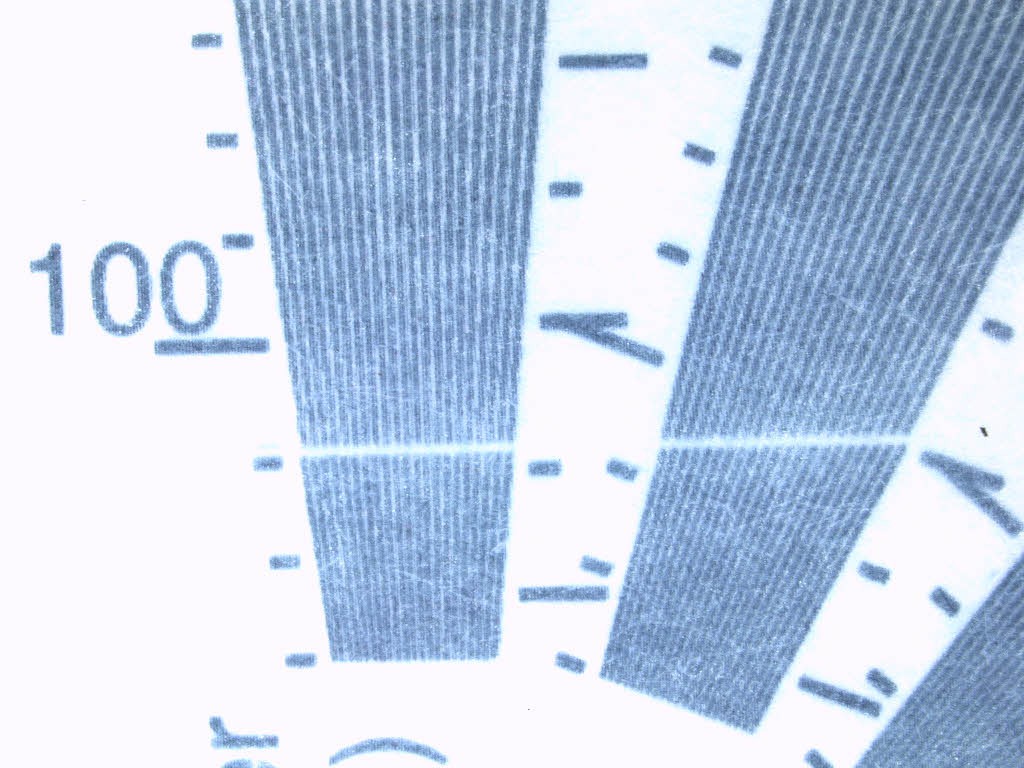
More data is here https://cdn.hackaday.io/files/21933938381472/21measurements.... pixel 4.65 microns. You can use opencv to do the trick. I added a little script in this one.
Re:Continuous 3D Printing Possible With Transparent Polygon Scanning?
on Monday August 05, 2019 @06:16PM (#20619699)
expensive is a matter of taste. The envisiontec 3SP costs well over 5K euros and can go up to 100K. You can only get a a price if you ask for a quote. Carbon 3D does not sell their printers you have to lease them. Formlabs does sell you a printer at 3.5K but you can't use third party resins, so
you decide. I actually know some open-hardware printers which sell for 5K.
Re:Continuous 3D Printing Possible With Transparent Polygon Scanning?
on Monday August 05, 2019 @06:03PM (#20619554)
That is indeed.. how i decided to brand it and this seems working. In reality both systems have different optical properties; this does matter if you push them to the limits.
Galvanometers are slow, require more calibration. Rotating devices don't stand still at the end of a sweep and are much faster (10 times).
Re:Continuous 3D Printing Possible With Transparent Polygon Scanning?
on Monday August 05, 2019 @05:53PM (#20619456)
Of course, what’s worse than a weak start is simply not starting at all. Moreover, if you’ve publicly disclosed your invention, then you have only a one-year grace period to apply for a patent. You forfeit your patent rights if you fail to file within the 1-year grace period. http://www.patenttrademarkblog.com/first-to-file-patent-rule...
In the EU.. you destroy immediately.. there is no grace period.
Re:Continuous 3D Printing Possible With Transparent Polygon Scanning?
on Monday August 05, 2019 @05:44PM (#20619373)
patents are expensive and you don't know the results.. Patent in my name is here https://patentimages.storage.googleapis.com/43/72/4e/1ee7792... .. but is for a plurality of sources. So I avoid my patent, I am author of :P
Re:Continuous 3D Printing Possible With Transparent Polygon Scanning?
on Monday August 05, 2019 @05:41PM (#20619345)
should have named it differently; I use a laser scanner with a prism instead of a mirror. A detailed description is here; https://reprap.org/wiki/Transparent_Polygon_Scanning
Re:Continuous 3D Printing Possible With Transparent Polygon Scanning?
on Monday August 05, 2019 @05:30PM (#20619212)
There is a blog here https://hackaday.io/project/21933-open-hardware-transparent-... also provides all the link to github files. Design are made in Freecad, Kicad, C++ and Python.
My main focus is on developing prior art. This needs to be done to prevent IP and "liberate" the technology from patent trolls.