fwessels
Re:Sneller: Building a SQL VM in AVX-512 Assembly (With Golang)
on Tuesday May 24, 2022 @10:26AM (#31492562)
disclaimer: I am one of the co-authors pf the code as well as founder
Re:Accelerated SQL for JSON with AVX512 (Golang)
on Thursday May 19, 2022 @10:33AM (#31435176)
Thank for for the feedback, that is nice to hear.
And as for the business question, we plan on launching a Sneller Cloud offering. (Sneller founder here)
Re:Accelerated SQL for JSON with AVX512 (Golang)
on Tuesday May 17, 2022 @04:37PM (#31415989)
Sneller founder here: we do not have any non-AVX code so we cannot compare directly against that. But generally speaking our code always works on 16 lanes in parallel per core, so that gives a huge speed-up.
Re:Ask HN: Any project ideas for a newbie to x64 assembler?
on Tuesday May 17, 2022 @10:36AM (#31411315)
Albeit not using gas, you may want to check out https://github.com/SnellerInc/sneller -- it has about ~250 primitives written in AVX-512.
(Sneller founder)
Re:Intel and ARM Performance Characteristics for S3 Compatible Object ...
on Tuesday June 09, 2020 @02:29PM (#23469265)
We have added both a cost and power consumption comparison to the blog post (including AMD EPYC as well), here is a snippet:
| Instance type | m6g.16xlarge | c5.18xlarge | c5.24xlarge | c5a.24xlarge |
| Architecture | Graviton2 | Skylake | Cascade lake | AMD EPYC |
| CPU(s) | 64 | 72 | 96 | 96 |
| RAM (GiB) | 256 | 144 | 192 | 192 |
| $/hour | $2.464 | $3.06 | $4.08 | $3.696 |
| Power usage (W) | ~115 | ~240 | ~240 | ~280 |
Re:Intel and ARM Performance Characteristics for S3 Compatible Object ...
on Monday June 08, 2020 @03:14PM (#23459750)
As per last week's announcement from AWS about the availability of AMD EPYC cpus, we have repeated the “single socket” test for the EPYC cpu as well.
The updated chart is included in the post or you can find it here: https://blog.min.io/content/images/2020/06/single-socket-per...
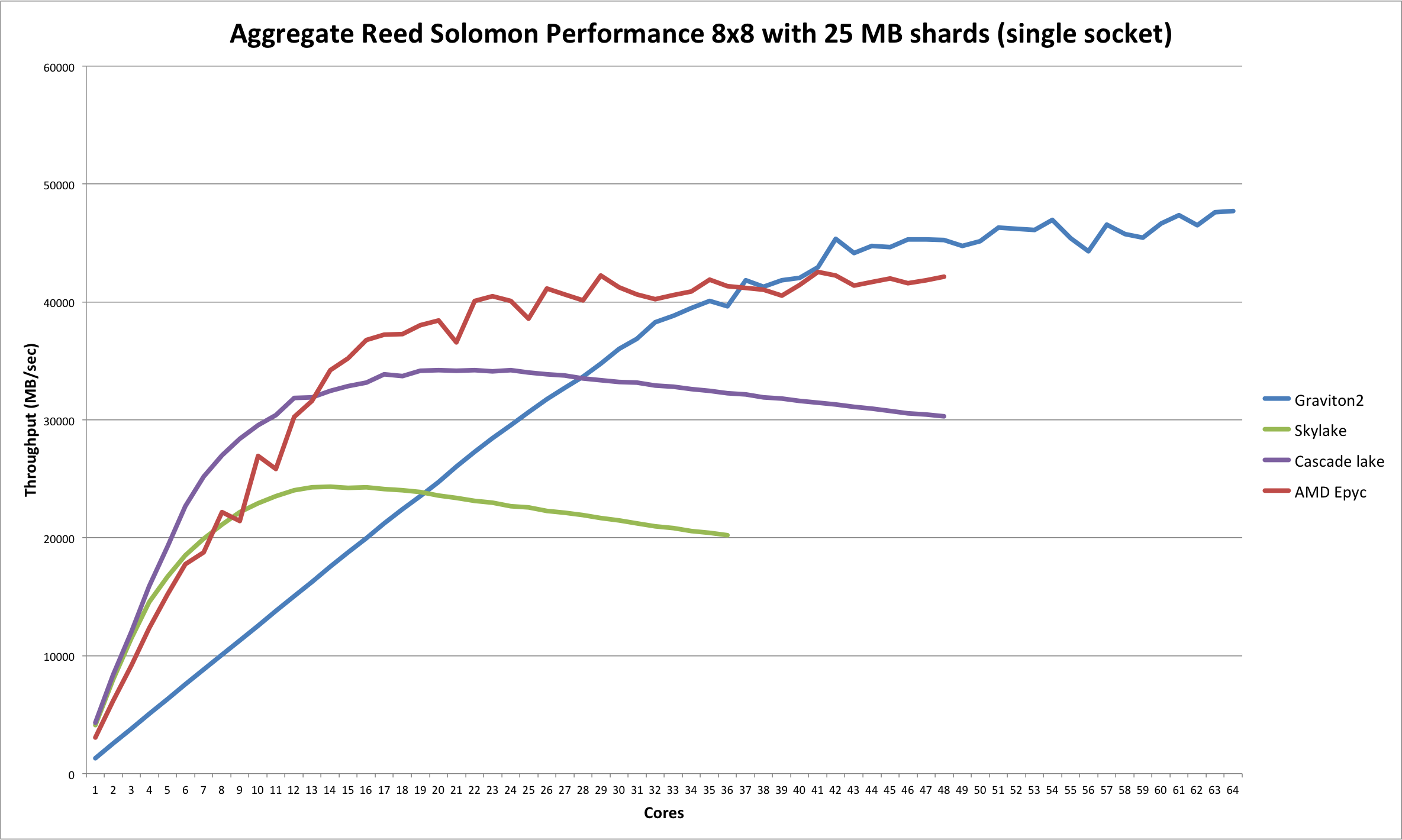
It clearly performs and scales a lot better than the Intel CPUs (no doubt also benefiting from the increased memory bandwidth) and at high core counts is very close to the Graviton2.
Furthermore, I agree that the “investment costs” for Amazon are almost minute, they might have already earned it back.
Re:Show HN: Go version of HighwayHash with optimized assembly implemen...
on Wednesday January 10, 2018 @10:23AM (#16115521)
Check out the graph at https://github.com/fwessels/HashCompare that compares different hashing techniques.
And also we've done some predictions for collisions, see: https://github.com/fwessels/HashCompare/issues/1#issuecommen...
Re:Benefits of named return values in Go
on Friday June 30, 2017 @02:55AM (#14669022)
Yes, you can, but just naming the return variable takes care of this.
Re:Show HN: C to Go Assembly
on Wednesday May 24, 2017 @07:55PM (#14414354)
No, it is not an IR code such as in Java or .Net.
At compile time it is translated into opcodes for the corresponding architecture that you are compiling for.
Re:Show HN: C to Go Assembly
on Wednesday May 24, 2017 @07:19PM (#14414212)
That is a good question but have never tried it. However, there is nothing "special" about the assembly as ported by c2goasm, so it should equally well as any other (hand-crafted) assembly.
Re:AWS S3 open source alternative written in Go
on Tuesday August 30, 2016 @03:05PM (#12392933)
S3 data transfers costs are an issue -- that's why you can host minio yourself at any hosting company, and save significantly (multiple times) on data transfer and storage costs.
Re:Show HN: Accelerating SHA256 by 100x in Golang on ARM
on Thursday July 28, 2016 @01:58AM (#12178616)
Nice blog, and the tool would have helped indeed.
And also, memory allocation is not the most obvious topic in Go/Golang assembly...
Re:Show HN: Accelerating SHA256 by 100x in Golang on ARM
on Wednesday July 27, 2016 @06:37PM (#12177006)
The Golang assembly does not support all instructions, we've created a tool (see https://github.com/minio/asm2plan9s) to assist in translating instructions into their opcode equivalents.
Re:Show HN: Accelerating SHA256 by 100x in Golang on ARM
on Wednesday July 27, 2016 @06:33PM (#12176988)
No we did not compare to SHA512 (since we don't need it).
I would expect SHA512 to be 2x faster compared to the SHA256 software version, but that is still way slower than the ARM SHA extensions accelerated version.
Re:Show HN: Accelerating SHA256 by 100x in Golang on ARM
on Wednesday July 27, 2016 @04:45PM (#12176386)
No, there are no algorithm changes (otherwise the results would be different), it is just taking advantage of the ARM SHA accelerations when they are available.
Re:Show HN: Accelerating SHA256 by 100x in Golang on ARM
on Wednesday July 27, 2016 @04:43PM (#12176374)
No, compared to an ASIC it will still be significantly slower.
Re:Show HN: Accelerating SHA256 by 100x in Golang on ARM
on Wednesday July 27, 2016 @04:43PM (#12176368)
Go didn't help specifically, it is just that this package makes support for the ARM SHA instructions available for Golang.
Time Machine for directories? Directory Versioning using s3git
Re:S3git: Git for Cloud Storage, Written in Go
on Tuesday March 22, 2016 @06:40AM (#11335549)
The library is not yet open sourced but will be soon. Some internals about how s3git uses the BLAKE2 hashing algorithm are described in https://github.com/s3git/s3git/blob/master/BLAKE2.md which may be of interest.
Re:S3git: Git for Cloud Storage, Written in Go
on Tuesday March 22, 2016 @03:57AM (#11335002)
That is correct (see also earlier reply), it is aimed at really large repos with primarily non-text blobs backed up cloud storage like S3, but doing so in the spirit of git and hence the name.
Re:S3git: Git for Cloud Storage, Written in Go
on Tuesday March 22, 2016 @03:40AM (#11334962)
Thanks for the links. However s3git more applies the git philosophy/way of working to Cloud Storage rather than being compatible at a binary level.