fbcpck
Re:eMudhra to Exit Global SSL/TLS Certificate Business
on Thursday October 22, 2026 @07:20PM (#50202454)
The whole ordeal makes me wonder why the ergonomics/interface around CA trust management is not better.
It should be very easy and normal to ask for approval which is limited to the particular app, limited in time, and limited in scope.
Still keep defaults, but make it much smaller and put them under even higher scrutiny, certainly not 100 root certificates.
I don't understand why e.g. a CA for research institutions should be able to issue certificate for mybank.com or ecommerce.com and my browser would just trust that.
Re:Any window from your Mac, on your iPhone and iPad
on Friday October 16, 2026 @04:47AM (#50115845)
Sidecar streams the mac display to the ipad, but it has to be initiated and controlled from the mac.
In contrast, what I wanted (what this app does!) is to view and control my mac from my handheld device, initiated from the handheld device.
These apps all look similar and it makes it very difficult to search:
• Mac screen --> Handheld, as extended display = Sidecar
Use-case: I use my ipad as additional window space for the mac.
• Mac screen --> Handheld, as duplicate display = Sill, Sunshine+Moonlight
Use-case: I leave my desktop and continue watching what I had playing on it from my kitchen ipad.
• Handheld screen --> Mac = Airplay
Use-case: I play some media from my iphone on the mac screen.
• iPhone screen --> Mac, controlled from Mac = iPhone Mirroring
Use-case: I use my iphone-only apps from my mac, wirelessly
• iPad controls --> Mac, controlled from Mac = Universal Controls
Use-case: I use my ipad with my mac mouse+keyboard
Usually, trying to search for this type of app obnoxiously returns results for Airplay, and if you manage to filter it out, it's Sidecar — but it's not what I want!
Re:Any window from your Mac, on your iPhone and iPad
on Friday October 16, 2026 @03:41AM (#50115352)
This is super nice!
I've been using Sunshine + Moonlight and it required a lot of tinkering and breaks half the time.
Looks like now I can forego that setup, this is way way nicer! Thank you!
Re:We All Depend on Open Source. We Will Defend It Together
on Friday June 26, 2026 @07:27AM (#48685357)
I think this is conflating opensource-corporate and english-non-english.
If you ask american/european/english-speaking developers about coding, it will mostly be about/in the context of corporate environments rather than open source too! The majority do not actively or primarily contribute to open source projects, but instead corporate environments as well.
In an alternative timeline where the lingua franca isn't english, I can still see open source culture exist; I don't think the desire to publish and cooperate in public is an inherently "western" culture. It will also run into the same conflict of interest between Open-Source and Corporate: one prefers transparency and full-disclosure, the other prefers control in the interest of minimizing risk.
Re:Loreline – Tools for writing interactive fiction
on Thursday June 18, 2026 @08:14AM (#48584169)
Having messed with RPG Maker formats recently, I find this fascinating because it's so much more elegant and nicer looking.
Though it seems like it's more suited to fully text based scripts. The format I was messing with was full of markers to e.g. change the facial expression of the speaker's portrait, play sound effects, etc. (mid dialogue!)
Makes me think about how script/dialogues are written and formatted internally in other mediums. Umamusume in particular stands out in my mind; it has a lot of movement and actions as the dialogue lines are spoken. Sounds silly but they really do make it feel more dynamic and alive.
Re:Ghostty is leaving GitHub
on Wednesday April 29, 2026 @03:31AM (#47945195)
Basically yes
In no particular order, it: decides what tests to run, tests, pulls dependencies, builds, decides what to deploy where in what order, and deploys. After the deployment it verifies and tests that it is stable. It orchestrates releases. It is used to check and enforce compliance policies, it scans for issues, it updates software dependencies, it builds non-build artifacts.
If you think most of these shouldn't be done through a CI system you would be right (not everyone does). But it is easy and arguably one of the strengths of github actions. Now we are paying the price for the overreliance.
When github (actions) is down I can't test, build, deploy, and auxiliary functions for internal analytics/metric collection, cleanups, process automations, dependency updates, are all unavailable or impacted.
Re:Hormuz Minesweeper – Are you tired of winning?
on Sunday March 22, 2026 @06:34AM (#47476130)
chording is available only during peace times
Re:AirPods Max 2
on Monday March 16, 2026 @09:49AM (#47399018)
It is such an annoying behavior; I came up with my own solution too for those interested:
Re:Deutsche Telekom is violating Net Neutrality
on Sunday January 25, 2026 @05:58AM (#46752932)
I literally could not ssh into several of my servers since last week, and could only do so through my berlin server.
Yes, I have to rent a local server to proxy all my home network through it, otherwise it is unreliable or outright does not work. It is absurd.
Re:Kidnapped by Deutsche Bahn
on Monday December 29, 2025 @10:09AM (#46421474)
It is certainly my biggest dislike factor with my stay in Germany, and I'm still struggling to come to terms with it: do I dislike it enough to compel me to move away? is this something I can accept? How much can I influence and improve things that I directly interact with?
It seeps in everywhere too, with almost all aspects.
Day-to-day with restaurants, cafe, shops. Almost all interaction feels like it's actively checked if it's in their process or job description. Shop staffs are typically disengaged and can't really help you with anything outside the normal process.
Healthcare, both receptionist and doctors. You can see the rushed service because they are only compensated for limited amount of time by the state insurance. This took me a while to figure out; the process really defines what treatment you get, with what equipments, as well as the duration, and they have to do their best with the constraints put by the process.
An example: with Wurzelkanalbehandlung, the process says (at least back then) only 1 hour of Laborkosten can be compensated by the state insurance. This means if the dentist took more than 1 hour to work on you, that would be done at their personal loss, and thus the incentive to rush the procedure.
Going private helps (they tend to be more relaxed after the mention of of Privatzahler, and gives you access to newer equipments not yet acknowledged by the state insurance processes), but you still have to research, find, and pick the right practice.
Bureaucracy, administrative. You often have to deal with clerks that just go "I just work here", the rules says this and there's nothing I can do, throws hand in the air. Goodbye, next person please!
In day-to-day work, I can also see it. New hires tend to be more into the work, and questions things, but the system does push everyone to just follow the process and not do anything more. I've seen my colleagues slowly shift into this mode, delivering what is outlined, nothing more, not questioning the intent behind the work (or at least, doing it much less than before, because the system does not incentivise that).
Re:Pricing Changes for GitHub Actions
on Tuesday December 16, 2025 @02:29PM (#46293192)
I don't know how much of that 6 hours build is tangled up in github workflows, but if it's a single contiguous block, you probably could make it near zero by making the self-hosted runner do only the preparation and only the final upload process (workflow_dispatch when the build is complete).
Re:Pricing Changes for GitHub Actions
on Tuesday December 16, 2025 @01:40PM (#46292479)
per minute billing is hard to wrap around the head
On my larger organization, we have on average 20 to 30 *active* runners during business hours. Assuming 5 on the off-hours, my napkin math says it comes down to about 10 fully-utilized-runners per month, so about 864$/mo. For the size of my organization that is honestly totally acceptable.
This is assuming 0.002$ per minute of job being actively executed. If it turns out to be 0.002$ per minute of *runner being registered* on the control plane, it would increase quite a bit. We are still using the old HorizontalRunnerAutoscaler with actions-runner-controller, with quite a pool of prewarmed runners idling to pick up a job. It would be a strong reason to use the new RunnerScaleSet (to take advantage of the reactive webhook-based scaling) and keep a very lean pool of prewarmed runners.
Re:IsMyXFeedFcked – Analyze How Your X Feed's Impacting You
on Monday January 20, 2025 @05:56AM (#42767350)
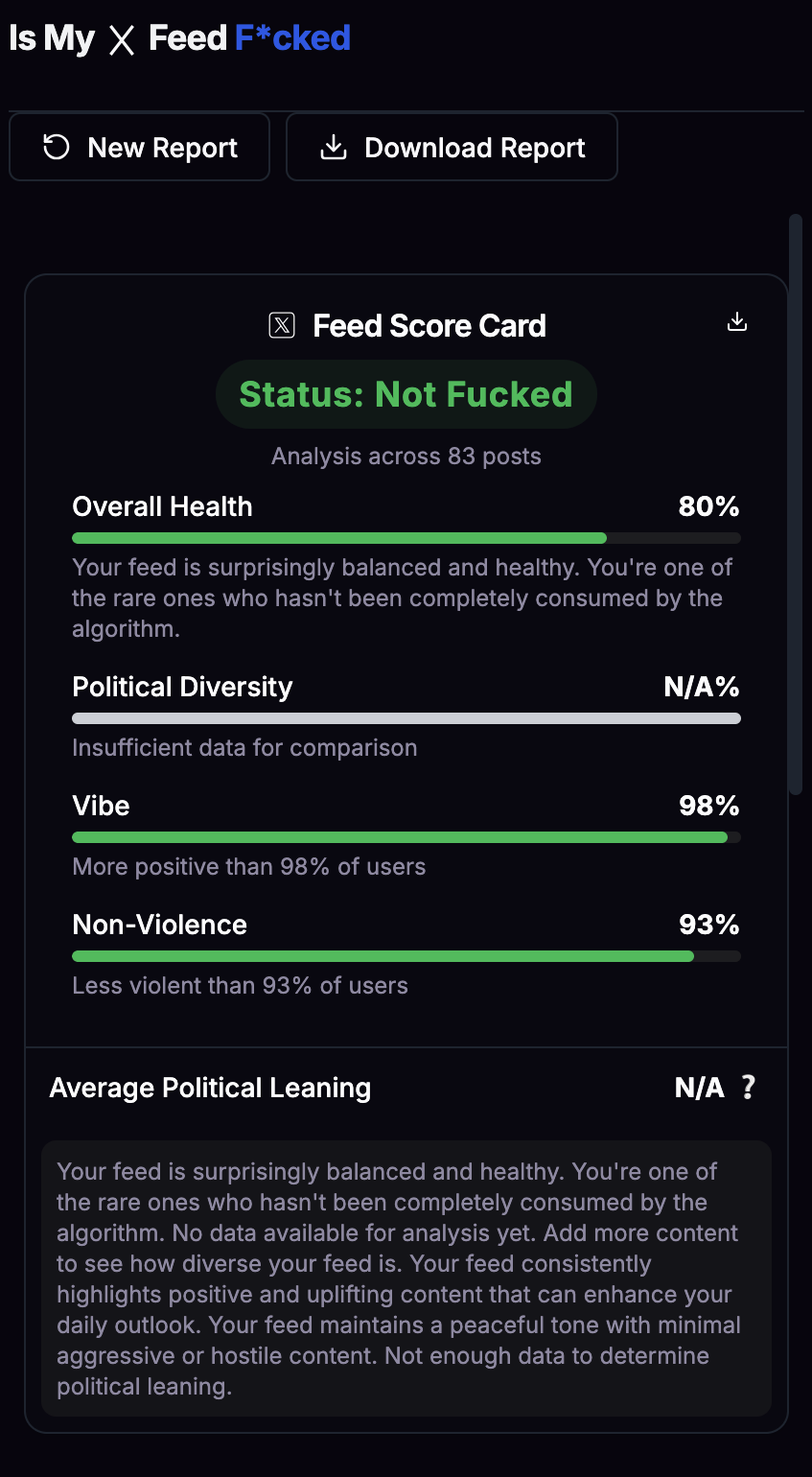
Similar results here (the vibes)! Explains why I it's hard for me to relate with the ongoing twitter / bluesky discussions
Re:Why Bother with uBlock Being Blocked in Chrome? Time to Switch to F...
on Monday November 27, 2023 @06:31AM (#38431083)
Addressing grandparent's comment regarding lack of tab grouping, I'd like to share a custom stylesheet for TST that somewhat tries to tackle this:
Re:Ask HN: Cheap VPS with 1TB HDD?
on Wednesday June 15, 2022 @03:19AM (#31750053)
I am actually not familiar with such limitations with storage VPS against webservers. It doesn't seem to be the norm, and I would still search with "Storage VPS" as search keyword in e.g. https://lowendtalk.com.
I've personally used the following in the past. It was quite cheap and generally happy with it.
https://www.time4vps.com/storage-vps/
———
You might also want to get (snipe) a server off https://www.kimsufi.com/uk/servers.xml — the best ones usually sold out within a minute or two, but nothing beats the price.
Re:Sunsetting Atom
on Wednesday June 08, 2022 @01:18PM (#31670700)
Interesting to find that I'm not the only person doing this! I also just hop to Atom if I need to do something more involved with git
I typically do this when tidying up / amending >1 commit at a time (anything I can't do easily with git rebase interactive mode), or to resolve merge conflicts.
Re:Ask HN: What game do you wish existed?
on Wednesday May 25, 2022 @08:29PM (#31512754)
Made in Abyss, as a game!
Procedurally generated[1] large-scale environment[2] to explore with the prime goal of adventuring downwards, with layers of organic pristine biomes[3], full of unexplainable relics and asymmetrically strong entities that live naturally within[4].
Risk of Rain 2 is the closest thing I know to this, the biggest difference being the gameplay (it's more of a fun shooter game, rather than an exploration/adventure game) and the fictional universe.
[1]: Primarily the tactical gameplay elements (terrain, elevation, enemies, spots of interest, etc.) much like roguelike games, over the visual aspects (colors, animals, trees, etc.) like No Man's Sky or biomes in Minecraft
[2]: Think of FromSoftware games: Dark Souls, Sekiro, Elden Ring — it invokes a sense of massive explorable environment, with limited movement capabilities
[3]: Think about the amazement and awe invoked when exploring an undiscovered, unique biomes in e.g.: Subnautica (Lava Lakes) or Etrian Odyssey (practically all the stratum)
[4]: Think of Monster Hunter monsters
Re:Eve Online fans cheer Microsoft Excel features at annual Fanfest
on Tuesday May 10, 2022 @11:44AM (#31328473)
Any games that have competitive, collaborative multiplayer aspect I think!
Especially Google Spreadsheets; perhaps not math/computation-heavy like EVE, but it's one of the best tools to organize data in a collaborative manner online.
An example: Inventory management/dashboard of a clan of 30 members: https://docs.google.com/spreadsheets/d/1tpbLmB4Fha_0TpMd4h3d...
I also see it (ab)used frequently as a mediawiki/online text-editor alternative, barely using any spreadsheet mathematical formulas, using it simply as a place to write text for others to read, e.g.: this gigantic reference spreadsheet: https://docs.google.com/spreadsheets/d/1JjK7Ws4gfzKChRs5ueox...
Re:Ask HN: Any piece of hardware that was more of game changer than yo...
on Sunday February 06, 2022 @03:06PM (#30236432)
On the topic of drying rack: I bought this ceiling-mounted drying rack[1] and it's been fantastic.
I live in an apartment with high ceilings (upwards 3 meters), so it worked out really well. It saves up the space a standard drying rack would otherwise occupy (both when used and unused/folded), and I installed it right above my washing machine so I don't need to carry the wet laundry around!
The one from the polish store[1] was the only cheap one I could find, all the others were upwards 200€[2]
[1]: https://www.suszarki-lazienkowe.pl/pol_m_Suszarki-sufitowe-1...
Re:macOS Monterey's new network quality tool is surprisingly good
on Monday November 15, 2021 @06:41PM (#29234514)
Spotlight is also amazing, but like Preview I suppose it doesn't count as a hidden gem.
Finder's column view is also excellent. I think it's the best way to navigate the filesystem through GUI; the way it displays nested directories is just super nice. It makes me wonder why other OS don't haven't copied this layout in their filesystem explorer.
Grapher.app is also perhaps a hidden gem.
Re:I Stopped Using Emojis
on Monday July 12, 2021 @05:59AM (#27808733)
I observed something related to what you've said.
In some casual/private Discord channels I frequent, there's usually a couple emojis that gets used a lot, that on its own have none or extremely ambiguous meaning. For most of them, I find it almost impossible to describe the meaning in words, yet at the same time everyone understands and acknowledges that it is not superfluous / that it conveys something.
We talked about these emojis and the best description we could come up with was that these are filler emojis. The primary purpose is to de-escalate the seriousness tone of a message, which by default is pretty serious for text-based messages. Think about how a message may come up as rude if it ends with a period (.) and without, then add another level after that; this is what the filler emoji does.
Aside from the seriousness de-escalation, we think it also helps with the tempo/pace of the conversation, similar to how in verbal conversation you pause/leave a gap when talking, as a cue for when other people can respond. The filler emoji here is that pause.
To (outside) observers unable to understand/confused by the meaning of the (singular) filler emoji, this can easily be seen as devolving the language, but I'd argue that it actually conveys something very complex extremely concisely with one emoji.
Re:OSSU: Path to a free, self-taught education in computer science
on Tuesday July 06, 2021 @05:28AM (#27745961)
This comes back to your (or my) definition of science. To me it's just about furthering knowledge through provable explanations.
Is it more efficient if you collaborate with other people with the same goal (e.g. Academia)? Yes.
Is it a necessity to conduct science? Absolutely not; how do you think it was done in the past? Almost all of the early scientists were self-taught individuals.
Re:New GitHub Issues Beta
on Wednesday June 23, 2021 @08:27PM (#27612392)
We encountered the same issue, but it seems to be only for projects at user/organization level. What we do to work around this is to create a new repository used solely for projects.
By doing so, you can create and put the issues in the project board, and apply labels to the issue (which does show up in the project board). The long details can be put in the issue description, and it can be linked to other repositories nicely as well. The trick really seems to be to not use user/organization project, but (dedicated) repository project.
I wish they documented this better or improve it somehow, but hey! I guess they were working on the beta issues board/table which is also pretty sweet!
Re:Coreutils Gotchas (2015)
on Friday June 18, 2021 @09:56AM (#27550352)
Somewhat relevant: the default sed that ships on all macos is freebsd sed.
The basic featureset and syntax is about the same, but the more advanced parameters and features have different syntax (or not implemented) when compared to gnu sed.
This caused me quite a headache in the past figuring out why certain scripts works (or breaks!) on local machine but not in others; I started taking closer look on all tool versions since then.
(The solution is to just use gnu sed with https://formulae.brew.sh/formula/gnu-sed)
Re:Brave, the false sensation of privacy
on Friday June 18, 2021 @09:11AM (#27549900)
> its performance leaves a lot to be desired
I'm not sure what you're talking about; this may be the case several times in the past, but you should check again because this is a thing that constantly changes. Firefox performance today doesn't really leave a lot to be desired IMO
> Microsoft Edge got a decent native vertical tab solution before Firefox did! Edge!
Tree Style Tabs has been around since like… 2007?. Or does the "native" part somehow make it a whole lot better?
Re:Useful and useless code comments
on Friday June 18, 2021 @04:55AM (#27548577)
This is true, but sometimes it's not possible or awkward to do.
I find myself writing such separator comment blocks in userscripts quite a bit; and stylesheets where I do not have any tooling attached to it (e.g. mediawiki css).
Re:JavaScript and the next decade of data programming (2020)
on Friday June 04, 2021 @06:00AM (#27392129)
Looks like something that can be solved by moving the task to background with [web workers][0].
[0]: https://developer.mozilla.org/en-US/docs/Web/API/Web_Workers...
Re:Japanese government is selling houses for $500 to populate rural areas
on Monday May 31, 2021 @03:06PM (#27347194)
> Immigration doesn't imply permanency. Indeed, most migrants don't aim for permanent residency.
I believe you're confusing immigration[0] and migration[1]. The former aims for permanent residency or naturalization, the latter is temporary.
Re:Ask HN: Show me some most beautiful fonts
on Friday May 28, 2021 @03:16AM (#27312583)
I’ve been using tewi for almost a decade now: