everythingabili
everythingabili on Hacker News
Re:Show HN: How religions evolved? Charts, Maps, Citations
on Monday October 26, 2026 @03:49AM (#50240456)
Can the dates at the side be fixed or built into the grey horizontal separator bars, the text is so small you have to zoom in...and then the dates are gone.
Re:Show HN: Vellum, the best diagram editor you'll ever use
on Tuesday September 22, 2026 @04:21AM (#49798090)
Lovely tool, but the UI and text are way too small. Makes it unusable. :-(
Re:Cowboys, Frontiersmen, Settlers, Townspeople, Cityfolk
on Friday July 03, 2026 @05:40AM (#48772978)
There's something naive about all this, as if the entire metaphor is a somehow laudable, benign or 'natural' process tied up with Americans' origin story - but some omits the wholesale slaughter of indiginous people, the mass enslavement of people from another continent, and along the way poisons half the land with toxic waste.
They're both also stuck in the "golden" 1970s, and is without the subsequent stages that contain bureaucrats, politicians, mafioso, tech oligarcs and demagogues, which pretty much reduces the prior stages to proles, subscribers or fodder.
As Adobe continue to enshittify their products, to public disgust, they're more profitable than ever, I'm not sure if these cutesy "Townspeople" metaphors mean anything at all.
Re:Show HN: Sheet Ninja – Google Sheets as a CRUD Back End for Vibe Co...
on Monday March 30, 2026 @04:05AM (#47571671)
You can do this with GQuery.
It's really good (no affiliation).
/* Uses: https://github.com/FCPS-TSSC/GQuery */
function exampleQuery1() { const gq = new GQuery(); const result = gq .from("Tags") .select(["ID","Name"]) .where((row) => row.ID == 12) // you can use > or < etc .get(); JSON.stringify(result, null, 2) }
Re:Show HN: HyperCOD – a web-based HyperCard-clone
on Friday February 27, 2026 @11:22AM (#47182348)
One rainy afternoon, armed with Gemini AI, I wondered how far I could get "making" a web version of HyperCard.
The HyperCOD(e) version is limited, but you can go next card, and run on idle commands. And it does colour!
Don't expect too much, but making this was fun and I'm now going to make a few stacks with it.
Re:Ask HN: How many of you are working in tech without a STEM degree?
on Sunday July 27, 2025 @04:12AM (#44699690)
30 years experience of coding and development with degree in Sculpture. After 4 or 5 years as an artist...
* Hypercard/Director/Photoshop based Multimedia
* AppleScript/Filemaker
* Web Development Prograph CPX / SQL Web Development
* Python/Zope/SQL/PHP Web Development
* Processing(Java)/P5js/GDevelop Edu/Games Development
* Python/AppleScript/Sheets/AI/Python
Re:How Not to Be Overwhelmed
on Wednesday May 14, 2025 @10:16AM (#43984836)
I was once at a coding conference (Prograph CPX now you ask) and there was a coding competition. Who could create a usable To Do List App in one hour. About six people took part.
At the end of the hour, people demoed their creations. "This one is clunky and works like this...", "This one uses text to" etc.
The last person got up and showed some doodles and notes on sheets of paper. He said "Mine is the only one that actually works and is well designed, I just need to code it now".
I don't know if there's a lesson in there, but to me it was cool as.
Re:Ask HN: If I want to compose my own music, how can I get started?
on Wednesday January 08, 2025 @04:29AM (#42632482)
Other non-linear music-making tool options include
* BespokeSynth - make music with flow diagrams * Orca - make music with shimmering conway worlds * Sonic Pi - make music with code
All free, all mind-blowing, all a possibility for composing and creating in a different metaphor to the left-to-right DAW like Garageband.
Re:Ask HN: Tools or frameworks to build music theory games
on Thursday November 28, 2024 @04:42AM (#42263928)
Yeah... one might use Sonic to load a csv and generate sounds based on your data, that might then be used as static assets in their app.
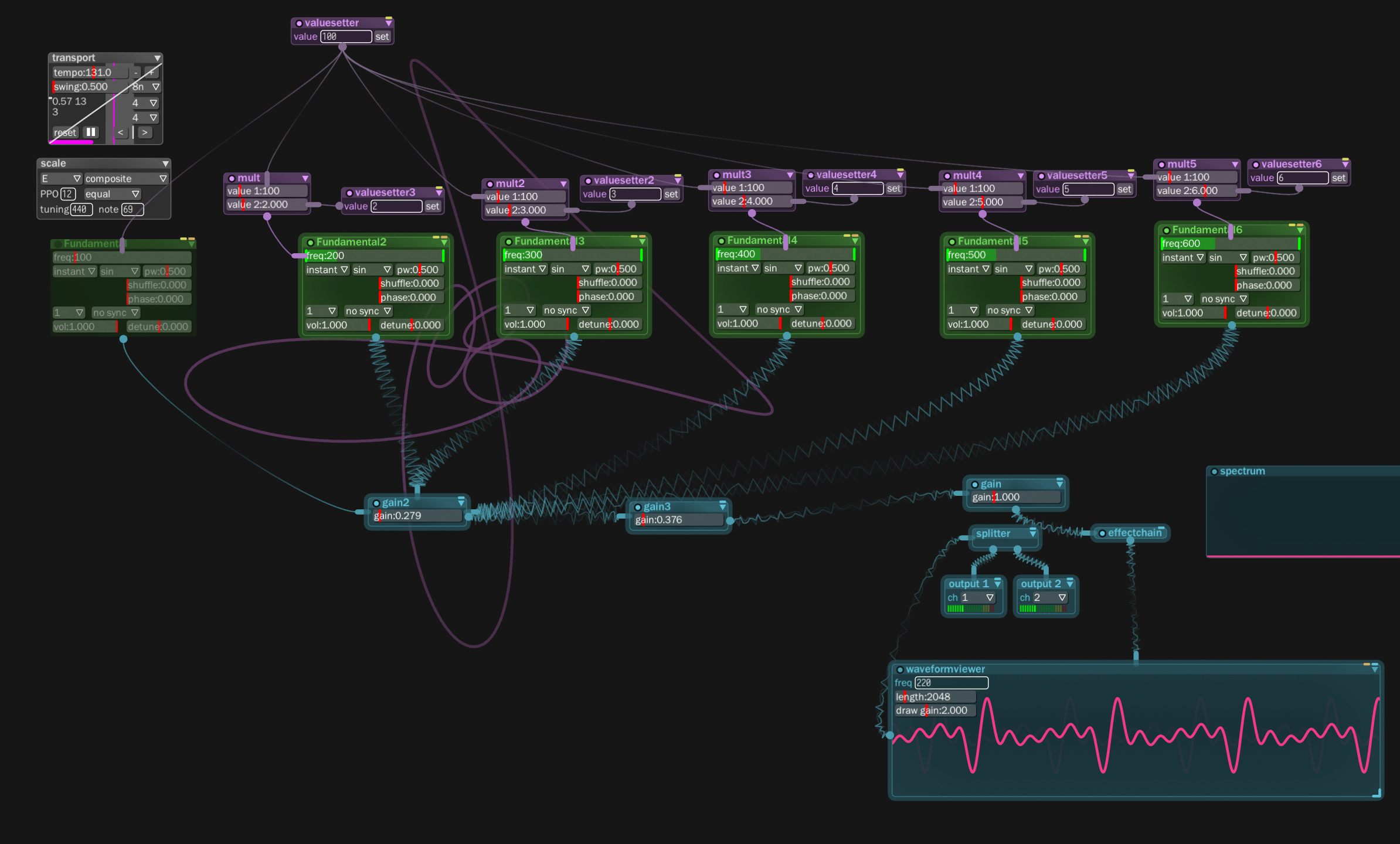
I recently helped a tutor using BespokeSynth to create audio explainers, wiring together frequencies and interactive oscillators and waveform viewers to explain resonant frequencies (or something, I didn't completely get it)
https://static.everythingability.opalstacked.com/bespoke_syn...
Re:Ask HN: How to learn UI/UX as a data/BE engineer?
on Tuesday October 22, 2024 @07:51AM (#41913358)
I came here to say the same thing exactly. Tufte books are very visual (and expensive - see if you can find a copy of any of his books, changed my life). You can just dip in.
Norman is ace. Although his books turned me into a usability weirdo unable to switch off my usability sensors... be careful! :-)
As is Raskin - whose interface "notation" (click-drag-click etc) I think isn't talked about enough.
Can I also throw in these...
Don't Make Me Think: https://www.amazon.co.uk/Dont-Make-Me-Think-Usability/dp/032... - I found this a REALLY useful book, and great to share with people too.
A Pattern Language https://www.amazon.co.uk/Pattern-Language-Buildings-Construc... - OK, this is a bit esoteric, but it's so valuable and lots of geeks/UX-ers kind of aim to create their own pattern language as opposed to a UX-dogma.
Information Architecture https://www.amazon.co.uk/Information-Architecture-Beyond-Lou...
Visual Language https://www.amazon.co.uk/Visual-Language-Global-Communicatio... - a kind of fundamental - hard to find.
--
There are dozens of methodologies to learn, and put into practice. I would put it that you don't really learn UX, you do it, and revise - in order to solve problems and make things better. Once you've digested some of the ideas you need to start trying the methodologies out. This is harder than it sounds. Even companies that claim to support UX, sort of bugger things up.... in that UX can't "fix" crap... it needs to be in at the beginning.
My favourite activities / methodologies, that produced REAL results were
* Ethnography - kinda just hanging out and observing what actually goes on. One client used to print off every page to proof read their changes cos the font sizes were designed by 21 year olds and they were 60+. The applause I got for raising the font size would never have been found any other way than sitting in the corner. * Card sorting - often collaboratively with armfuls of post its to decide on categories/navigation * Wireframing - I had less success with paper prototyping, but still ... * Personas + Use Cases
...and Eye Tracking - which tbh was SO VALUABLE, not because of the insights it provided, but for the EVIDENCE (video and heatmaps) that you could use to persuade the big wigs.
So find a way to start getting yourself into trying out various methodologies, to fix problems. Doing UX when things are "kind of OK" can be quite hard imo, especially at the beginning.
Your background will be so useful, again imo and experience, you will be able to use UX to provide guidance and ideas and then MAKE THE BLOODY THING which lots of UX-ers can't do. I liked the cross-over - I code a bit and sometimes found it easier to make what I wanted, rather than specifying it or creating "designs".
Good luck!
Tom
Re:Hot Take: Low Code/No Code platforms die as LLMs get better
on Tuesday September 03, 2024 @08:17AM (#41434194)
Gdevelop might be described as a low code platform as it's language is visual (like Scratch on acid). It already has "Generate a game with AI" built in. It's not very good.
What makes you think LLMs will get better? The more we've seen AI develop the more fine tuned everyone's senses have got hyper-sensitised to what's AI and it just reeks of the uncanny, rendering it ultimately useless.
Re:Show HN: A simple and powerful RSS reader for the web
on Wednesday August 21, 2024 @05:40AM (#41308490)
https://feeds.bbci.co.uk/news/rss.xml
Doesn't work.
Re:Unit is a general purpose visual programming system
on Tuesday July 09, 2024 @04:54AM (#40913879)
Hi,
I've probably mentioned this a few times on here, but Prograph was a GREAT example of a visual language, that solved a LOT of issues (spaghetti code) etc. It's worth a look if you're interested in visual programming
* object oriented * scrunching of code - tha could be turned into functions (local-to-opers) * you could edit code and values whilst it was running * FAST!
Here's an ole video of some server software I made, that at the end shows me rustily doing some Prographing.
https://youtu.be/MtECJw59elc?si=svRbd5_IA4cAFhVa&t=1429
p.s A free version of Prograph (Marten) used to exist, but when the genius creator died, the project, sort of lost its way too.
Re:Designing a Website Without 404s
on Thursday June 13, 2024 @02:56PM (#40673233)
This really isn't crowing but we created a dynamic site that used HyperCard as a CGI and we did that in 1984. Not kidding. Mosaic'd up to the hilt.
Still, it's a good idea.
You can further this idea (especially when the slug returns nothing) by having this page also list "Best Bets" or what people most often come to your site for (regardless of any search query, perhaps, with their referrer, or on this day of the week etc)
And additionally, put the slug (bar the dashes) into a search box so it might be ammended (but tell them that you didn't find anything and they need to try something else).
Re:Ask HN: Modern Day Equivalent to HyperCard?
on Thursday May 02, 2024 @12:37PM (#40238215)
I was a HyperCarder too.
I would say the answer is none of the below/above...
GDevelop is an app for making games. Your son will love it. It has a very cute visual programming language, not too far from Scratch.
I watched a few 10 minute tutorial videos and "got it"... you two will too.
p.s No connection to the company.
Re:Ask HN: 9-yo son wants to build a game, I'm lost. What can I do?
on Thursday January 18, 2024 @11:32AM (#39043816)
Came here to recommend GDevelop too. I taught my 10 year old GDevelop and she preferred it to p5js (Javascript programming) and it's a lot more powerful than Scratch coding. (but is visual too, like Scratch)
Also, lots of good tutorials on YouTube and a friendly community.
Re:Ask HN: Favorite Game Engine?
on Wednesday September 13, 2023 @05:03AM (#37494124)
I'm not really a game maker, but would like to give a shout out to the fabulous https://gdevelop.io/
It has everything you need, is free and its VISUAL PROGRAMMING is fab...
Re:Ask HN: What topics are good for a UI/UX Primer?
on Monday June 26, 2023 @04:17AM (#36477096)
I came here to recommend these exact three life changing authors.
Bonus items
Don't Make Me Think - Steve Krug Information Architecture - Louis Rosenfeld, Peter Morville
Re:Ask HN: Technology/Creative books and games for my daughter (7 years)
on Friday April 14, 2023 @05:57AM (#35567531)
I teach creative coding and maintain a site that has a list of creative tools (graphics, music, coding, writing, game-making) that are mainly free, and web-based. You can filter them by "easiness".
https://digitalcreativitytools.everythingability.com/
I made the site for university students, but I have tested/vetted all of the tools myself, often with my child who is now just 11. There are some activities you could do with her too. The Inspiration section might throw up some useful stuff for you both.
With regards to game-making, Scratch is a great starting point, but recently we have been really enjoying working with gDevelop - a free, no-code game engine. The videos on YouTube are great to get you both started. Twine (Chapbook) has been a fun tool for creating interactive adventure games, and this Zine-maker is ace https://alienmelon.itch.io/electric-zine-maker
Re:Show HN: Lunette – A word processor designed around writing, not fo...
on Monday March 27, 2023 @10:59AM (#35327558)
The text is bloody almost invisible which is so bloody annoying. A blacker font? Or a better or bigger one perhaps? Or is it just the colour? The notes are not linked to the text either... (which may or may not be a good idea).
Re:Ask HN: Why haven't bookmarks been re-invented?
on Friday December 30, 2022 @06:55AM (#34184233)
EXACTLY!
Back in the days when "small pieces loosely joined" was a thing, I thought Delicious was very, very cool. (I use Diigo (free) now which is the closest I could find to Delicious when it went bad). I needed something that isn't account dependent and works on web and mobile, so matter where I am browsing content I can save a reference to it. Hypothesis looks interesting but imo is more geared to textual annotation than tagging.
Bookmarks are so bad, that they don't even keep your most recent bookmark in a folder at the top.
But what we lost when we lost Delicious was so much potential. For example...
* people were exploring using tag clouds semanticly, to sort of translate how two different people categorised things (you say "cool", they say "hot" etc)
* I think NASA did collaborative tagging where you merely tag interesting things to keep an eye on with nextYear, fiveYears or TenYears then produced a Horizon Report of the overlaps.
* People were making news readers that found interesting items based on your tag cloud and items adjacent to those tagged in your cloud.
* A tag cloud was a quick "Contents page" for any blog out there... You could glance at one and see if this content was for you.
* They were emergent, as in, they evolved over time - so much better than most peoples' idea of categories, or how categories are used in the real world.
I think that despite all the potential in bookmarking/tagging people weren't ready to pay for it - and if you're the kind of person who squirrels lots of things away for later, in a sensible manner, you're going to find a way to do it somehow.
But bookmarks/tags etc could be so much more.
Re:Ask HN: Why are there over a dozen recent no code Excel spreadsheet...
on Thursday December 22, 2022 @05:35AM (#34091962)
I'd say one reason. It's an absolute nightmare for the regular end user to handle relational data in a spreadsheet. I've tried a lot of those below (you missed of AppSheet from Google which kinda falls into this bracket too).
I regularly work with intelligent people (who aren't techies) who by themselves figure out their project needs to be relational all by themselves (knowing nothing about SQL).
I think, and I guess these companies do, that there must be a market for those millions of people who want to manage a few thousand rows of project data but are never going to learn SQL + web development to put a UI on it, but are struggling to keep their data managed "logically" and easily.
Re:Ask HN: Anyone else not so excited about the metaverse?
on Wednesday December 14, 2022 @11:20AM (#33985707)
Limmy had the best view(s) on Metaverse.
https://www.youtube.com/results?search_query=limmy+metaverse
Re:Ask HN: Good resource on writing web app with plain JavaScript/HTML...
on Thursday November 17, 2022 @01:18PM (#33643198)
[2] crashed Chrome 3 times. Mac Monterey.
Re:Ask HN: How would software look if hardware had stopped improving l...
on Tuesday October 25, 2022 @12:26PM (#33332754)
It would remind me of the work of the hundred rabbits.
Re:Ask HN: Why aren't code diagram generating tools more common?
on Saturday June 04, 2022 @12:23PM (#31622234)
I'd say the question was "solved" by Prograph CPX in the 1990s, except the diagram WAS the code.
https://www.google.com/search?q=Prograph+CPX&rlz=1C5CHFA_enG...
You'd have high level classes, and low-level nitty gritty. You could edit your code as it was running (and then continue).
People prefer text (weirdly).
Re:Ask HN: Which small video editor do you use?
on Thursday April 28, 2022 @12:29PM (#31194611)
I really like clipchamp.com and have used it with kids to make great short videos (you pay for longer/bigger), but it has been bought recently so may have changed since I last used it anger.
Go take a look... it's great (I have no affiliation)