drmpeg
Re:H.264 Is Magic
on Thursday October 29, 2026 @11:07PM (#50299434)
Today I learned about Intel Quick Sync. Thanks. I retired from video compression in 2011, so I've been out of the loop for a long time.
Re:H.264 Is Magic
on Thursday October 29, 2026 @05:12PM (#50296073)
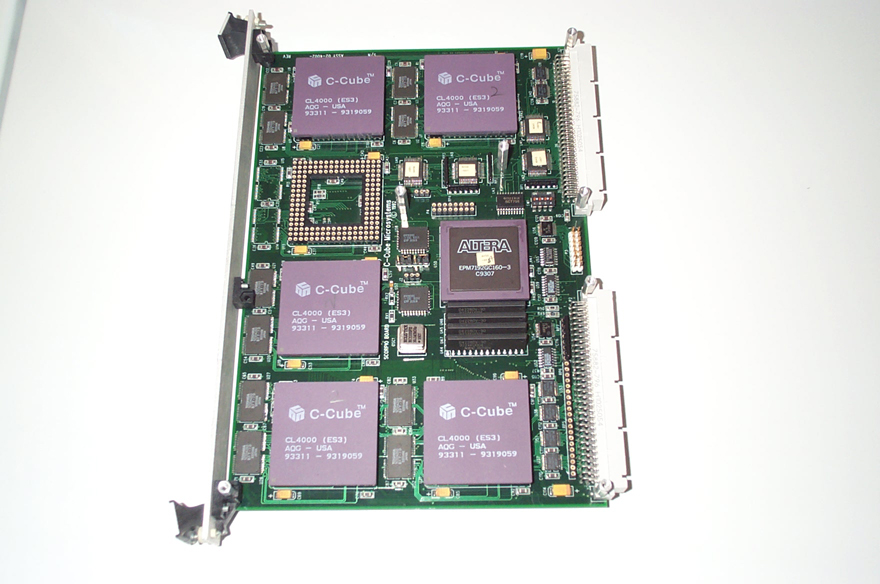
Using multiple CPUs for encoding goes way back. The early (1994) C-Cube MPEG-1 and MPEG-2 real-time encoders for DirecTV were built with 8 chips running in parallel (out of necessity since they were only 60 MHz processors) to encode 704x480. Each chip encoded a slice of the image and an auxiliary bus was used to send reconstruction video between chips so that motion vectors could cross chip image boundaries.
Here's a picture of the VME bus development board. It was a two board sandwich to support 10 chips in parallel (only one board pictured).
https://www.w6rz.net/scorpio.jpg
The first real-time HDTV encoders for terrestrial digital television (ATSC) were built by Harris using an IBM encoder chip. It took 6 chips to encode 1920x1080. The IBM chips didn't have an auxiliary bus, so you could see motion vectors limited to chip image boundaries (in this case, 6 tiles arranged like so).
  -------------------------
  |       |       |       |
  |   1   |   2   |   3   |
  |       |       |       |
  -------------------------
  |       |       |       |
  |   4   |   5   |   6   |
  |       |       |       |
  -------------------------
Re:Scientists solve 1840s space weather mystery
on Monday September 28, 2026 @08:12PM (#49886242)
There's never been a recorded S5 solar radiation storm. The highest level recorded was 43000 or S4 back in 1991. Another S4 storm occurred recently back in January 19, 2026 with a recorded flux of 36976.133.
https://www.spaceweatherlive.com/en/solar-activity/top-solar...
Re:Kodak DC50 now usable on the Apple II
on Monday August 24, 2026 @01:20AM (#49415448)
I still have my DC280. 1760x1168. Here's a sample (from the Jaques Littlefield tank collection).

Re:How we used to get jobs: A newspaper classifieds story
on Tuesday August 11, 2026 @09:07PM (#49266640)
In 1981, my first job in Silicon Valley was obtained by answering a blind (no company name) ad in the Mercury News. It was a kooky company that built burn-in ovens for semiconductors (mostly 2164 memory chips back then).
I had a lot of fun there. The purchasing manager was a Scottish guy and he had an after hours drinking club in a small conference room with a wet bar. I was only 24 years old and working crazy hours. I'd get a few beers around 7 pm and then go back to work writing 8080 assembly language code for a few more hours.
I also ended up smoking weed with the CEO and CFO a couple of times. The CFO was not a young guy. I'm not sure how old he was, but he had all white hair. The CEO gave me a mason jar full of his homegrown weed as a gift when I finished the project.
That company and even the building is long gone. It's now a Google parking garage.
Re:It's a shame what's happened to radio
on Tuesday July 21, 2026 @11:48PM (#49001637)
I'll never forget Dennis Erectus on KOME 98.5 (the wet spot on your dial) in 80's Silicon Valley.
Re:The Last MPEG-4 Visual Patent Has Expired
on Sunday July 19, 2026 @11:41PM (#48974107)
For sure. Just YouTube alone is a vast ocean of H.264 bits.
Re:The Last MPEG-4 Visual Patent Has Expired
on Sunday July 19, 2026 @06:25PM (#48972222)
MPEG-2 video is still very much alive. In the US, almost all terrestrial OTA broadcast (ATSC 1.0) and all SD channels on cable systems. Even Comcast VOD was all MPEG-2 (including HD) until they shut down the QAM version in 2023.
Re:Nintendo Wii U games running from a 1980's Bernoulli disk [video]
on Monday June 22, 2026 @10:06PM (#48639285)
I was the project engineer for the Air Force Space Command / NORAD DSP satellite ground network back in the 80's. The system used the 10MB 8" Bernoulli drive and cartridges to store the early warning message traffic. The system was installed in 1988 and was decommissioned around 2005.
I'm not sure if they used the 8" cartridges all the way to 2005, but I can find out. I'm still friends with the original system maintainer. I pivoted to video compression in 1993 and lost track of the program, but we found each other on Facebook in 2010.
Re:John Carmack on Fabrice Bellard
on Tuesday June 16, 2026 @07:22AM (#48553514)
Advanced Television Systems Committee. It's the US standards organization for terrestrial digital television. ATSC 3.0 is a new standard that's very similar to DVB-T2 (used in the UK for HDTV) at the PHY layer.
Re:John Carmack on Fabrice Bellard
on Tuesday June 16, 2026 @05:36AM (#48552761)
Little known Fabrice Bellard project. He worked with the ATSC to test the ATSC 3.0 PHY layer when he was consulting at DekTec.
Re:Eight More 8-bit Era Microprocessors (2024)
on Monday May 11, 2026 @05:42AM (#48092910)
The article kind of disses the Intel 8085. For those of us with 8080 code bases that were never going to be rewritten for the Z80, it was a welcome upgrade. On the paper dryer process control systems I was working on in 1979, the 8085 based Intel 80/30 Multibus SBC could be dropped in for the older 8080 based 80/20 SBC with no changes and provide a significant 2.5X performance upgrade.
Re:Dirtyfrag: Universal Linux LPE
on Friday May 08, 2026 @03:42AM (#48059938)
Looks like the esp4 and esp6 fixes have been pushed for 7.0, 6.18, 6.12 and 6.6 kernels.
https://lore.kernel.org/lkml/2026050851-iron-hurdle-6421@gre...
https://lore.kernel.org/lkml/2026050843-unplowed-spinster-cf...
https://lore.kernel.org/lkml/2026050832-remold-faceless-bed0...
https://lore.kernel.org/lkml/2026050825-heaving-spender-13a8...
Re:An open-source 240-antenna array to bounce signals off the Moon
on Monday April 06, 2026 @01:37AM (#47657345)
Previous post.
Re:Using FireWire on a Raspberry Pi
on Thursday March 26, 2026 @08:26PM (#47537626)
It's actively being maintained by Takashi Sakamoto. Here's the commit for Linux 7.0-rc1.
https://github.com/torvalds/linux/commit/0d6dd4738dbcc32b60c...
Re:A ternary plot of citrus geneology
on Friday March 06, 2026 @08:55AM (#47274931)
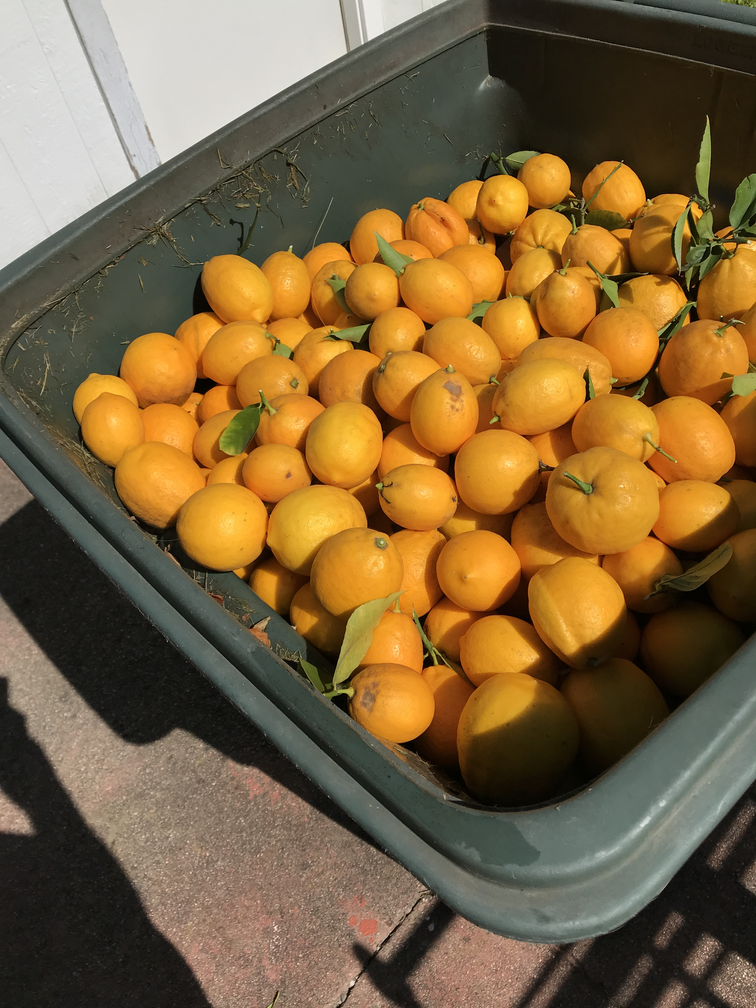
Meyer lemons from my backyard.
Re:Time Station Emulator
on Tuesday January 27, 2026 @06:45PM (#46788857)
Here's an emulation of WWV I did with a transmit capable SDR.
Re:Television is 100 years old today
on Monday January 26, 2026 @01:16PM (#46769368)
VSB came later. From https://www.tvtechnology.com/opinions/hdtv-from-1925-to-1994
In the United States in 1935, the Radio Corporation of America demonstrated a 343-line television system. In 1936, two committees of the Radio Manufacturers Association (RMA), which is now known as the Consumer Electronics Association, proposed that U.S. television channels be standardized at a bandwidth of 6 MHz, and recommended a 441-line, interlaced, 30 frame-per-second television system. The RF modulation system proposed in this recommendation used double-sideband, amplitude-modulated transmission, limiting the video bandwidth it was capable of carrying to 2.5 MHz. In 1938, this RMA proposal was amended to employ vestigial-sideband (VSB) transmission instead of double sideband. In the vestigial-sideband approach, only the upper sidebands-those above the carrier frequency-plus a small segment or vestige of the lower sidebands, are transmitted. VSB raised the transmitted video bandwidth capability to 4.2 MHz. Subsequently, in 1941, the first National Television Systems Committee adopted the vestigial sideband system using a total line rate of 525 lines that is used in the United States today.
Re:Level S4 solar radiation event
on Monday January 19, 2026 @07:32PM (#46686481)
Although everyone is interested in visible aurora, the proton flux is also really impressive. It peaked at 37,000 pfu at 1910Z. The highest ever recorded was 43,500 pfu in March 1991.
Re:More than one hundred years of Film Sizes
on Sunday January 11, 2026 @07:14AM (#46575056)
VistaVision has made a comeback with "The Brutalist", "One Battle After Another" and "Bugonia".
Re:When square pixels aren't square
on Wednesday December 31, 2025 @11:13AM (#46445430)
Here's some captures from my Comcast system here in Silicon Valley.
Re:When square pixels aren't square
on Wednesday December 31, 2025 @10:15AM (#46444817)
> Videos with non-square pixels are pretty rare...
Before HD, almost all video was non-square pixels. DVD is 720x480. SD channels on cable TV systems are 528x480.
Re:Ask HN: What skills do you want to develop or improve in 2026?
on Friday December 26, 2025 @07:27AM (#46391411)
There's some thought that Ukraine could become a tech hub after the war due to their drone technology.
Re:Ask HN: What skills do you want to develop or improve in 2026?
on Friday December 26, 2025 @07:24AM (#46391396)
Here's my ATSC 3.0 transmitter in C++.
Re:When a video codec wins an Emmy
on Wednesday December 10, 2025 @01:27AM (#46214719)
Here's the Emmy that C-Cube Microsystems won back in 1995 for the MPEG-2 (actually unconstrained MPEG-1) encoder chip set used in the roll-out of DirecTV.
https://www.w6rz.net/DCP_1235.JPG

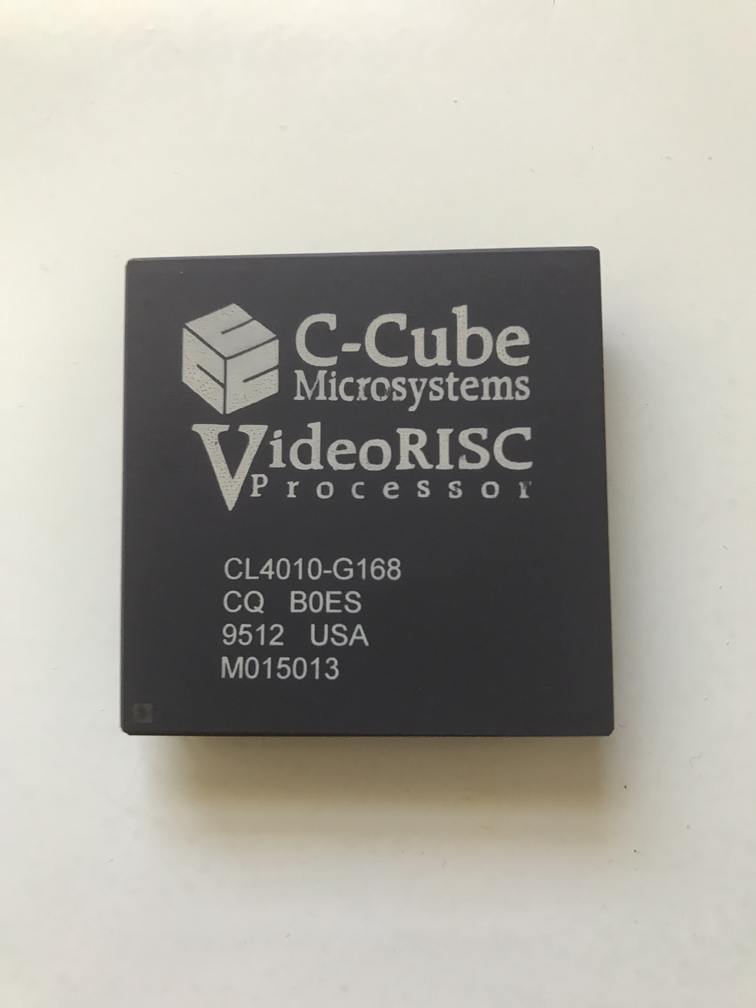
The original DirecTV encoder was MPEG-1 at 704x480 using eight CL4000 chips. Then in 1995 when the MPEG-2 capable CL4010 was finished, the encoders were upgraded to MPEG-2 (frame only encoding). Then upgraded again to a 12 chip AFF (Adaptive Field/Frame) encoder when the firmware was completed.
Re:Scientific and Technical Amateur Radio
on Monday December 08, 2025 @11:50PM (#46201340)
I believe he's using a 6m antenna at the Allen Telescope Array (ATA).
Re:The "Mad Men" in 4K on HBO Max Debacle
on Wednesday December 03, 2025 @10:42AM (#46135765)
The first 16:9 content I ever saw was the trailer to "Batman Forever" (with Val Kilmer) in 1995 when I was working at C-Cube Microsystems. The studios use to send them test content all the time for video compression testing. It was on D1 tape, and looked beautiful for SD resolution. The professional Sony CRT 4:3 monitors back then had a 16:9 button to letterbox the image.
Re:X5.1 solar flare, G4 geomagnetic storm watch
on Wednesday November 12, 2025 @08:11AM (#45899713)
Yes, you have it correct.
However, predicting the effects of solar flares is very difficult. Not only does the particle stream have to hit the Earth, it has to couple with the magnetic field.
Large flares can cause small events on Earth and vice versa.
Re:X5.1 solar flare, G4 geomagnetic storm watch
on Wednesday November 12, 2025 @07:53AM (#45899541)
The CME from the X5.1 flare has not arrived yet. Here are the websites I use:
https://www.swpc.noaa.gov/communities/space-weather-enthusia...