degio
Man’s YouTube Video of White Noise Hit with Five Copyright Claims
A visual comparison of 2015 and 2017 snow packs in California
Re:Grafana 4.0 with alerting is released
on Wednesday November 30, 2016 @01:00AM (#13068798)
When APM fails: A 502 troubleshooting tale
The LHC “nightmare scenario” has come true
Re:Vizceral Open Source
on Wednesday August 03, 2016 @11:12AM (#12218508)
It's not Open Source, but the sysdig cloud dynamic topology map does pretty much what you describe https://sysdig.com/product/.
(Disclosure: I work at sysdig)
Re:50 Shades of System Calls
on Wednesday July 20, 2016 @11:03AM (#12129537)
author here. Please take a look at the solution proposed in this issue https://github.com/draios/sysdig/issues/599. If it doesn't work for you, feel free to comment in the issue.
Docker Stacks and Distributed Application Bundles
Re:Sysdig: Behavioral Activity Monitor With Container Support
on Thursday May 19, 2016 @07:54AM (#11729479)
(one of the authors here)
Yes, this currently emits to file or syslog and you need to take care of the alerting. Of course, this is the very initial release and we plan to improve it. If you have a specific need or idea, feel free to open an issue or let us know on the mailing list.
Docker open sources datakit
Re:Lessons Learned from 30 Years of MINIX
on Sunday March 06, 2016 @06:56PM (#11236255)
off topic but I think interesting: Andy Tanenbaum is also the creator and maintainer of http://www.electoral-vote.com/, which I find to be one of best resources on american elections.
Re:50 Shades of System Calls
on Tuesday February 23, 2016 @06:16PM (#11163167)
Blog post author here.
Yes, when you drill down using the mouse you will get the relevant system calls, including the buffers if they are I/O reads and writes.
Also, sysdig and csysdig have pretty advanced system call capture and filtering functionality. See this link for an introduction https://github.com/draios/sysdig/wiki/Sysdig%20User%20Guide
Sketchbook of a GPS artist
Re:Moving on from Picasa
on Friday February 12, 2016 @09:00PM (#11092061)
by the way, I can find a million alternative cloud based photo services, all with comparable features. On the other hand, there are very few desktop picture managers, especially on windows and linux.
Rkt Monitoring and Troubleshooting in Production
CoreOS Announcing Distributed Trusted Computing
Twitter noob Snowden gets hammered with 47GB of notification emails
Share your terminal as a web application
Most startups should be deer hunters
Google street view on El Capitan
Docker announces experimental releases
Re:Csysdig – Universal System Visibility with Native Container Support
on Thursday June 04, 2015 @04:44PM (#9661909)
One of the tool authors here. The answer is "it depends". We absolutely designed sysdig and csysdig to work on production systems. They both work by capturing system events, so their cpu usage depends on the number of system calls in the system. On machines with average workloads, I would expect csysdig's CPU usage to be comparable or slighly lower than htop. On machines that do a lot I/O, the CPU will probably be higher. Memeory usage is typically some tens of megabytes.
A better way to collect StatsD metrics from containers
Re:Ask HN: Brag about open-source projects you're proud of
on Friday April 24, 2015 @04:33PM (#9435856)
sysdig(http://www.sysdig.org/)
winpcap(http://www.winpcap.org/)
Show HN: Sysdig introduces deep visibility into containers
Re:Visualizing AWS Storage with Real-Time Latency Spectrograms
on Wednesday January 28, 2015 @02:17AM (#8958552)
Yes, I did pre-warm the volumes before using them.
And yes, there are several interesting workloads that I didn't test, including read only and read+write. It's potential material for another blog post.
Re:Visualizing AWS Storage with Real-Time Latency Spectrograms
on Tuesday January 27, 2015 @05:18PM (#8956455)
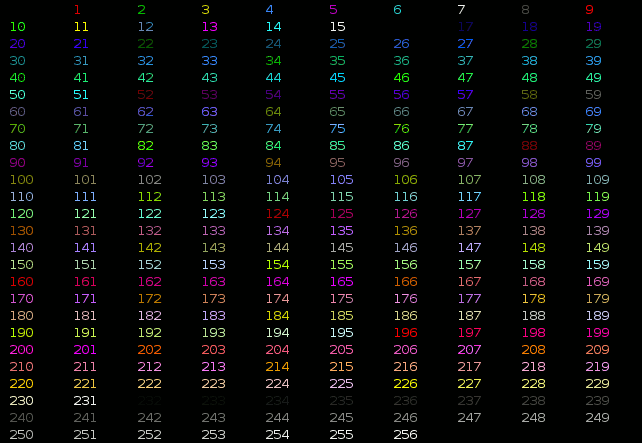
OP here. Unfortunately the ansi palette is pretty limited so I didn't have a lot of flexibility in the color choice. That said, this can definitely be improved. I can work on it if people find it useful.
In the meantime, it's very easy to tune the colors your own: just modify this line https://github.com/draios/sysdig/blob/master/userspace/sysdi... in your local version of the script, using this as a reference http://misc.flogisoft.com/_media/bash/colors_format/256_colo....