coderobe
Re:Ask HN: How can I prevent myself from being doxxed?
on Saturday September 05, 2020 @10:51PM (#24388591)
Easy, just dox yourself first.
Re:Flipper Zero – Tamagochi for Hackers
on Thursday July 30, 2020 @07:56AM (#23997060)
The main creator of this has been posting about his progress for months, personally I've been following its development ever since I first saw it. It's such a neat project that I can totally believe this being entirely organic growth.
Re:Show HN: Tired of reading NerdWallet to see the best credit card? I...
on Tuesday July 28, 2020 @04:01PM (#23980031)
If the "Get Started" button - the first thing you see on the website without scrolling - does nothing but yield a white page that asks for an email address, you're alienating a lot of interested users.
Re:Manjaro Linux treasurer resigns amid unjustified use of donation funds
on Friday July 24, 2020 @08:27PM (#23945866)
Attempted unjustified use of donation funds is not really any less questionable just because it didn't get past the treasurer - especially if the treasurer is, uh, constructively dismissed right after.
Holding off on the purchase after that event is the least they could've done.
Re:Show HN: My Weekend Project, AutoSSL
on Wednesday November 13, 2019 @01:40PM (#21527728)
>- Security: Can you read my customers' traffic?
Yes, anything that (re)terminates TLS will be able to - including this - and there is no way around it short of hosting it on-prem.
Marketing it as end-to-end security the way the author is doing is ... wrong.
Re:Show HN: My Weekend Project, AutoSSL
on Wednesday November 13, 2019 @01:35PM (#21527662)
>As long as the origin has SSL, the communication is secure end-to-end.
It cannot be secure end-to-end, as your edge location is quite literally performing a MITM. That aside:
How are you validating the TLS cert that the origin presents?
Going by the info on your website, the possibilities are as follows:
Scenario 1: The SAAS provider presents a TLS cert not valid for customer-domain.com when accessed as customer-domain.com
Scenario 2: The SAAS provider presents a TLS cert valid for customer.saasprovider.com when accessed as customer.saasprovider.com
Assuming scenario 1, you would need to validate the certificate out-of-band as the traditional trust chain does not validate for the given domain. Assuming scenario 2, you would need to rewrite the URLs from customer.saasprovider.com to customer-domain.com to prevent the users from following generated resource URLs to the origin domain. Or am i missing something?
Re:Show HN: My Weekend Project, AutoSSL
on Wednesday November 13, 2019 @01:19PM (#21527456)
>SSL is terminated at an edge location that is closest to the users.
So this is routing plain text http for most of the connection and at the same time giving the managed edge location direct access to the traffic and a valid tls cert for the domain? Isn't that mostly snake oil then, as the secure connection never originates from the target service?
Re:AndOTP: Open-source two-factor authentication for Android
on Sunday September 15, 2019 @09:33AM (#20977117)
Been using AndOTP for months and i love that it supports android's keystore and device credentials for authentication. I had switched to it from Authy, which was quite heavy.
Aegis' design looks a lot less dense than AndOTP on the screenshots, though it seems to be widely recommended. I'll have to check what that's all about
Re:Microsoft Issues Windows 10 Upgrade Warning
on Monday January 28, 2019 @02:54PM (#19020494)
it's a nice quality of life improvement unless you're running low on space. 7+ gb is a lot, especially on embedded devices with low soldered storage - like microsoft's own products!
coincidentally instead of offering upgradeable internal storage they upsell really hard on the models with more storage in their surface lineup
if anything, this should be a toggle- if only an opt-out toggle.
fwiw, you can install a linux system including an entire graphical stack with web browser and mail client in that space, twice.
Re:Ask HN: Minimal html code to make a black page
on Saturday November 17, 2018 @11:30AM (#18476134)
Yes.
<body bgcolor=0>
Re:Where Ruby/Sinatra falls short
on Monday October 15, 2018 @10:34AM (#18219979)
>And besides: If Sinatra starts a server listening for incoming traffic, why does it still seem common to run a regular webserver like nginx in front of that server?
This is a common technique used for tls-termination and management of 'virtual hosts', among other things.
The mentioned "issues" don't seem to be Sinatra-specific, but rather about the authors shallow understanding of the topic as a whole
Re:Cops Told ‘Don’t Look’ at New iPhones to Avoid Face ID Lock-Out
on Saturday October 13, 2018 @02:02PM (#18209192)
a little tape on the camera would do just as well, wouldn't it?
Re:Boredom is not a problem to be solved. It's the last privilege of a...
on Saturday September 29, 2018 @05:21AM (#18099469)
Re:Ask HN: Why not hardcode the Google search home page into Chrome?
on Saturday September 29, 2018 @05:20AM (#18099463)
How so? If google wanted to save bandwidth, they would simply up the cache time of their page(s), baking some version into the browser only saves the very first load. Doesn't seem like a decent strategy to face potential backlash for baking in their search page when the same thing, sans the initial load, can be accomplished with other techniques
Re:10 handy Bash aliases for Linux
on Friday September 28, 2018 @10:11AM (#18093481)
On a more serious note,
> alias www='python -m SimpleHTTPServer 8000'
that'll only work on systems where python is python2
> alias speed='speedtest-cli --server 2406 --simple'
speedtest-cli automatically selects a server, invoking it without any opts at all is perfectly fine
> alias ipi='ipconfig getifaddr en0'
the interface name is not predictable, nor portable - `ip a`
Most if not all of these aliases seem rather pointless after all
Re:10 handy Bash aliases for Linux
on Friday September 28, 2018 @10:04AM (#18093425)
This article covers gems like `alias c='clear'` - very handy! scnr
Re:Show HN: A native Upspin file browser for macOS
on Friday May 26, 2017 @09:12PM (#14428376)
I'm sorry but how is this native? It's an electron app...
Re:Twitter is down
on Friday May 19, 2017 @09:50AM (#14375580)
Up in Germany
Re:QUIC in the wild, only for Google ad advantage
on Tuesday April 25, 2017 @11:30AM (#14194398)
They ask google to:
'Confirm, with appropriate supporting data, that their bid requests made with QUIC are not anti-competitive, and justify why bid requests are being used by a new and opaque request protocol under conditions where competitors are bound to use TCP with its extra round trip overhead.'
Which just looks like they have no idea what they're talking about.
Things QUIC isn't:
- Limited to Google(rs)
- "Opaque" as-is, it's just that the JS APIs are bad. It's still experimental software after all.
Re:QUIC in the wild, only for Google ad advantage
on Tuesday April 25, 2017 @11:28AM (#14194365)
I don't think the people that wrote this know how QUIC works and what its benefits are.
The problem is not QUIC, it's the request API the adblockers use to filter the content. QUIC is a fast, documented protocol used by way more people and organisations that aren't Google.
Re:Orion Ubuntu Laptop Review: The Powerful MacBook Pro Alternative
on Monday March 13, 2017 @01:22PM (#13860006)
I'm using a Hackintoshed Lenovo Y50-70 (FHD model) running MacOS Sierra and i can only recommend it so far, all of the configurations that are being sold are very compatible with macOS. It even comes with a dedicated GPU which is great for GPU-intensive tasks on different OSes - it's disabled whilst running macOS because of missing drivers for nVidia optimus though.
Re:CIA licensed Sublime Text
on Wednesday March 08, 2017 @09:10AM (#13820309)
The license is still valid on the latest build BTW.
Re:HSTS Preload lists cause Chromium to think http://google/ is a vali...
on Tuesday March 07, 2017 @11:58AM (#13812046)
There should be no A-labels on bare gTLDs, so "https://google" should never make sense (per SSAC053 report - https://www.icann.org/groups/ssac/documents)
Re:HSTS Preload lists cause Chromium to think http://google/ is a vali...
on Monday March 06, 2017 @09:45AM (#13802928)
the period has to be there because it breaks spec btw
Re:HSTS Preload lists cause Chromium to think http://google/ is a vali...
on Monday March 06, 2017 @09:39AM (#13802878)
To whoever edited my title: The bug report title is inaccurate. It's specifically about HSTS preloads, which is why my original title stated that instead of "gTLDs".
Re:HSTS Preload lists cause Chromium to think http://google/ is a vali...
on Monday March 06, 2017 @09:37AM (#13802858)
It would probably work, but it would break spec.
Re:HSTS Preload lists cause Chromium to think http://google/ is a vali...
on Monday March 06, 2017 @08:38AM (#13802522)
This causes funny behavior like https://pbs.twimg.com/media/C6L3IvsUsAABuyS.jpg:large
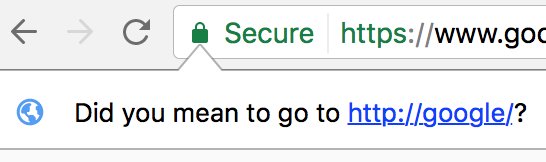
Chrom(e|ium) will suggest to navigate to http://google if you're opening google.com
Re:BlueCoat and other proxies hang up during TLS 1.3
on Monday February 27, 2017 @11:47PM (#13751275)
Not necessarily just a field trial. AFAIK it was bundled with a recent ChromeOS update, causing logon to fail when MITM'd
Re:BlueCoat and other proxies hang up during TLS 1.3
on Monday February 27, 2017 @10:45PM (#13750978)
Client and Server exchange a list of capabilities at the beginning of a TLS connection, if the proxy just filters out the protocols/versions it doesn't understand, server/client will agree on a different version (like 1.2).