beothorn
Re:Show HN: Javaflame – Simple Flamegraph for your Java application
on Friday November 10, 2023 @12:36PM (#38221819)
I took a better look. This, as other profilers, work by sampling the process, getting the stack trace all at once.
This is either getting it from tooling baked on the kernel (that is why it doesn't work on windows) or getting the stack sample from the JVM (see the tiny-profiler from part-time nerd above)
Sampling makes sense if you want to be as much non intrusive as possible. That is not how JavaFlame works.
What I do is injecting byte code on every function that matches the filters. This code will update a custom stack that stores not only the function name, but also uses reflection to get the argument and their values. In exit, it also records the return value.
It does record the time the function took to run, but this includes the time to get the values from the arguments. It is not exact, but it is good enough to get an idea of the overall logic.
In short, I don't think you can have the argument values with sampling.
Re:Show HN: Javaflame – Simple Flamegraph for your Java application
on Friday November 10, 2023 @10:36AM (#38220149)
Pretty cool!
Re:Show HN: Javaflame – Simple Flamegraph for your Java application
on Friday November 10, 2023 @05:03AM (#38217029)
I did not know about this project, I will look into it, thanks for linking :)
But, from a quick peek, I think my motivation is different.
My intention when creating this was not profiling exactly each operation, but understanding the logic (what each function calls do and what parameters are passed). I see that this, apparently, does not capture argument values and return values (I may be wrong).
If you are profiling, that makes sense. Calling toString on every argument obviously affect the performance.
Another thing is that this is pretty simple, there are not many tweaks you need to do, as the goal is just to glance at the values being passed around at runtime.
If you look at the example page, with the sort algorithms, you will see that you can follow exactly how each one works by looking at the values being passed and returned. You don't get this from only looking at the calls.
Re:Show HN: Javaflame – Simple Flamegraph for your Java application
on Wednesday November 08, 2023 @11:46AM (#38193029)
Mainly for debugging locally. I use it either to understand which parts of the code will be touched by a certain action or over unit tests to get an overall idea of what values are passed to which parts of the system.
Works well if you need to reproduce a bug and wants to check how did you get to whatever invalid state you are looking into. In contrast, before, I would do the same by adding a bunch of breakpoints and going through the function calls. This is slow, and specially annoying when you have lots of timeouts in your code.
But this is project is very new, I am starting to feel the actual json with the stacktrace is a little bit more useful than the graph itself to peek at the values. In the sort example, this would be https://www.isageek.com.br/javaflame/data.js
Show HN: Javaflame – Simple Flamegraph for your Java application
https://github.com/beothorn/javaflame
Javaflame will generate a flamegraph of your application function calls, including the argument values and the return of each function.Check https://beothorn.github.io/javaflame to see an example.There are already some tools that render flamegraphs for java, but they are focused on measuring performance or require some other process running along with the application. They also record function...
Re:Less than 168 hours since Photoshop dropped the new “Generative Fil...
on Thursday June 01, 2023 @03:10PM (#36155920)
I try explaining it here https://github.com/beothorn/OneClickStableDifusionAutomatic1...
Show HN: Botecko, a gpt4 client that simulates an instant messenger
https://github.com/beothorn/Botecko
This is a simulation of an instant messenger running on the browser. It generates contacts (including the profile picture) based on a single sentence. All chat history is stored on your browser. Features: - Open source (apache 2) - Profile generation including picture - Prompt with plan-ahead in 4 steps. This improves the response and also gives a way to debug the character motivation. -...
Show HN: How to make a blog using GitHub
Re:Show HN: A template for slide presentations using the browser
on Wednesday October 30, 2019 @04:02AM (#21395468)
I've done this after needing to heavily customize slide using reveal js.
Reveal js programmatically changes the slides and made styling them difficult. Besides, the grid layout is perfect for this kind of whole page design.
Show HN: Telegram bot that can run some commands
Show HN: A template for slide presentations using the browser
Re:Show HN: JSON Pizza – Beautify your JSON quickly
on Friday August 09, 2019 @09:38AM (#20654162)
On chrome at least copy(Paste json here) is enough
Re:Fun at the Unix Terminal
on Friday April 07, 2017 @10:29AM (#14059907)
I don't remember where did I get this from but it is a cool thing to add to your .bashrc
  #!/bin/bash
  #teach you some new commands every time you open a new terminal
  echo 'Did you know that:'
  echo $( whatis $(ls /bin | shuf | head -1))
  echo $( whatis $(ls /sbin | shuf | head -1))
  echo $( whatis $(ls /usr/bin | shuf | head -1))
Re:GitHub commit search: “remove password”
on Wednesday February 15, 2017 @08:43AM (#13651901)
Also:
search for code making connections to db
ruby https://github.com/search?q=DBI.connect&ref=searchresults&ty...
java https://github.com/search?p=2&q=DriverManager.getConnection%...
and so on...
Re:Blender for Hackers – 3D modeling is just like using VIM
on Saturday January 14, 2017 @01:43PM (#13399839)
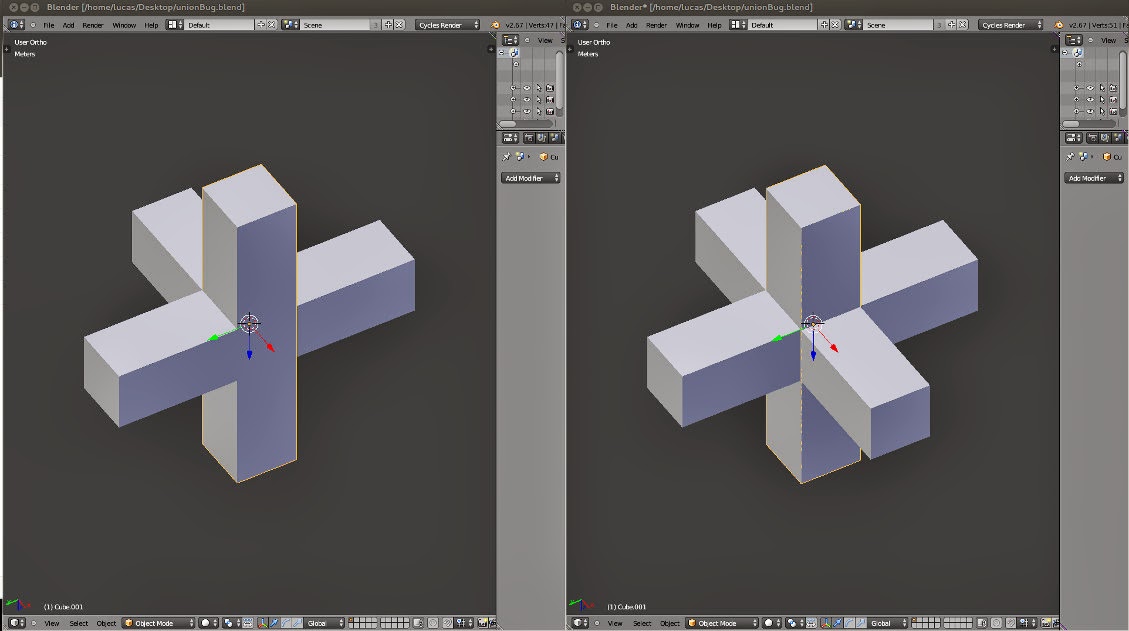
3 years ago I've tried to use blender as a substitute to openscad but stopped because the boolean operators didn't alwyas gave the same result.
Here I started to some basic examples from openscad on blender
https://github.com/beothorn/openscadExamplesAsBlenderScripts
Here is an example of union not working properly
http://3.bp.blogspot.com/-IDRl_LygKz4/UeRvMEoP9RI/AAAAAAAABd...
It is already some time since I last checked, but if the boolean operators are working properly I would love to use blender instead.
Edit:
The blog post from where the image is from
http://www.isageek.com.br/2013/07/blender-doesnt-do-construc...
Re:Researchers quantum teleport particle of light six kilometres
on Thursday September 22, 2016 @01:40PM (#12558600)
For anyone interested, there is a great video by the PBS space time channel explaining quantum entanglement here https://www.youtube.com/watch?v=tafGL02EUOA
The thing is, although the quantum state of the photom collapses instantaneously on both entangled photons, we can't manipulate at which state the photon will collapse, and so, we can't really send information using quantum entanglement.
We can't also confirm the entanglement until we can compare both measurement results or else we could send information from the future as in the quantum eraser experiment https://www.youtube.com/watch?v=2Uzytrooz44
Edit: formatting and typos
Re:Telegram gains 1M users after Whatsapp ban
on Thursday December 17, 2015 @01:14PM (#10753173)
Other commenter here. The text says that any autority (autoridade policial ou administrativa -> police force or administrative power) may require that the metadata be recorded for a period of time , but access to this metadata needs the judges order.
For example, if the cops starts investigating John Doe they may ask the service provider to keep metadata for a fixed period of time, stated on the Marco Civil (six months IIRC). But access to this metadata can only be authorized by a judge.
Edit: Reread the Marco civil an refreshed my memory. What I said is not entirely correct. All metadata is kept by default and needs a court order to be accessed. What authorities may ask without a court order is for the service provider to keep the metadata for a time longer than specified on the Marco civil.
Also, as I said on my previous comment, the intention of the bill was that only metadata was recorded, but the term "registros de conexão -> connections log" is vague enough to be interpreted in other ways :(
Re:Brazilian Judge Shuts Down WhatsApp for 48 Hours
on Thursday December 17, 2015 @08:05AM (#10751216)
It doesn't say contents, it says registros de conexão "connections log".
The intent was to log IP adresses and dates, not content, but it is known that the interpretation of the text would be up to our judicial system. It also does not say without a court order. It says they can require them to log those ips, but access to these information requires a court order (as said on chapter 2 item I)
There are other ambiguities regarding who should keep those logs, ISP or service providers.
Free Whatsapp and facebook does hurt net neutrality. It undermines competition and leads to a division between services that are "free" and the ones which are not, on a ISP level.
That's not what article 2 says, article 2 is a preamble with the intentions of the marco civil and contains no definition of rules nor obligations. The removal of those videos are not based on marco civil, but on other laws and our own constitution.
The problem is not the Marco Civil, but how it is being interpreted. Our judges do not understand what is cryptography. Our population don't understand and doesn't care. People are just upset that whatsapp is offline.
Show HN: ClojureCalc, a libreoffice Calc Add-In to evaluate clojure expressions
Re:Samsung playing with possible phone designs
on Wednesday February 25, 2015 @12:17PM (#9107947)
I really wish mobile makers tried to deviate from the current mobile design norm.
I am not against touch interfaces, but i sure miss some more physical buttons.
Samsung playing with possible phone designs
Show HN: Java library for scraping a page using annotations
Re:Humble Indie Bundle X – Pay what you want and help charity
on Tuesday January 07, 2014 @06:16PM (#7020690)
Bit trip runner one was on Humble Indie Bundle 4. Just checked my game library and the game is still there
Re:User Culture Versus Programmer Culture
on Friday December 27, 2013 @10:20AM (#6970881)
Why?
Show HN: An interactive implementation of the Koch Island fractal
Re:Father of GIFs: 'It's Pronounced JIF'
on Thursday May 23, 2013 @09:29AM (#5756693)
Offtopic but kinda related.
Father of the "Dothraki", the language used on game of thrones says you're all pronouncing Khaleesi WRONG
http://io9.com/youre-all-pronouncing-khaleesi-wrong-47877979...
Re:Why babies in every country on Earth say 'mama'
on Sunday May 12, 2013 @01:33PM (#5695043)
In portuguese 'mamar' means to suck, usually associated with babies. Mother is 'mãe' or 'mamãe'. Actually, the r is usually dropped when speaking, so 'mamar' is usally spoken 'mama'.
Cold War-era Governement Computer Created the First Digital Art
Re:Why Everyone Eventually Hates or Leaves Maven
on Thursday January 24, 2013 @08:48AM (#5109446)
"Generating get/set and abstract method bodies is only necessary in Java"
On smalltalk instance variables are private, so if you want get/set it's value you need a getter/setter.
You can argument that this is bad oo design, but it's not java exclusive.