beklein
Re:Porsche Mission S
on Friday October 16, 2026 @04:24AM (#50115660)
I see a lot of Claudeisms/AI slop in the copy text on that page. Really disappointed from that page, agreed, fire the marketing team.
Re:Tiny Little Office
on Thursday October 15, 2026 @08:52AM (#50102933)
It worked well on my machine, git clone, install, start dev server... also it seems the worker is up and running again. I guess public sharing will only work to some extend when running the dev server for testing.
Re:Tiny Little Office
on Thursday October 15, 2026 @07:49AM (#50102331)
While the page is rate limited due to probably HN's hug of death, I guess this is the relevant repo: https://github.com/aboard-io/tinylittleoffice
Most people will be able to host it locally and test it this way.
Re:OpenAI, the Partition Principle, and Mathematics
on Thursday October 08, 2026 @08:55PM (#50014635)
Love your metaphor here. I guess there will always be people who try to keep going and follow their current projects and say that only human math is real math and we should only use alien technology for proofreading mails and such but not their highly established and esteemed professions.
Or just keep your hubris low, update your priors, work towards progress.
Re:I'm a seeing-eye dog for a computer
on Monday September 07, 2026 @03:26AM (#49595064)
They mentioned "... and my visualizer tool comes with an MCP server ...", with a link to the rerun project. I guess it makes more sense that his visualizer tool uses rerun...Sorry for the confusion from my side.
Re:I'm a seeing-eye dog for a computer
on Monday September 07, 2026 @02:44AM (#49594740)
A bit off topic, but I absolutely love the little robot on the author's main project's landing page (https://rerun.io/).
I normally condemn mouse hijacking, but this implementation will be allowed.
Re:Solaris, Our Interface World Models
on Monday August 31, 2026 @03:45PM (#49514071)
I don't know what kind of experiences and apps this UI/UX mode will enable but it's one of the most innovative and coolest AI model demos I've seen this year.
Re:How Universities Should Prepare Founders
on Tuesday August 25, 2026 @05:26AM (#49431072)
"In fact there are only two things universities need to change to be perfect at preparing founders: they need to make students feel that starting a startup is something they can do, and they need to encourage them to work on their own projects."
I'd argue that both of these would be highly beneficial for all kinds of students, founders and non-founders alike.
Starting a startup could be generalized for all students to having a dream or goal, taking ownership of it, and making it happen. A startup is just one possible path, pg is probably too specific here, I would agree.
Having more free time to work on my own projects is probably the freedom I missed most at university. I think learning to choose what to work on and making something happen would benefit future workers, teachers, doctors, and engineers just as much as entrepreneurs.
It's a trade-off in terms of time and other resources, since parts of the existing curriculum would have to fade away. But I think it's a good starting point for change and a good direction to move in.
Re:Don't Paste the AI, please
on Thursday August 20, 2026 @05:44AM (#49372422)
Thanks for sharing your thoughts. One of the best frameworks I have encountered, and one I point people to whenever I can, is the AI Fluency framework by Anthropic, Prof. Joseph Feller (University College Cork), and Prof. Rick Dakan (Ringling College):
https://www.anthropic.com/learn/claude-for-you
This framework provides a more abstract way of thinking when working with AI systems. Especially valuable to me is the pattern of the 4 D's: Delegation, Description, Discernment, and Diligence, which I have now internalized whenever I use AI systems. It helps me understand my own and others' (mis)use of AI systems a bit better.
Re:Nvidia Nemotron 3.5 Lightning
on Tuesday August 11, 2026 @11:03AM (#49259536)
Thanks for pointing that out!
I actually copied the link from NVIDIA's Technical Blog post:
- https://developer.nvidia.com/blog/nvidia-nemotron-3-5-lightn...
You can also try the model via a free API endpoint from Openrouter, would be interesting to see if it's the BF16 or NVFP4 version:
Nvidia Nemotron 3.5 Lightning
Re:Mario Meets Pareto
on Thursday August 06, 2026 @09:26AM (#49196366)
I guess the author used a different framework but I like this one: https://animejs.com/
Re:Claude Cookbook
on Friday July 24, 2026 @04:50AM (#49032902)
Thanks! I also like the OpenAI Cookbook:
https://developers.openai.com/cookbook
Other AI labs also tend to publish examples and cookbooks on GitHub and Hugging Face, so it's always worth keeping an eye on those as well.
Re:Kimi K3: second only to Fable 5 on AA-Briefcase
on Wednesday July 22, 2026 @02:31AM (#49002614)
Details about the methods can be found here: https://artificialanalysis.ai/methodology/intelligence-bench...
Specifically they use this harness: https://github.com/ArtificialAnalysis/Stirrup
Bunker Boyz [video]
Re:German AI consortium releases Soofi S, an open 30B model that tops ...
on Thursday July 16, 2026 @03:35PM (#48939202)
Some other (as in better) sources I found:
- https://huggingface.co/spaces/Soofi-Project/Pretraining-Tech...
Re:Satellite Tracker – Live Map of Starlink and 30k Satellites
on Wednesday July 15, 2026 @09:34AM (#48920627)
Thanks for sharing the paper, it seems my intuition on size was bad but also my intuition on max satellite density for LEO was wrong.
The Most Human Technology Ever Made
Re:Satellite Tracker – Live Map of Starlink and 30k Satellites
on Tuesday July 14, 2026 @07:24AM (#48905047)
To get a better sense of the scale, if you are viewing this app on a 4K display, with the planet measuring about 2,000 pixels across Earth’s diameter is approximately 12,742 km (7,918 miles), so each pixel represents about 6.37 km (3.96 miles).
A Starlink satellite is roughly 6 m (20 ft) wide without its solar panels. This means a one-pixel satellite marker is shown at roughly 1,000 times its true size. So even if this image already looks extremely crowded, the dots are still massively exaggerated. Visually, there would be roughly another factor of 1,000 before the satellites themselves were shown at their true scale—although this does not mean that orbit could easily accommodate 1,000 times more satellites but I guess there is still some space in space.
Re:Mistral OCR 4
on Tuesday June 23, 2026 @02:04PM (#48648829)
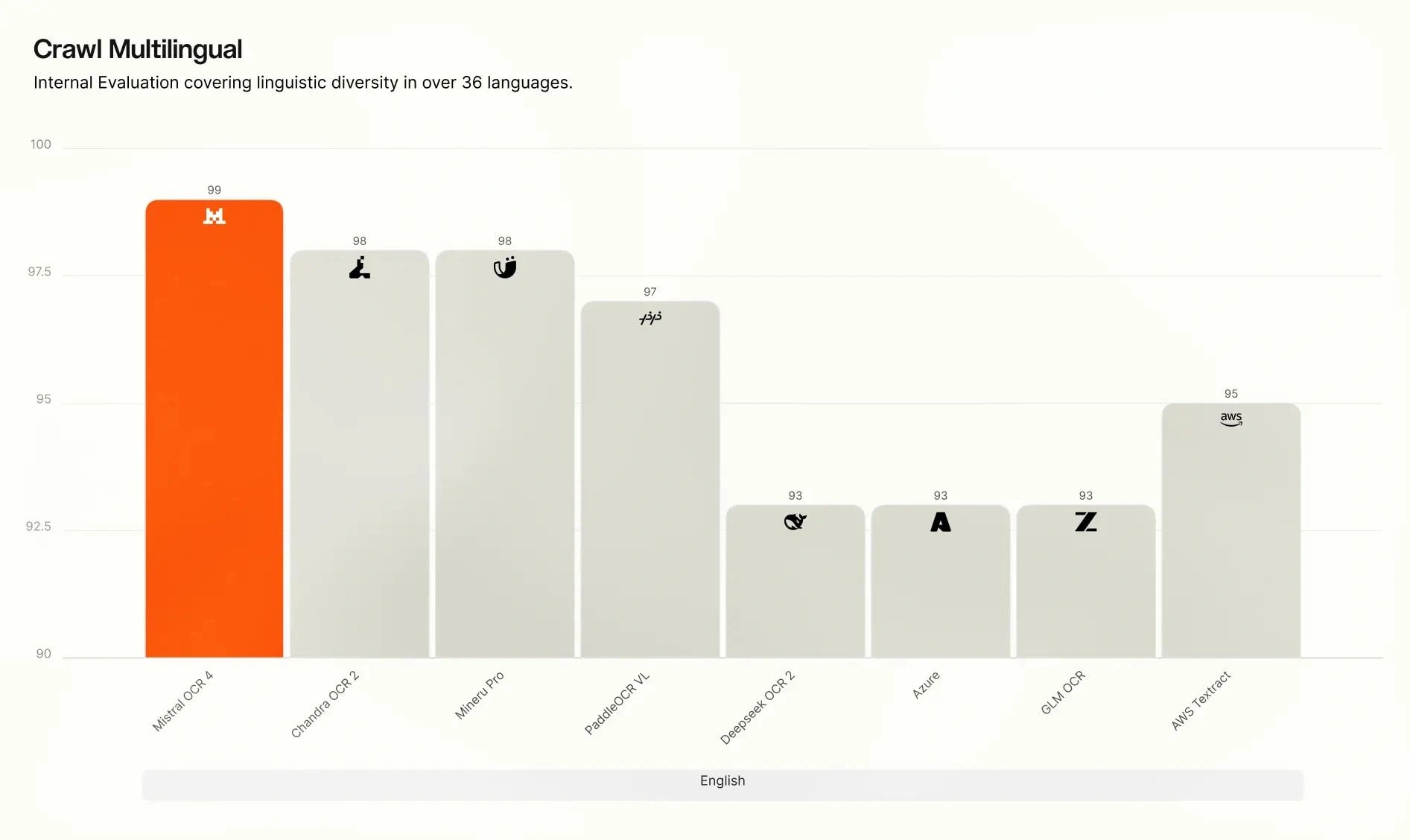
All AI labs really need to stop using truncated y-axes for benchmark bar charts...
https://mistral.ai/_astro/cm-engish_ZhlvoT.webp?dpl=6a3a94bd...
Enpire: Agentic Robot Policy Self-Improvement in the Real World
Re:DiffusionGemma: 4x Faster Text Generation
on Wednesday June 10, 2026 @12:46PM (#48479042)
A good visual explanation of how text diffusion models like DiffusionGemma work: https://newsletter.maartengrootendorst.com/p/a-visual-guide-...
Re:Texico: Learn the principles of programming without even touching a...
on Monday May 04, 2026 @09:22AM (#48008421)
Principles of programming:
1. Break things down into small units
2. Think about sequence
3. Find patterns
4. Focus on the important things
5. Visualize sequences in your mind
Love the silly music and the way they teach, thanks for sharing this!
Re:A Steerable Model with Emergent Capabilities
on Friday April 17, 2026 @09:28AM (#47805724)
Also relevant to this is the newest episode of The Lightcone Podcast with Quan Vuong, co-founder of PI and, one of many co-authors of that paper.
Re:Explaining the Most Important Artemis II Photos [video]
on Saturday April 11, 2026 @04:35AM (#47728725)
Thanks for sharing this here, it's a beautiful video. The images are linked in the description but if anybody is reading this, check: https://www.flickr.com/photos/nasa2explore/
ARC-AGI-3
Re:GPT‑5.4 Mini and Nano
on Tuesday March 17, 2026 @02:00PM (#47416058)
As a big Codex user, with many smaller requests, this one is the highlight: "In Codex, GPT‑5.4 mini is available across the Codex app, CLI, IDE extension and web. It uses only 30% of the GPT‑5.4 quota, letting developers quickly handle simpler coding tasks in Codex for about one-third the cost." + Subagents support will be huge.
Arduino Ventuno Q
Not sure why you think Anthropic has not the same problems? Their version numbers across different model lines jump around too... for Opus we have 4.6, 4.5, 4.1 then we have Sonnet at 4.6, 4.5, and 4.1? No version 4.1 here, and there is Haiku, no 4.6, but 4.5 and no 4.1, no 4 but then we only have old 3.5...
Also their pricing based on 5m/1h cache hits, cash read hits, additional charges for US inference (but only for Opus 4.6 I guess) and optional features such as more context and faster speed for some random multiplier is also complex and actually quiet similar to OpenAI's pricing scheme.
To me it looks like everybody has similar problems and solutions for the same kinds of problems and they just try their best to offer different products and services to their customers.